

Ejemplo de contrato de acceso al acuerdo general de inventor
Recientemente, algunos usuarios han estado hablando sobreAOFEXEste Exchange, considerando que no existe ningún ejemplo en FMZ sobre cómo conectarse a la interfaz REST del Exchange de contratos. Este artículo se centrará en el acceso.AOFEXTomemos esto como ejemplo para explicar cómo acceder al intercambio de contratos.
En FMZ existe una distinción entre bolsas al contado y bolsas de futuros. Por ejemplo, las tres principales bolsas que conocemos ofrecen operaciones al contado y operaciones por contrato. Estas diferentes interfaces API de mercado también son diferentes, y algunas incluso tienen sistemas API completamente separados e independientes. Por lo tanto, al encapsular estos Exchanges en FMZ, se hace una distinción entre spot y futuros.
Ya existen muchos ejemplos de uso del protocolo general de FMZ para encapsular intercambios spot en la comunidad y los documentos de la plataforma FMZ, pero no existe ningún ejemplo completo de encapsulamiento de un intercambio de contratos. Sin embargo, el programa de complemento de protocolo general de la versión de futuros empaquetada es básicamente el mismo que el de la versión al contado, excepto que tiene algunas interfaces más.
Documento de protocolo general de FMZ: https://www.fmz.com/bbs-topic/1052
El documento viene con un acceso al protocolo general de intercambio spot DEMO
Las interfaces que detectan objetos de intercambio y objetos de intercambio de futuros deben encapsularse
La interfaz principal del objeto de intercambio spot
-
exchange.GetTicker()
Obtenga datos del mercado de ticks tanto para el spot como para los futuros. -
exchange.GetDepth()
Obtenga datos de la cartera de órdenes tanto para spot como para futuros. -
exchange.GetTrades()
Obtener datos del flujo de órdenes (registros de transacciones del mercado), tanto para spot como para futuros. -
exchange.GetRecords()
Para obtener datos de la línea K, se requieren tanto contratos al contado como futuros. -
exchange.GetAccount()
Obtenga datos de activos de la cuenta tanto para spot como para futuros. -
exchange.Buy()
Para colocar una orden de compra, se requieren tanto contratos al contado como futuros. -
exchange.Sell()
Para colocar una orden de venta, se requieren tanto contratos al contado como futuros. -
exchange.GetOrder()
Obtenga los datos de la orden del ID especificado, tanto al contado como de futuros. -
exchange.GetOrders()
Obtenga las órdenes pendientes actualmente activas, tanto al contado como a futuros. -
exchange.CancelOrder()
Cancelar la orden con el ID especificado, tanto para spot como para futuros.
Además de encapsular estas interfaces de los objetos de intercambio al contado, los objetos de intercambio de futuros también necesitan encapsular las funciones de interfaz utilizadas por los futuros.
-
exchange.SetMarginLevel()
Establezca el valor de apalancamiento para el símbolo actual. -
exchange.SetDirection()
Establezca la dirección comercial del producto actual, es decir, abrir posición larga/abrir posición corta/cerrar posición larga/cerrar posición corta. -
exchange.SetContractType()
Establecer el código de contrato actual. Porque los futuros tienen contratos perpetuos (swap)、Contrato de entrega(quarterTrimestral), etc., cada uno tiene su propio código de contrato definido en FMZ. Para obtener más detalles, consulte el documento de API de FMZ. Estas configuraciones también deben seguirse durante la encapsulación, de lo contrario, las antiguas estrategias existentes podrían no funcionar correctamente. -
exchange.GetPosition()
Obtener los datos de la posición actual. Aquí podemos ver que no existe el concepto de posición en el trading al contado. La posición lógica solo se puede calcular comparando los cambios en la cuenta. Pero los futuros sí tienen posiciones.
Los datos del cuerpo de la solicitud enviada por el custodio al complemento de protocolo universal al llamar a la interfaz específica de futuros en la estrategia
Tomando como ejemplo el intercambio AOFEX, si configura el objeto de intercambio del protocolo general en FMZ, la CLAVE API que se completa es:
- accessKey : 212f54a1-1c88-1bf5-54a1-f7bf52b3256c
- secretKey : 7RJPKpBJMBkUL87RJPKpkULJPSUpsaKpUL83ysDs
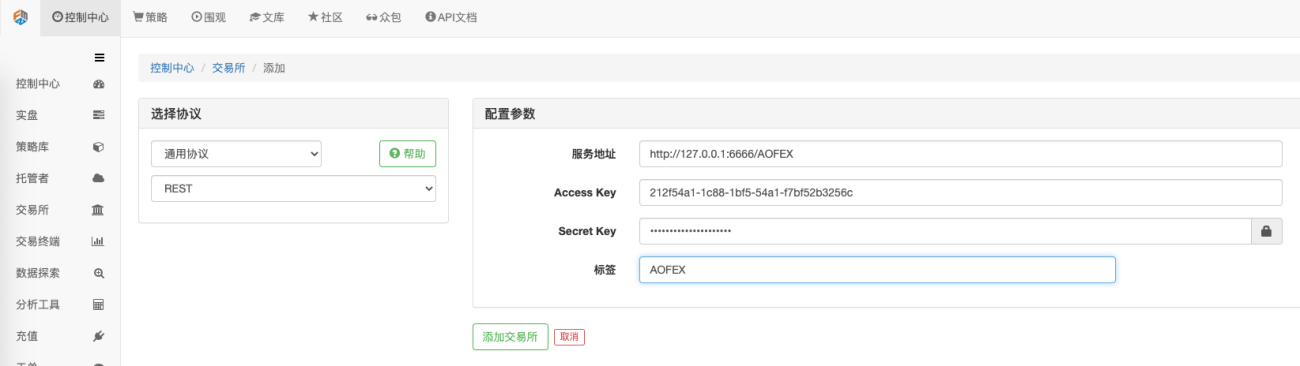
En la página de configuración del protocolo general de FMZ hayaccessKeyysecretKeyCuadro de entrada, después de configurar el objeto de intercambio de protocolo universal, los datos en formato JSON del cuerpo de la solicitud recibida cuando se ejecuta el complemento de protocolo universalaccessKeyEl valor del campo es212f54a1-1c88-1bf5-54a1-f7bf52b3256c,secret_keyEl valor del campo es7RJPKpBJMBkUL87RJPKpkULJPSUpsaKpUL83ysDs。
Al llamar a la siguiente interfaz, el host emitirá una solicitud RPC al complemento de protocolo general de la siguiente manera:
-
Cuando se llama a la política
exchange.SetMarginLevel(10)Cuando los datos en el cuerpo de la solicitud son:{ "access_key":"212f54a1-1c88-1bf5-54a1-f7bf52b3256c", "method":"io", "nonce":1631858961289247000, "params":{"args":[10],"code":0}, "secret_key":"7RJPKpBJMBkUL87RJPKpkULJPSUpsaKpUL83ysDs" }Intercambio de llamadas.SetMarginLevel(10) con 10 como parámetro.
-
Cuando se llama a la política
exchange.SetDirection("buy")Cuando los datos en el cuerpo de la solicitud son:{ "access_key":"212f54a1-1c88-1bf5-54a1-f7bf52b3256c", "method":"io", "nonce":1631860438946922000, "params":{"args":["buy"],"code":1}, "secret_key":"7RJPKpBJMBkUL87RJPKpkULJPSUpsaKpUL83ysDs" }Llame a exchange.SetDirection("buy") y pase "buy" como parámetro.
-
Cuando se llama a la política
exchange.SetContractType("swap")Cuando los datos en el cuerpo de la solicitud son:{ "access_key":"212f54a1-1c88-1bf5-54a1-f7bf52b3256c", "method":"io", "nonce":1631860847525039000, "params":{"args":["swap"],"code":2}, "secret_key":"7RJPKpBJMBkUL87RJPKpkULJPSUpsaKpUL83ysDs" }Llame a exchange.SetContractType("swap") y pase "swap" como parámetro.
-
Cuando se llama a la política
exchange.GetPosition()Cuando los datos en el cuerpo de la solicitud son:{ "access_key":"212f54a1-1c88-1bf5-54a1-f7bf52b3256c", "method":"io", "nonce":1631860996119505000, "params":{"args":[],"code":3}, "secret_key":"7RJPKpBJMBkUL87RJPKpkULJPSUpsaKpUL83ysDs" }Al llamar a exchange.GetPosition(), no se pasan parámetros.
Observe los datos JSON en el cuerpo de la solicitud anterior y descubra que:
- Cuando se llama a una función específica de un objeto de intercambio de futuros, el cuerpo de la solicitud
methodLos valores del campo sonio。 - Para distinguir estas funciones es necesario:
paramsEn el campocodeJuicio, es decir:codepara0SíSetMarginLevel。codepara1SíSetDirection。codepara2SíSetContractType。codepara3SíGetPosition。
- Cuando se llaman estas funciones específicas del objeto de intercambio de futuros, los parámetros que se pasan están en el cuerpo de la solicitud.
paramsCampoargsmedio.
En comparación con el ejemplo de complemento de idioma Go existente, necesitaOnPostHacer una extensión en la función:
Vea el siguiente código para "Funciones necesarias para ampliar los objetos de intercambio de futuros"La ubicación del comentario.
            func OnPost(w http.ResponseWriter, r *http.Request) {
    var ret interface{}
    defer func() {
        if e := recover(); e != nil {
            if ee, ok := e.(error); ok {
                e = ee.Error()
            }
            ret = map[string]string{"error": fmt.Sprintf("%v", e)}
        }
        b, _ := json.Marshal(ret)
        w.Write(b)
    }()

    b, err := ioutil.ReadAll(r.Body)
    if err != nil {
        panic(err)
    }

    var request RpcRequest
    err = json.Unmarshal(b, &request)
    if err != nil {
        panic(err)
    }
    e := newZG(request.AccessKey, request.SecretKey)

    var symbol string
    if _, ok := request.Params["symbol"]; ok {
        symbol = strings.ToUpper(request.Params["symbol"].(string))
    }

    var data interface{}
    switch request.Method {
    case "ticker":
        data, err = e.GetTicker(symbol, "GET")
    case "depth":
        data, err = e.GetDepth(symbol, "GET")
    case "trades":
        data, err = e.GetTrades(symbol, "GET")
    case "records":
        data, err = e.GetRecords(toInt64(request.Params["period"]), symbol, "GET")
    case "accounts":
        data, err = e.GetAccount(symbol, "GET")
    case "trade":
        side := request.Params["type"].(string)
        if side == "buy" {
            side = "BUY"
        } else {
            side = "SELL"
        }
        price := toFloat(request.Params["price"])
        amount := toFloat(request.Params["amount"])
        data, err = e.Trade(side, price, amount, symbol, "POST")
    case "orders":
        data, err = e.GetOrders(symbol, "POST")
    case "order":
        data, err = e.GetOrder(toString(request.Params["id"]), symbol, "POST")
    case "cancel":
        data, err = e.CancelOrder(toString(request.Params["id"]), symbol, "POST")
    default:
        if strings.HasPrefix(request.Method, "__api_") {
            params := map[string]interface{}{}
            for k, v := range request.Params {
                params[k] = toString(v)
            }
            data, err = e.tapiCall(request.Method[6:], params, "GET")
        } else if request.Method == "io" {              // 扩展期货交易所对象需要的函数
            code := toString(request.Params["code"])
            if code == "0" {
                // 处理SetMarginLevel
                // ...
            } else if code == "1" {
                // 处理SetDirection
                // ...
            } else if code == "2" {
                // 处理SetContractType
                // ...
            } else if code == "3" {
                // 处理GetPosition
                // ...
            } else {
                panic(errors.New(request.Method + " not support"))
            }
        } else {
            panic(errors.New(request.Method + " not support"))
        }
    }
    if err != nil {
        panic(err)
    }
    ret = map[string]interface{}{
        "data": data,
    }
    return
}
SetMarginLevel/SetDirection/SetContractTypeDesde el significado literal, podemos ver que las tres funciones se utilizan para establecer la configuración relevante del producto comercial actual. enSetDirection/SetContractTypeDesde una perspectiva de diseño, se establece una variable local para registrar la dirección actual de la orden (es decir, al colocar una orden, se debe leer esta configuración para saber en qué dirección se colocará la orden. La razón es que las compras de futuros tienen dos direcciones). : apertura en largo y cierre en corto. Por lo tanto, es necesario distinguir entre el código de contrato actual y el código de contrato actual (qué contrato se está consultando al obtener información de mercado, colocar órdenes, etc.).
SetMarginLevelDebe diseñarse específicamente de acuerdo con el mecanismo de apalancamiento del intercambio (1. El parámetro de apalancamiento se pasa como parámetro en la interfaz de orden. 2. El intercambio tiene una interfaz para configurar el apalancamiento).
GetPositionEs una función para obtener la posición actual del producto. Cuando el complemento de protocolo general obtiene los datos devueltos por la interfaz de posición de intercambio, construye directamente la función de posición en FMZ.positionLa misma estructura de datos es suficiente.
Ejemplo completo de complemento de protocolo general de futuros de AOFEX:
Ir
mylang
/*
CGO_ENABLED=0 GOOS=windows GOARCH=amd64 go build xxx.go
*/
package main
import (
"bytes"
"encoding/hex"
"crypto/sha1"
"encoding/json"
"errors"
"flag"
"fmt"
"io/ioutil"
"log"
"net/http"
"net/url"
"sort"
"strconv"
"strings"
"time"
// proxy
"golang.org/x/net/proxy"
"crypto/tls"
"math/rand"
)
var isUsedProxy bool = false
var ct string = ""
var direction string = "buy"
var marginLevel float64 = 10
var currSymbol string = ""
func toFloat(s interface{}) float64 {
var ret float64
switch v := s.(type) {
case float64:
ret = v
case float32:
ret = float64(v)
case int64:
ret = float64(v)
case int:
ret = float64(v)
case int32:
ret = float64(v)
case string:
ret, _ = strconv.ParseFloat(strings.TrimSpace(v), 64)
}
return ret
}
func float2str(i float64) string {
return strconv.FormatFloat(i, 'f', -1, 64)
}
func toInt64(s interface{}) int64 {
var ret int64
switch v := s.(type) {
case int:
ret = int64(v)
case float64:
ret = int64(v)
case bool:
if v {
ret = 1
} else {
ret = 0
}
case int64:
ret = v
case string:
ret, _ = strconv.ParseInt(strings.TrimSpace(v), 10, 64)
}
return ret
}
func toString(s interface{}) string {
var ret string
switch v := s.(type) {
case string:
ret = v
case int64:
ret = strconv.FormatInt(v, 10)
case float64:
ret = strconv.FormatFloat(v, 'f', -1, 64)
case bool:
ret = strconv.FormatBool(v)
default:
ret = fmt.Sprintf("%v", s)
}
return ret
}
type Json struct {
data interface{}
}
func NewJson(body []byte) (*Json, error) {
j := new(Json)
err := j.UnmarshalJSON(body)
if err != nil {
return nil, err
}
return j, nil
}
func (j *Json) UnmarshalJSON(p []byte) error {
return json.Unmarshal(p, &j.data)
}
func (j *Json) Get(key string) *Json {
m, err := j.Map()
if err == nil {
if val, ok := m[key]; ok {
return &Json{val}
}
}
return &Json{nil}
}
func (j *Json) CheckGet(key string) (*Json, bool) {
m, err := j.Map()
if err == nil {
if val, ok := m[key]; ok {
return &Json{val}, true
}
}
return nil, false
}
func (j *Json) Map() (map[string]interface{}, error) {
if m, ok := (j.data).(map[string]interface{}); ok {
return m, nil
}
return nil, errors.New("type assertion to map[string]interface{} failed")
}
func (j *Json) Array() ([]interface{}, error) {
if a, ok := (j.data).([]interface{}); ok {
return a, nil
}
return nil, errors.New("type assertion to []interface{} failed")
}
func (j *Json) Bool() (bool, error) {
if s, ok := (j.data).(bool); ok {
return s, nil
}
return false, errors.New("type assertion to bool failed")
}
func (j *Json) String() (string, error) {
if s, ok := (j.data).(string); ok {
return s, nil
}
return "", errors.New("type assertion to string failed")
}
func (j *Json) Bytes() ([]byte, error) {
if s, ok := (j.data).(string); ok {
return []byte(s), nil
}
return nil, errors.New("type assertion to []byte failed")
}
func (j *Json) Int() (int, error) {
if f, ok := (j.data).(float64); ok {
return int(f), nil
}
return -1, errors.New("type assertion to float64 failed")
}
func (j *Json) MustArray(args ...[]interface{}) []interface{} {
var def []interface{}
switch len(args) {
case 0:
case 1:
def = args[0]
default:
log.Panicf("MustArray() received too many arguments %d", len(args))
}
a, err := j.Array()
if err == nil {
return a
}
return def
}
func (j *Json) MustMap(args ...map[string]interface{}) map[string]interface{} {
var def map[string]interface{}
switch len(args) {
case 0:
case 1:
def = args[0]
default:
log.Panicf("MustMap() received too many arguments %d", len(args))
}
a, err := j.Map()
if err == nil {
return a
}
return def
}
func (j *Json) MustString(args ...string) string {
var def string
switch len(args) {
case 0:
case 1:
def = args[0]
default:
log.Panicf("MustString() received too many arguments %d", len(args))
}
s, err := j.String()
if err == nil {
return s
}
return def
}
func (j *Json) MustInt64() int64 {
var ret int64
var err error
switch v := j.data.(type) {
case int:
ret = int64(v)
case int64:
ret = v
case float64:
ret = int64(v)
case string:
if ret, err = strconv.ParseInt(v, 10, 64); err != nil {
panic(err)
}
default:
ret = 0
}
return ret
}
func (j *Json) MustFloat64() float64 {
var ret float64
var err error
switch v := j.data.(type) {
case int:
ret = float64(v)
case int64:
ret = float64(v)
case float64:
ret = v
case string:
v = strings.Replace(v, ",", "", -1)
if ret, err = strconv.ParseFloat(v, 64); err != nil {
panic(err)
}
default:
ret = 0
}
return ret
}
type headerTuple struct {
name string
value string
}
type Request struct {
headers []headerTuple
Proxy string
Method string
Uri string
Body interface{}
QueryString interface{}
Timeout time.Duration
ContentType string
Accept string
Host string
UserAgent string
}
func (r *Request) AddHeader(name string, value string) {
if r.headers == nil {
r.headers = []headerTuple{}
}
r.headers = append(r.headers, headerTuple{name: name, value: value})
}
type iAOFEX struct {
accessKey string
secretKey string
clientID string
currency string
opCurrency string
baseCurrency string
quoteCurrency string
apiBase string
timeout time.Duration
timeLocation *time.Location
// ext
contractTypes []string
}
type MapSorter []Item
type Item struct {
Key string
Val string
}
func NewMapSorter(m map[string]string) MapSorter {
ms := make(MapSorter, 0, len(m))
for k, v := range m {
if strings.HasPrefix(k, "!") {
k = strings.Replace(k, "!", "", -1)
}
ms = append(ms, Item{k, v})
}
return ms
}
func (ms MapSorter) Len() int {
return len(ms)
}
func (ms MapSorter) Less(i, j int) bool {
return ms[i].Key < ms[j].Key
}
func (ms MapSorter) Swap(i, j int) {
ms[i], ms[j] = ms[j], ms[i]
}
func encodeParams(params map[string]string, escape bool) string {
ms := NewMapSorter(params)
sort.Sort(ms)
v := url.Values{}
for _, item := range ms {
v.Add(item.Key, item.Val)
}
if escape {
return v.Encode()
}
var buf bytes.Buffer
keys := make([]string, 0, len(v))
for k := range v {
keys = append(keys, k)
}
sort.Strings(keys)
for _, k := range keys {
vs := v[k]
prefix := k + "="
for _, v := range vs {
if buf.Len() > 0 {
buf.WriteByte('&')
}
buf.WriteString(prefix)
buf.WriteString(v)
}
}
return buf.String()
}
func newiAOFEX(accessKey, secretKey string) *iAOFEX {
s := new(iAOFEX)
s.accessKey = accessKey
s.secretKey = secretKey
s.apiBase = "https://openapi-contract.aofex.info"
s.timeout = 20 * time.Second
s.timeLocation = time.FixedZone("Asia/Shanghai", 8*60*60)
s.contractTypes = []string{"swap"}
return s
}
func (p *iAOFEX) isValidContractType(contractType string) bool {
for _, t := range p.contractTypes {
if contractType == t {
return true
}
}
return false
}
func (p *iAOFEX) calcContractTypeMap(currency string) (contractTypeMap map[string]string, err error) {
var baseCurrency, quoteCurrency string
contractTypeMap = map[string]string{}
if arr := strings.SplitN(currency, "_", 2); len(arr) == 2 {
baseCurrency = arr[0]
quoteCurrency = arr[1]
} else {
err = errors.New("symbol error!")
return
}
contractTypeMap["swap"] = fmt.Sprintf("%s-%s", strings.ToUpper(baseCurrency), strings.ToUpper(quoteCurrency))
return
}
func (p *iAOFEX) apiCall(method string) (*Json, error) {
req, err := http.NewRequest("GET", fmt.Sprintf("%s%s", p.apiBase, method), nil)
if err != nil {
return nil, err
}
fmt.Printf("\n %c[1;44;32m%s%c[0m\n", 0x1B, "apiCall GET create req:" + fmt.Sprintf("%s%s", p.apiBase, method), 0x1B)
fmt.Println("req:", req)
req.Header.Set("Content-Type", "application/json;utf-8")
// proxy
strProxy := ""
client := http.DefaultClient
if isUsedProxy {
var auth *proxy.Auth
proxyAddr := strings.Split(strProxy, "//")[1]
if strings.Contains(proxyAddr, "@") {
arr := strings.SplitN(proxyAddr, "@", 2)
arrAuth := strings.SplitN(arr[0], ":", 2)
proxyAddr = arr[1]
auth = &proxy.Auth{}
auth.User = arrAuth[0]
if len(arrAuth) == 2 {
auth.Password = arrAuth[1]
}
}
var dialer proxy.Dialer
if dialer, err = proxy.SOCKS5("tcp", proxyAddr, auth, proxy.Direct); err == nil {
client = &http.Client{
Transport: &http.Transport{
Dial: dialer.Dial,
MaxIdleConnsPerHost: 5,
TLSClientConfig: &tls.Config{InsecureSkipVerify: true},
ResponseHeaderTimeout: 20 * time.Second,
},
Timeout: 20 * time.Second,
}
} else {
return nil, err
}
}
resp, err := client.Do(req)
if err != nil {
return nil, err
}
defer resp.Body.Close()
b, err := ioutil.ReadAll(resp.Body)
if err != nil {
return nil, err
}
var js *Json
js, err = NewJson(b)
if err != nil {
return nil, err
}
// fault tolerant
if _, ok := js.data.(map[string]interface{}); ok {
if code, ok := js.MustMap()["code"]; ok {
if toString(code) != "0" {
err = errors.New(fmt.Sprintf("%v", js.data))
}
}
}
return js, err
}
func (p *iAOFEX) GetTicker(symbol string) (ticker interface{}, err error) {
mpCt, mpCtErr := p.calcContractTypeMap(symbol)
if mpCtErr != nil {
err = mpCtErr
return
}
realCt, ok := mpCt[ct]
if !ok {
err = errors.New("invalid contractType!")
return
}
var js *Json
js, err = p.apiCall(fmt.Sprintf("/openApi/contract/market?symbol=%s", realCt))
if err != nil {
return
}
depth, errDepth := p.GetDepth(symbol)
if errDepth != nil {
err = errDepth
return
}
ask1 := depth.(map[string]interface{})["asks"].([][2]float64)[0][0]
bid1 := depth.(map[string]interface{})["bids"].([][2]float64)[0][0]
mp := js.Get("result").MustMap()
ticker = map[string]interface{}{
"time": time.Now().UnixNano() / 1e6,
"buy": toFloat(bid1),
"sell": toFloat(ask1),
"last": toFloat(mp["close"]),
"high": toFloat(mp["high"]),
"low": toFloat(mp["low"]),
"vol": toFloat(mp["vol"]),
}
return
}
func (p *iAOFEX) GetDepth(symbol string) (depth interface{}, err error) {
mpCt, mpCtErr := p.calcContractTypeMap(symbol)
if mpCtErr != nil {
err = mpCtErr
return
}
realCt, ok := mpCt[ct]
if !ok {
err = errors.New("invalid contractType!")
return
}
var js *Json
js, err = p.apiCall(fmt.Sprintf("/openApi/contract/depth?symbol=%s", realCt))
if err != nil {
return
}
asks := [][2]float64{}
bids := [][2]float64{}
for _, pair := range js.Get("result").Get("asks").MustArray() {
arr := pair.([]interface{})
asks = append(asks, [2]float64{toFloat(arr[0]), toFloat(arr[1])})
}
for _, pair := range js.Get("result").Get("bids").MustArray() {
arr := pair.([]interface{})
bids = append(bids, [2]float64{toFloat(arr[0]), toFloat(arr[1])})
}
depth = map[string]interface{}{
"time": js.Get("result").Get("ts").MustInt64(),
"asks": asks,
"bids": bids,
}
return
}
func (p *iAOFEX) GetTrades(symbol string) (trades interface{}, err error) {
mpCt, mpCtErr := p.calcContractTypeMap(symbol)
if mpCtErr != nil {
err = mpCtErr
return
}
realCt, ok := mpCt[ct]
if !ok {
err = errors.New("invalid contractType!")
return
}
var js *Json
js, err = p.apiCall(fmt.Sprintf("/openApi/contract/trade?symbol=%s", realCt))
if err != nil {
return
}
items := []map[string]interface{}{}
for _, pair := range js.Get("result").Get("data").MustArray() {
item := map[string]interface{}{}
mp := pair.(map[string]interface{})
item["id"] = toString(mp["id"])
item["price"] = toFloat(mp["price"])
item["amount"] = toFloat(mp["amount"])
item["time"] = toInt64(mp["ts"])
if toString(mp["direction"]) == "buy" {
item["type"] = "buy"
} else {
item["type"] = "sell"
}
items = append(items, item)
}
for i := 0; i < len(items); i++ {
for j := 0; j < len(items)-i-1; j++ {
if toInt64(items[j]["time"]) > toInt64(items[j+1]["time"]) {
items[j], items[j+1] = items[j+1], items[j]
}
}
}
trades = items
return
}
func (p *iAOFEX) GetRecords(step int64, symbol string) (records interface{}, err error) {
mpCt, mpCtErr := p.calcContractTypeMap(symbol)
if mpCtErr != nil {
err = mpCtErr
return
}
realCt, ok := mpCt[ct]
if !ok {
err = errors.New("invalid contractType!")
return
}
var periodDict map[int64]string = map[int64]string{
1 : "1min",
5 : "5min",
15 : "15min",
30 : "30min",
60 : "1hour",
1440 : "1day",
}
period, okPeriod := periodDict[step]
if !okPeriod {
err = errors.New("period not support")
return
}
var js *Json
js, err = p.apiCall(fmt.Sprintf("/openApi/contract/kline?symbol=%s&period=%s&size=500", realCt, period))
if err != nil {
return
}
items := []interface{}{}
recordsData := js.Get("result").Get("data").MustArray()
for i := len(recordsData) - 1 ; i >= 0 ; i-- {
mp := recordsData[i].(map[string]interface{})
item := [6]interface{}{}
item[0] = toInt64(mp["id"]) // time
item[1] = toFloat(mp["open"]) // open
item[2] = toFloat(mp["high"]) // high
item[3] = toFloat(mp["low"]) // low
item[4] = toFloat(mp["close"]) // close
item[5] = toFloat(mp["vol"]) // vol
items = append(items, item)
}
records = items
return
}
func JSON_Encode(d interface{}) string {
buffer := &bytes.Buffer{}
encoder := json.NewEncoder(buffer)
encoder.SetEscapeHTML(false)
encoder.Encode(d)
return buffer.String()
}
func (p *iAOFEX) tapiCall(httpMethod string, method string, params map[string]string) (js *Json, err error) {
if params == nil {
params = map[string]string{}
}
nonce := toString(time.Now().UnixNano() / 1e9)
strLetter := "124567890abcdefghijklmnopqrstuvwxyz"
for i := 0 ; i < 5 ; i++ {
rand.Seed(time.Now().UnixNano())
nonce += string(strLetter[rand.Intn(len(strLetter))])
}
arrParams := []string{}
arrParams = append(arrParams, p.accessKey)
arrParams = append(arrParams, p.secretKey)
arrParams = append(arrParams, nonce)
for k, v := range params {
arrParams = append(arrParams, fmt.Sprintf("%s=%s", k, v))
}
sort.Strings(arrParams)
strSign := ""
for _, ele := range arrParams {
strSign += toString(ele)
}
h := sha1.New()
h.Write([]byte(strSign))
signature := hex.EncodeToString(h.Sum(nil))
strUrl := fmt.Sprintf("%s%s", p.apiBase, method)
if len(params) > 0 {
strUrl = fmt.Sprintf("%s%s?%s", p.apiBase, method, encodeParams(params, false))
}
req, err := http.NewRequest(httpMethod, strUrl, nil)
if err != nil {
return nil, err
}
req.Header.Add("Nonce", nonce)
req.Header.Add("Token", p.accessKey)
req.Header.Add("Signature", signature)
strProxy := ""
client := http.DefaultClient
if isUsedProxy {
var auth *proxy.Auth
proxyAddr := strings.Split(strProxy, "//")[1]
if strings.Contains(proxyAddr, "@") {
arr := strings.SplitN(proxyAddr, "@", 2)
arrAuth := strings.SplitN(arr[0], ":", 2)
proxyAddr = arr[1]
auth = &proxy.Auth{}
auth.User = arrAuth[0]
if len(arrAuth) == 2 {
auth.Password = arrAuth[1]
}
}
var dialer proxy.Dialer
if dialer, err = proxy.SOCKS5("tcp", proxyAddr, auth, proxy.Direct); err == nil {
client = &http.Client{
Transport: &http.Transport{
Dial: dialer.Dial,
MaxIdleConnsPerHost: 5,
TLSClientConfig: &tls.Config{InsecureSkipVerify: true},
ResponseHeaderTimeout: 20 * time.Second,
},
Timeout: 20 * time.Second,
}
} else {
return nil, err
}
}
fmt.Printf("\n %c[1;44;32m%s%c[0m\n", 0x1B, "apiCall GET create req:" + fmt.Sprintf("%s%s", p.apiBase, method), 0x1B)
fmt.Println("tapiCall req:", req)
resp, err := client.Do(req)
if err != nil {
return nil, err
}
defer resp.Body.Close()
b, err := ioutil.ReadAll(resp.Body)
if err != nil {
return nil, err
}
js, err = NewJson(b)
if err != nil {
return nil, err
}
// fault tolerant
if mp, ok := js.data.(map[string]interface{}); ok {
if errno, ok := mp["errno"]; !ok || toString(errno) != "0" {
err = errors.New(fmt.Sprintf("%v", js.data))
}
} else {
err = errors.New(fmt.Sprintf("%v", js.data))
}
return js, err
}
func (p *iAOFEX) GetAccount(symbol string) (account interface{}, err error) {
symbol = currSymbol
mpCt, mpCtErr := p.calcContractTypeMap(symbol)
if mpCtErr != nil {
err = mpCtErr
return
}
realCt, ok := mpCt[ct]
if !ok {
err = errors.New("invalid contractType!")
return
}
var js *Json
js, err = p.tapiCall("GET", "/openApi/contract/walletList", nil)
if err != nil {
return
}
assets := map[string]map[string]interface{}{}
for _, ele := range js.Get("result").MustArray() {
dic := ele.(map[string]interface{})
if realCt != toString(dic["symbol"]) {
continue
}
arr := strings.SplitN(toString(dic["symbol"]), "-", 2)
if arr[1] == "USDT" {
if _, ok := assets[arr[1]]; !ok {
assets[arr[1]] = map[string]interface{}{}
}
assets[arr[1]]["currency"] = arr[1]
assets[arr[1]]["Info"] = dic
assets[arr[1]]["free"] = toFloat(dic["avail"])
assets[arr[1]]["frozen"] = toFloat(dic["frozen"])
}
}
accounts := []map[string]interface{}{}
for _, pair := range assets {
accounts = append(accounts, pair)
}
account = accounts
return
}
func (p *iAOFEX) Trade(side string, price, amount float64, symbol string) (orderId interface{}, err error) {
mpCt, mpCtErr := p.calcContractTypeMap(symbol)
if mpCtErr != nil {
err = mpCtErr
return
}
realCt, ok := mpCt[ct]
if !ok {
err = errors.New("invalid contractType!")
return
}
params := map[string]string{}
if direction == "buy" {
params["contract_type"] = "open"
} else if direction == "sell" {
params["contract_type"] = "open"
} else if direction == "closebuy" {
params["contract_type"] = "close"
} else if direction == "closesell" {
params["contract_type"] = "close"
} else {
err = errors.New("invalid direction!")
return
}
if (side == "buy-limit" || side == "buy-market") && (direction == "sell" || direction == "closebuy") {
err = errors.New("invalid direction!")
return
} else if (side == "sell-limit" || side == "sell-market") && (direction == "buy" || direction == "closesell") {
err = errors.New("invalid direction!")
return
}
params["type"] = side
params["lever_rate"] = toString(marginLevel)
params["amount"] = toString(amount)
params["symbol"] = realCt
if price > 0 {
params["price"] = toString(price)
}
var js *Json
js, err = p.tapiCall("POST", "/openApi/contract/add", params)
if err != nil {
return
}
orderId = map[string]string{"id": toString(js.MustMap()["result"])}
return
}
func (p *iAOFEX) GetOrders(symbol string) (orders interface{}, err error) {
mpCt, mpCtErr := p.calcContractTypeMap(symbol)
if mpCtErr != nil {
err = mpCtErr
return
}
realCt, ok := mpCt[ct]
if !ok {
err = errors.New("invalid contractType!")
return
}
from := ""
limit := 100
items := []map[string]interface{}{}
for {
params := map[string]string{
"symbol" : realCt,
"limit" : toString(limit),
}
if from != "" {
params["from"] = toString(from)
}
var js *Json
js, err = p.tapiCall("GET", "/openApi/contract/currentList", params)
if err != nil {
return
}
arr := js.Get("result").MustArray()
for _, ele := range arr {
mp := ele.(map[string]interface{})
item := map[string]interface{}{}
item["id"] = toString(mp["order_id"])
item["amount"] = toFloat(mp["amount"])
item["price"] = toFloat(mp["price"])
item["deal_amount"] = toFloat(mp["deal_amount"])
item["avg_price"] = toFloat(mp["price_avg"])
if toString(mp["type"]) == "buy-limit" || toString(mp["type"]) == "buy-market" || toString(mp["type"]) == "buy-tactics" || toString(mp["type"]) == "buy-market-tactic" || toString(mp["type"]) == "buy-plan" || toString(mp["type"]) == "buy-market-plan" {
item["type"] = "buy"
} else {
item["type"] = "sell"
}
item["status"] = "open"
item["contract_type"] = ct
items = append(items, item)
from = toString(mp["order_id"])
}
if len(arr) < limit {
break
}
}
return items, nil
}
func (p *iAOFEX) GetOrder(orderId string, symbol string) (order interface{}, err error) {
mpCt, mpCtErr := p.calcContractTypeMap(symbol)
if mpCtErr != nil {
err = mpCtErr
return
}
realCt, ok := mpCt[ct]
if !ok {
err = errors.New("invalid contractType!")
return
}
var js *Json
js, err = p.tapiCall("GET", "/openApi/contract/historyList", map[string]string{
"from" : toString(orderId),
"symbol" : realCt,
"limit" : "1",
})
if err != nil {
return
}
item := map[string]interface{}{}
for _, ele := range js.Get("result").MustArray() {
mp := ele.(map[string]interface{})
if realCt != toString(mp["symbol"]) || toString(mp["order_id"]) != toString(orderId) {
continue
}
item["id"] = toString(mp["order_id"])
item["amount"] = toFloat(mp["amount"])
item["price"] = toFloat(mp["price"])
item["deal_amount"] = toFloat(mp["deal_amount"])
item["avg_price"] = toFloat(mp["price_avg"])
item["contract_type"] = ct
if toString(mp["type"]) == "buy-limit" || toString(mp["type"]) == "buy-market" || toString(mp["type"]) == "buy-tactics" || toString(mp["type"]) == "buy-market-tactic" || toString(mp["type"]) == "buy-plan" || toString(mp["type"]) == "buy-market-plan" {
item["type"] = "buy"
} else {
item["type"] = "sell"
}
switch toString(mp["status"]) {
case "1", "2":
item["status"] = "open"
case "3":
item["status"] = "closed"
case "4", "5", "6":
item["status"] = "cancelled"
}
return item, nil
}
err = errors.New("order not found")
return
}
func (p *iAOFEX) CancelOrder(orderId string, symbol string) (ret bool, err error) {
mpCt, mpCtErr := p.calcContractTypeMap(symbol)
if mpCtErr != nil {
err = mpCtErr
return
}
realCt, ok := mpCt[ct]
if !ok {
err = errors.New("invalid contractType!")
return
}
_, err = p.tapiCall("POST", "/openApi/contract/cancel", map[string]string{
"order_ids" : toString(orderId),
"symbol" : realCt,
})
if err != nil {
return
}
ret = true
return
}
type RpcRequest struct {
AccessKey string `json:"access_key"`
SecretKey string `json:"secret_key"`
Nonce int64 `json:"nonce"`
Method string `json:"method"`
Params map[string]interface{} `json:"params"`
}
func OnPost(w http.ResponseWriter, r *http.Request) {
var ret interface{}
defer func() {
if e := recover(); e != nil {
if ee, ok := e.(error); ok {
e = ee.Error()
}
ret = map[string]string{"error": fmt.Sprintf("%v", e)}
}
b, _ := json.Marshal(ret)
w.Write(b)
}()
b, err := ioutil.ReadAll(r.Body)
if err != nil {
panic(err)
}
var request RpcRequest
err = json.Unmarshal(b, &request)
if err != nil {
panic(err)
}
e := newiAOFEX(request.AccessKey, request.SecretKey)
symbol := strings.ToUpper(toString(request.Params["symbol"]))
if _, ok := request.Params["symbol"]; ok {
currSymbol = symbol
}
var data interface{}
switch request.Method {
case "ticker":
data, err = e.GetTicker(symbol)
case "depth":
data, err = e.GetDepth(symbol)
case "trades":
data, err = e.GetTrades(symbol)
case "records":
data, err = e.GetRecords(toInt64(request.Params["period"]), symbol)
case "accounts":
data, err = e.GetAccount(symbol)
case "trade":
side := toString(request.Params["type"])
if side == "buy" {
side = "buy-limit"
if toFloat(request.Params["price"]) <= 0 {
side = "buy-market"
}
} else {
side = "sell-limit"
if toFloat(request.Params["price"]) <= 0 {
side = "sell-market"
}
}
price := toFloat(request.Params["price"])
amount := toFloat(request.Params["amount"])
data, err = e.Trade(side, price, amount, symbol)
case "orders":
data, err = e.GetOrders(symbol)
case "order":
data, err = e.GetOrder(toString(request.Params["id"]), symbol)
case "cancel":
data, err = e.CancelOrder(toString(request.Params["id"]), symbol)
default:
if strings.HasPrefix(request.Method, "__api_") {
params := map[string]string{}
for k, v := range request.Params {
params[k] = toString(v)
}
data, err = e.tapiCall("GET", request.Method[6:], params)
} else if request.Method == "io" {
code := toString(request.Params["code"])
if code == "0" {
if args, ok := request.Params["args"].([]interface{}); ok && len(args) == 1 {
marginLevel = toFloat(args[0])
} else {
err = errors.New(fmt.Sprintf("%v", request.Params))
}
} else if code == "1" {
if args, ok := request.Params["args"].([]interface{}); ok && len(args) == 1 {
orderDirection := toString(args[0])
if orderDirection == "buy" || orderDirection == "sell" || orderDirection == "closebuy" || orderDirection == "closesell" {
direction = orderDirection
data = orderDirection
} else {
err = errors.New(fmt.Sprintf("not support orderDirection: %s", orderDirection))
}
} else {
err = errors.New(fmt.Sprintf("%v", request.Params))
}
} else if code == "2" {
if args, ok := request.Params["args"].([]interface{}); ok && len(args) == 1 {
contractType := toString(args[0])
if e.isValidContractType(contractType) {
ct = contractType
data = contractType
} else {
err = errors.New(fmt.Sprintf("not support contractType: %s", contractType))
}
} else {
err = errors.New(fmt.Sprintf("%v", request.Params))
}
} else if code == "3" {
symbol := currSymbol
mpCt, mpCtErr := e.calcContractTypeMap(symbol)
if mpCtErr != nil {
panic(mpCtErr)
}
realCt, ok := mpCt[ct]
if !ok {
err = errors.New("invalid contractType!")
panic(err)
}
var js *Json
js, err = e.tapiCall("GET", "/openApi/contract/position", map[string]string{
"symbol" : realCt,
})
if err != nil {
panic(err)
}
items := []map[string]interface{}{}
for _, ele := range js.Get("result").MustArray() {
mp := ele.(map[string]interface{})
item := map[string]interface{}{}
item["MarginLevel"] = toFloat(mp["lever_rate"])
item["Amount"] = toFloat(mp["amount"])
item["FrozenAmount"] = toFloat(mp["contract_frozen"])
item["Price"] = toFloat(mp["open_price_avg"])
item["Profit"] = toFloat(mp["un_profit"])
if toString(mp["type"]) == "1" {
item["Type"] = 0
} else {
item["Type"] = 1
}
item["ContractType"] = ct
item["Margin"] = toFloat(mp["bood"])
items = append(items, item)
}
data = items
} else {
panic(errors.New(request.Method + " not support"))
}
} else {
panic(errors.New(request.Method + " not support"))
}
}
if err != nil {
panic(err)
}
ret = map[string]interface{}{
"data": data,
}
return
}
func main() {
var addr = flag.String("b", "127.0.0.1:6617", "bind addr")
flag.Parse()
if *addr == "" {
flag.Usage()
return
}
basePath := "/AOFEX"
log.Println("Running ", fmt.Sprintf("http://%s%s", *addr, basePath), "...")
http.HandleFunc(basePath, OnPost)
http.ListenAndServe(*addr, nil)
}
