Estrategia de fusión de datos de múltiples fuentes EMA inFusion Pro

EMA ADX ATR ROC HEIKIN-ASHI VOLUME
Fecha de creación: 2025-09-03 14:23:19 Última modificación: 2025-09-03 14:23:19
Copiar: 0 Número de Visitas: 213
2
Seguir
319
Seguidores

Estrategia de fusión de datos de múltiples fuentes EMA inFusion Pro Estrategia de fusión de datos de múltiples fuentes EMA inFusion Pro

En la actualidad, la estrategia de Zhao es más que una estrategia de precios.

¿Sabías que la mayoría de las personas que usan EMAs solo miran el precio, pero ¿dónde está la fuerza de esta estrategia? Puede calcular EMAs de 6 fuentes de datos diferentes.

Las 6 fuentes de datos incluyen: precio promedio, volumen de ventas, tasa de cambio, precio promedio de la línea K, volumen promedio de ventas de la línea K, tasa de cambio promedio de la línea K. Cada una tiene una visión diferente del mercado.

El sistema de triple filtración de aluminio: una señal más precisa

¡La estrategia no es para dar señales al azar!

La primera: el juicio de tendencia de la EMA 📈 Es como mirar el pronóstico del tiempo para saber si va a estar despejado o lluvioso.

La segunda: filtración de la intensidad ADX 💪
El ADX es como un instrumento para medir el viento, solo si la tendencia es lo suficientemente fuerte (por defecto, más de 25) para emitir una señal. ¡Evite ser golpeado de frente en una ciudad con movimiento!

Tercera vía: la confirmación de la cantidad. 🔊 El repunte de las ventas es como si las acciones estuvieran “hablando en voz alta”, lo que demuestra que la señal es seria y no una broma.

Tres modos de salida: adaptarse a diferentes estilos de negociación

Lo más familiar es que la estrategia ofrece tres salidas, como si el juego tuviera tres niveles de dificultad: simple, normal y difícil:

Modo 1: Se retira la señal inversa 🔄 La más simple es la más grosera, la señal de más cabezas se vacía más, la señal de cabezas vacías se vacía más.

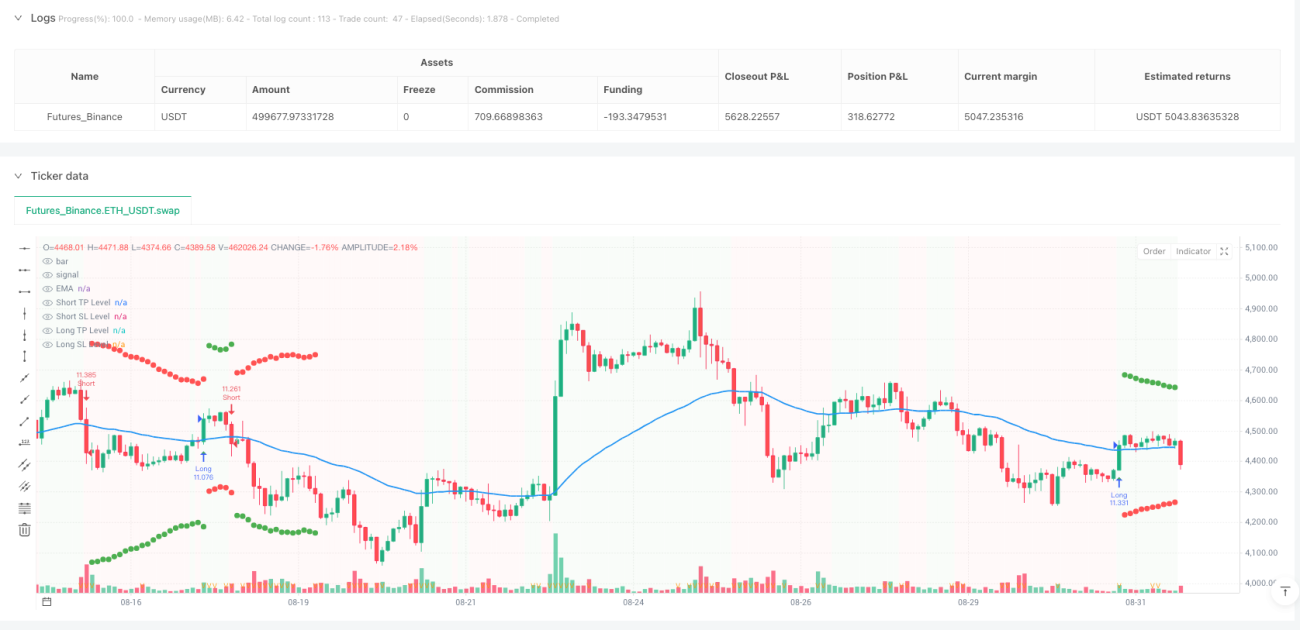
Modo 2: pérdidas por parada dinámica de ATR 📏 Ajuste automático según la volatilidad del mercado, puntos de amortización de pérdidas cuando las fluctuaciones son grandes y puntos de ajuste cuando son pequeñas

Modo 3: Detención de pérdidas por ciento fijo 📊 La mejor manera de entenderlo es que ganan el 2% y corren, y pierden el 1.5% y ceden (customizable)

Recomendaciones para aplicaciones en combate

Ciclo de aplicaciónTráfico a corto y medio plazo, especialmente para mercados con cierta volatilidad Guía para evitar las fosasLa ciudad de Shikoku: “Cuidado, se recomienda activar el filtro ADX” Cómo avanzar¡La fuente de intercambio es especialmente efectiva en el momento de la ruptura de la carga!

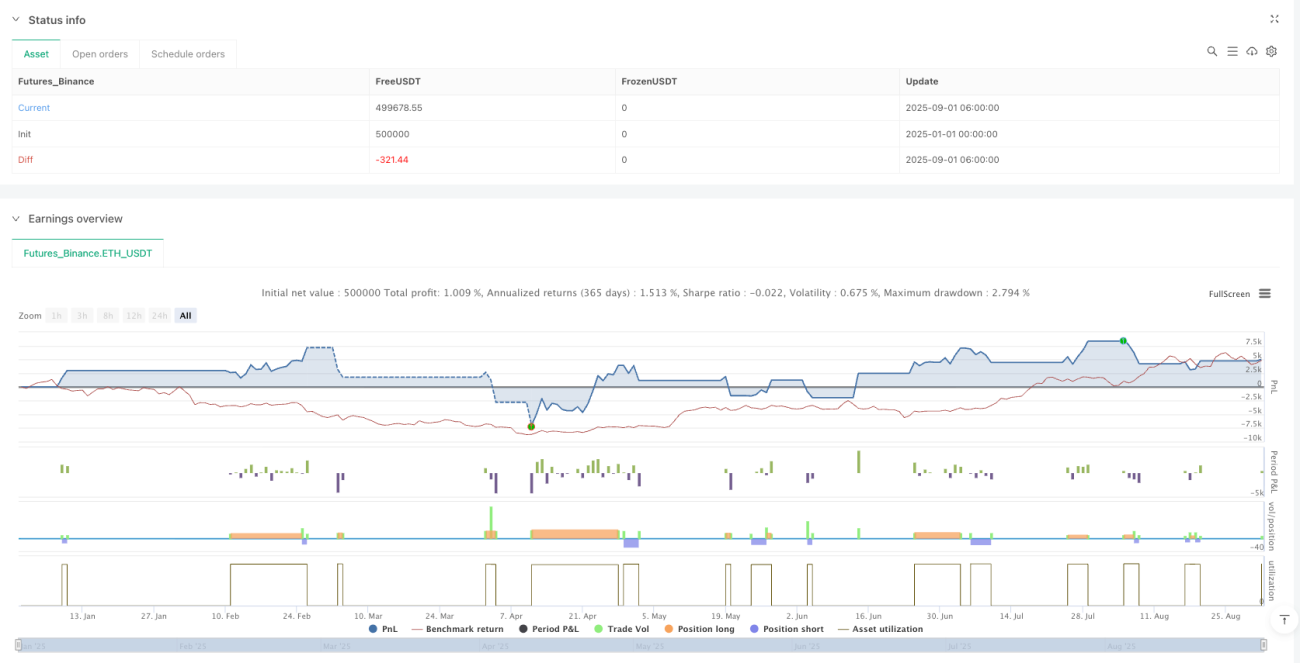
La mayor ventaja de esta estrategia es su gran flexibilidad, ya que puede elegir la fuente de datos y el modo de salida más adecuados en función de las diferentes circunstancias del mercado. Recuerde, no hay estrategias perfectas, solo las que mejor se adaptan al mercado actual!

Código Fuente de la Estrategia
/*backtest
start: 2025-01-01 00:00:00
end: 2025-09-01 08:00:00
period: 2h
basePeriod: 2h
exchanges: [{"eid":"Futures_Binance","currency":"ETH_USDT","balance":500000}]
*/

//@version=5
//@fenyesk
strategy("EMA inFusion Pro - Source Selection", overlay=true, initial_capital=10000, default_qty_type=strategy.percent_of_equity, default_qty_value=10)

// =============================================
// === INPUT PARAMETERS =======================
// =============================================

// Moving Average Source Selection
maSourceSelection = input.string("Price", "Moving Average Source", 
  options=["Price", "Volume", "Rate of Change", "Heikin Ashi Price", "Heikin Ashi Volume", "Heikin Ashi Rate of Change"],
  tooltip="Select data source for EMA calculation")

// EMA Settings
emaLength = input.int(50, title="EMA Length", minval=1, maxval=200)
rocLength = input.int(1, title="Rate of Change Length", minval=1, maxval=50, tooltip="Length for ROC calculation")

// ADX Filter Settings
useAdxFilter = input.bool(true, title="Use ADX Filter", group="ADX Settings")
adxLength = input.int(14, title="ADX Length", minval=1, maxval=50, group="ADX Settings")
adxThreshold = input.float(25, title="ADX Threshold", minval=10, maxval=50, step=0.5, group="ADX Settings")

// Volume Spike Settings
useVolumeFilter = input.bool(true, title="Use Volume Spike Filter", group="Volume Settings")
volumeMultiplier = input.float(1.0, title="Volume Spike Multiplier", minval=1.0, maxval=5.0, step=0.1, group="Volume Settings")
volumeSmaLength = input.int(20, title="Volume SMA Length", minval=5, maxval=100, group="Volume Settings")

// Trading Exit Mode Selector
tradingMode = input.int(2, title="Trading Exit Mode", minval=1, maxval=3, 
  tooltip="1: Exit on reverse signal\n2: ATR based TP/SL\n3: Percent based TP/SL", 
  group="Exit Strategy")

// Mode 3: Percent-Based Settings
takeProfitPercent = input.float(2.0, title="Take Profit %", minval=0.1, maxval=10.0, step=0.1, group="Percent Exit")
stopLossPercent = input.float(1.5, title="Stop Loss %", minval=0.1, maxval=10.0, step=0.1, group="Percent Exit")

// Mode 2: ATR-Based Settings
atrLength = input.int(14, title="ATR Length", minval=1, maxval=50, group="ATR Exit")
atrMultiplierTp = input.float(4.0, title="ATR Take Profit Multiplier", minval=0.1, maxval=10.0, step=0.1, group="ATR Exit")
atrMultiplierSl = input.float(4.0, title="ATR Stop Loss Multiplier", minval=0.1, maxval=10.0, step=0.1, group="ATR Exit")

// =============================================
// === SOURCE CALCULATIONS ====================
// =============================================

// Rate of Change calculation
roc(src, length) =>
    change = src - src[length]
    src[length] != 0 ? (change / src[length] * 100) : 0

// Standard Rate of Change
rocPrice = roc(close, rocLength)
rocVolume = roc(volume, rocLength)

// Heikin Ashi calculations
haClose = (open + high + low + close) / 4
var float haOpen = na
haOpen := na(haOpen[1]) ? (open + close) / 2 : (haOpen[1] + haClose[1]) / 2
haHigh = math.max(high, math.max(haOpen, haClose))
haLow = math.min(low, math.min(haOpen, haClose))

// Heikin Ashi Rate of Change
haRocPrice = roc(haClose, rocLength)
haRocVolume = roc(volume, rocLength)  // Volume remains same for HA

// Define EMA source based on selection
emaSource = switch maSourceSelection
    "Price" => close
    "Volume" => volume
    "Rate of Change" => rocPrice
    "Heikin Ashi Price" => haClose
    "Heikin Ashi Volume" => volume  // Volume doesn't change in HA
    "Heikin Ashi Rate of Change" => haRocPrice
    => close  // Default fallback

// =============================================
// === INDICATOR CALCULATIONS =================
// =============================================

// Core Indicators
emaValue = ta.ema(emaSource, emaLength)
[diPlus, diMinus, adx] = ta.dmi(adxLength, adxLength)
volumeSma = ta.sma(volume, volumeSmaLength)
volumeSpike = volume > (volumeSma * volumeMultiplier)
atrValue = ta.atr(atrLength)

// Trend Conditions (adjusted for different source types)
bullishTrend = switch maSourceSelection
    "Price" => close > emaValue
    "Heikin Ashi Price" => haClose > emaValue
    "Volume" => volume > emaValue
    "Heikin Ashi Volume" => volume > emaValue
    "Rate of Change" => rocPrice > emaValue
    "Heikin Ashi Rate of Change" => haRocPrice > emaValue
    => close > emaValue

bearishTrend = not bullishTrend

// Cross conditions (adjusted for source type)
emaCrossUp = switch maSourceSelection
    "Price" => ta.crossover(close, emaValue)
    "Heikin Ashi Price" => ta.crossover(haClose, emaValue)
    "Volume" => ta.crossover(volume, emaValue)
    "Heikin Ashi Volume" => ta.crossover(volume, emaValue)
    "Rate of Change" => ta.crossover(rocPrice, emaValue)
    "Heikin Ashi Rate of Change" => ta.crossover(haRocPrice, emaValue)
    => ta.crossover(close, emaValue)

emaCrossDown = switch maSourceSelection
    "Price" => ta.crossunder(close, emaValue)
    "Heikin Ashi Price" => ta.crossunder(haClose, emaValue)
    "Volume" => ta.crossunder(volume, emaValue)
    "Heikin Ashi Volume" => ta.crossunder(volume, emaValue)
    "Rate of Change" => ta.crossunder(rocPrice, emaValue)
    "Heikin Ashi Rate of Change" => ta.crossunder(haRocPrice, emaValue)
    => ta.crossunder(close, emaValue)

// Filters
strongTrend = useAdxFilter ? adx >= adxThreshold : true
volumeConfirm = useVolumeFilter ? volumeSpike : true

// Entry Signals
longCondition = emaCrossUp and strongTrend and volumeConfirm
shortCondition = emaCrossDown and strongTrend and volumeConfirm

// =============================================
// === STRATEGY EXECUTION WITH EXIT MODES =====
// =============================================

// MODE 1: EXIT ON REVERSE SIGNAL
if (tradingMode == 1)
    if (longCondition)
        strategy.entry("Long", strategy.long)
        strategy.close("Short")
    if (shortCondition)
        strategy.entry("Short", strategy.short)
        strategy.close("Long")

// MODE 2: ATR-BASED TAKE PROFIT & STOP LOSS
else if (tradingMode == 2)
    if (longCondition)
        strategy.entry("Long", strategy.long)
        strategy.exit("Long TP/SL", "Long", 
          profit=atrMultiplierTp * atrValue / syminfo.mintick, 
          loss=atrMultiplierSl * atrValue / syminfo.mintick)
    
    if (shortCondition)
        strategy.entry("Short", strategy.short)
        strategy.exit("Short TP/SL", "Short", 
          profit=atrMultiplierTp * atrValue / syminfo.mintick, 
          loss=atrMultiplierSl * atrValue / syminfo.mintick)

// MODE 3: PERCENT-BASED TAKE PROFIT & STOP LOSS
else if (tradingMode == 3)
    if (longCondition)
        longTpPrice = close * (1 + takeProfitPercent / 100)
        longSlPrice = close * (1 - stopLossPercent / 100)
        strategy.entry("Long", strategy.long)
        strategy.exit("Long TP/SL", "Long", limit=longTpPrice, stop=longSlPrice)
    
    if (shortCondition)
        shortTpPrice = close * (1 - takeProfitPercent / 100)
        shortSlPrice = close * (1 + stopLossPercent / 100)
        strategy.entry("Short", strategy.short)
        strategy.exit("Short TP/SL", "Short", limit=shortTpPrice, stop=shortSlPrice)

// =============================================
// === VISUALIZATIONS =========================
// =============================================

// Plot EMA with dynamic color based on source type
emaColor = switch maSourceSelection
    "Price" => color.blue
    "Volume" => color.orange
    "Rate of Change" => color.purple
    "Heikin Ashi Price" => color.green
    "Heikin Ashi Volume" => color.red
    "Heikin Ashi Rate of Change" => color.maroon
    => color.blue

plot(emaValue, title="EMA", color=emaColor, linewidth=2)

// Plot source data for reference (in separate pane when not price-based)
sourceColor = maSourceSelection == "Price" or maSourceSelection == "Heikin Ashi Price" ? na : color.gray
plot(str.contains(maSourceSelection, "Price") ? na : emaSource, title="Source Data", color=sourceColor)

// Background color based on trend
bgcolor(bullishTrend ? color.new(color.green, 95) : color.new(color.red, 95), title="Trend Background")

// Entry signals
plotshape(longCondition, title="Long Signal", style=shape.triangleup, location=location.belowbar, color=color.green, size=size.small)
plotshape(shortCondition, title="Short Signal", style=shape.triangledown, location=location.abovebar, color=color.red, size=size.small)

// Volume spikes
plotchar(useVolumeFilter and volumeSpike, title="Volume Spike", char="V", location=location.bottom, color=color.orange, size=size.tiny)

// ATR-based levels for Mode 2
plot(tradingMode == 2 and strategy.position_size > 0 ? strategy.position_avg_price + (atrMultiplierTp * atrValue) : na, 
  title="Long TP Level", color=color.green, style=plot.style_circles, linewidth=1)
plot(tradingMode == 2 and strategy.position_size > 0 ? strategy.position_avg_price - (atrMultiplierSl * atrValue) : na, 
  title="Long SL Level", color=color.red, style=plot.style_circles, linewidth=1)
plot(tradingMode == 2 and strategy.position_size < 0 ? strategy.position_avg_price - (atrMultiplierTp * atrValue) : na, 
  title="Short TP Level", color=color.green, style=plot.style_circles, linewidth=1)
plot(tradingMode == 2 and strategy.position_size < 0 ? strategy.position_avg_price + (atrMultiplierSl * atrValue) : na, 
  title="Short SL Level", color=color.red, style=plot.style_circles, linewidth=1)


// Alert conditions
alertcondition(longCondition, title="Long Entry", message="EMA Fusion Pro: Long entry signal")
alertcondition(shortCondition, title="Short Entry", message="EMA Fusion Pro: Short entry signal")