Stratégie de prédiction des croisements de volatilité dynamique MACD

Aperçu
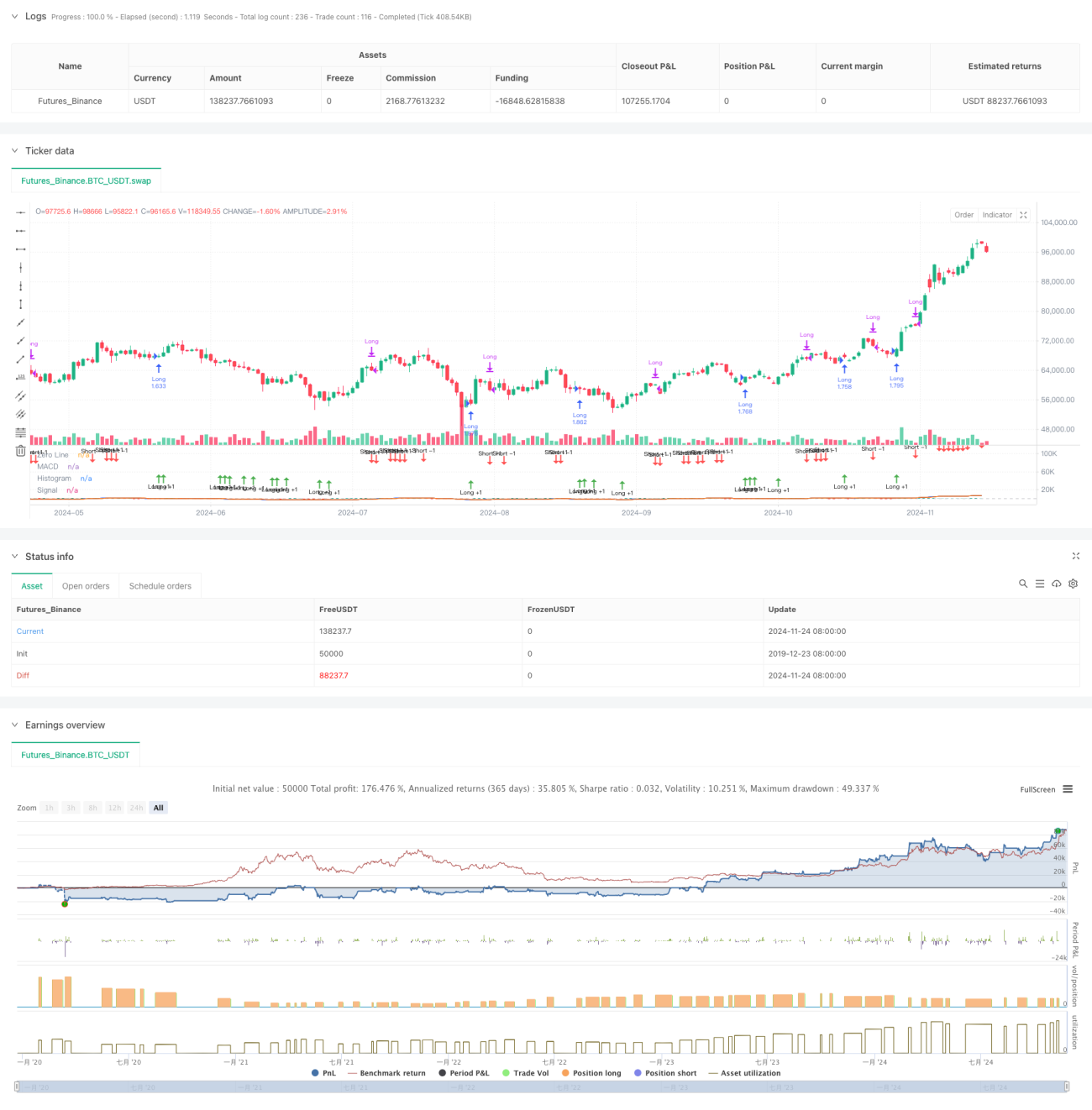
Cette stratégie prend ses décisions de trading en se basant sur les caractéristiques dynamiques du MACD (Moving Average Convergence Divergence). Son cœur consiste à prédire les éventuels croisements haussiers (golden cross) et baissiers (death cross) en observant la tendance d'évolution de l'histogramme du MACD, afin de se positionner à l'avance. La stratégie ne se limite pas aux signaux de croisement traditionnels du MACD, mais s'attache davantage aux variations dynamiques de l'histogramme, permettant ainsi d'obtenir des points d'entrée plus favorables en anticipant les signaux de croisement.
Principe de la stratégie
La stratégie utilise un système MACD modifié, comprenant le calcul de la différence entre une moyenne mobile exponentielle rapide (EMA12) et une moyenne mobile exponentielle lente (EMA26), ainsi qu'une ligne de signal basée sur 2 périodes. La logique de trading centrale repose sur les points suivants :
- Calcul du taux de variation de l'histogramme (hist_change) pour évaluer les changements dynamiques de tendance.
- Lorsque l'histogramme est négatif et montre une tendance haussière pendant trois périodes consécutives, on anticipe un possible croisement haussier et on entre en position longue.
- Lorsque l'histogramme est positif et montre une tendance baissière pendant trois périodes consécutives, on anticipe un possible croisement baissier et on sort de la position.
- La stratégie intègre un mécanisme de filtrage temporel, ne négociant que dans une plage horaire définie.
Avantages de la stratégie
- Forte capacité d'anticipation des signaux : en observant les variations dynamiques de l'histogramme, on prévoit les croisements potentiels, améliorant ainsi le timing d'entrée.
- Contrôle des risques raisonnable : des frais de transaction de 0,1 % et un dérapage de 3 points sont pris en compte, reflétant les conditions de trading réelles.
- Gestion flexible du capital : la gestion de position basée sur un pourcentage du capital total permet un contrôle efficace des risques.
- Excellente visualisation : l'histogramme est coloré différemment selon les hausses et les baisses, et les signaux de trading sont marqués par des flèches, facilitant l'analyse.
Risques de la stratégie
- Risque de faux signaux : dans un marché en range, des signaux de rupture fréquents mais trompeurs peuvent apparaître.
- Risque de retard : bien que la stratégie utilise un mécanisme d'anticipation, le MACD lui-même reste intrinsèquement en retard.
- Dépendance à l'environnement de marché : la stratégie donne de meilleurs résultats sur des marchés en tendance, mais peut être moins performante sur des marchés sans tendance claire.
- Sensibilité aux paramètres : le choix des périodes des moyennes mobiles influence fortement les performances.
Pistes d'optimisation
- Introduction d'un filtre basé sur l'environnement de marché : ajouter un indicateur de tendance pour utiliser différents paramètres selon les conditions de marché.
- Optimisation de la gestion du capital : ajuster dynamiquement la taille de la position en fonction de la force du signal.
- Amélioration du mécanisme de stop : ajouter un stop suiveur ou un stop fixe pour limiter les drawdowns.
- Ajout d'un mécanisme de confirmation des signaux : combiner avec d'autres indicateurs techniques pour une validation croisée, améliorant ainsi la fiabilité des signaux.
- Optimisation des paramètres : utiliser une approche de paramètres adaptatifs qui s'ajustent dynamiquement en fonction des conditions du marché.
Conclusion
Cette stratégie améliore et optimise le système de trading MACD traditionnel en utilisant de manière innovante les caractéristiques dynamiques de l'histogramme du MACD. Le mécanisme d'anticipation permet d'obtenir des signaux d'entrée plus précoces, tandis que des conditions de trading strictes et des mesures de contrôle des risques assurent la stabilité de la stratégie. Avec des optimisations et des améliorations supplémentaires, cette stratégie pourrait offrir de meilleures performances en conditions réelles de trading.
/*backtest
start: 2019-12-23 08:00:00
end: 2024-11-25 08:00:00
period: 1d
basePeriod: 1d
exchanges: [{"eid":"Futures_Binance","currency":"BTC_USDT"}]
*/

//@version=5
strategy(title="Demo GPT - Moving Average Convergence Divergence", shorttitle="MACD", commission_type=strategy.commission.percent, commission_value=0.1, slippage=3, default_qty_type=strategy.percent_of_equity, default_qty_value=100)

// Getting inputs- 1