
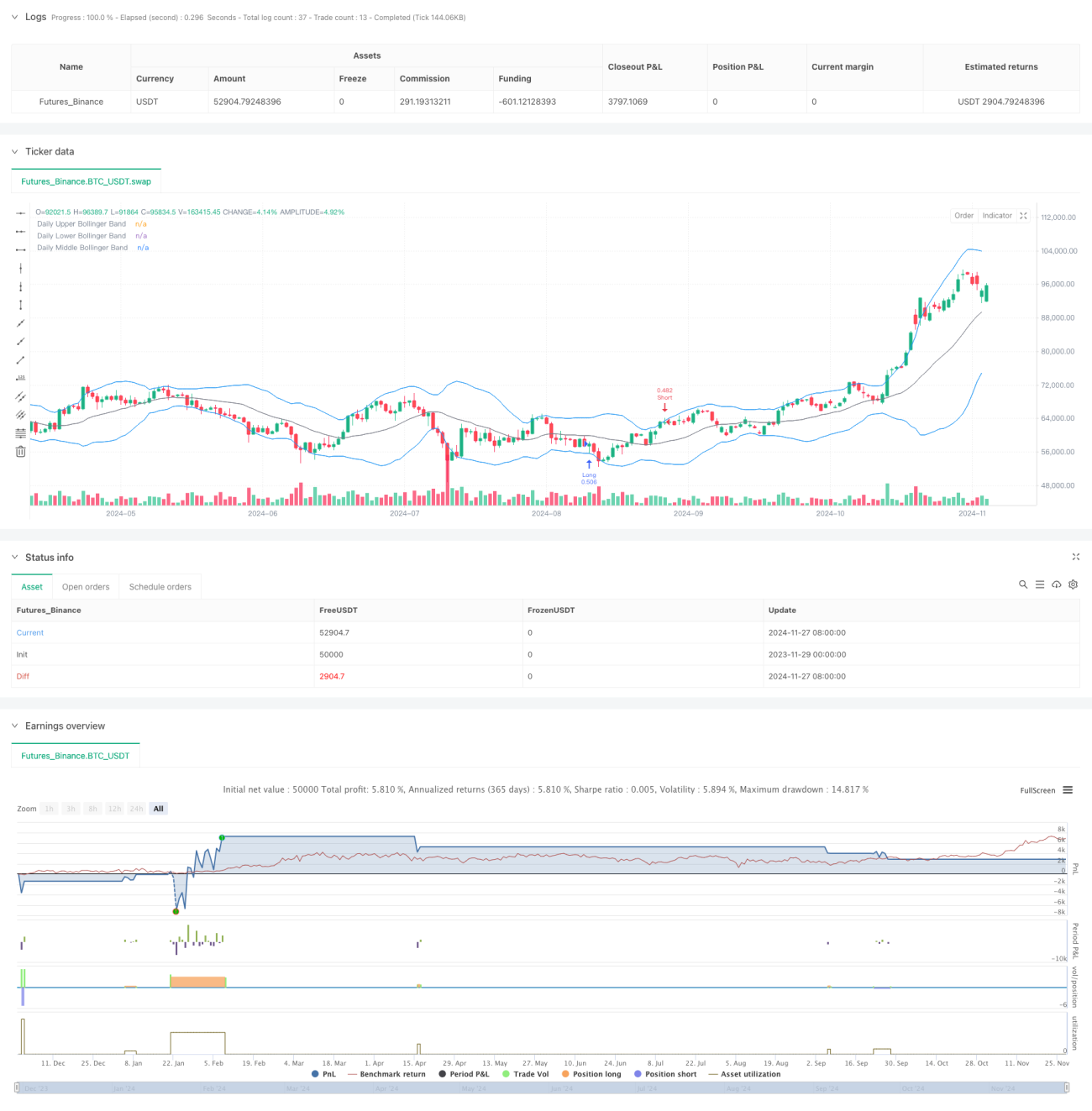
Aperçu
Cette stratégie est un système de trading basé sur les bandes de Bollinger et l'analyse des motifs de chandeliers, visant à capturer les opportunités de retournement du marché en analysant les fluctuations de prix au niveau journalier et les caractéristiques des chandeliers. Le cœur de la stratégie combine le canal de volatilité des bandes de Bollinger avec le ratio entre les ombres hautes/basses et le corps du chandelier. Lorsque le prix atteint les limites des bandes de Bollinger, le système recherche des signaux de retournement potentiels. Ce système prend en charge l'analyse multi-périodes, permettant d'effectuer des transactions sur des périodes plus courtes tout en maintenant l'analyse au niveau journalier.
Principe de la stratégie
La stratégie utilise des bandes de Bollinger sur 20 périodes comme indicateur technique principal, avec un multiplicateur d'écart-type de 2,0. En calculant le rapport entre les ombres hautes/basses et le corps du chandelier, lorsque ce rapport dépasse le seuil défini (par défaut 1,0) et que le prix touche la limite des bandes de Bollinger, le système génère un signal de trading. Le moment d'entrée peut être choisi de manière flexible : à la clôture de la bougie journalière, à l'ouverture du jour suivant, au plus haut ou au plus bas intraday. La stratégie inclut également un système de gestion des risques basé sur le solde du compte, contrôlant le risque de chaque transaction en calculant dynamiquement la taille de la position. Le stop-loss est placé au niveau du plus haut ou du plus bas récent des fluctuations, tandis que le take-profit est fixé à la bande de Bollinger opposée.
Avantages de la stratégie
- Analyse multidimensionnelle : Combine indicateurs techniques et analyse des motifs de prix, améliorant la fiabilité des signaux.
- Mécanisme d'entrée flexible : Propose plusieurs choix de moments d'entrée, adaptés à différents styles de trading.
- Gestion des risques complète : Contrôle des risques via une taille de position dynamique et un stop-loss automatique.
- Compatibilité multi-périodes : Permet d'exécuter des transactions sur des périodes plus courtes tout en conservant l'analyse journalière.
- Haut niveau d'automatisation : Automatise tout le processus, de la reconnaissance des signaux à la gestion des positions.
Risques de la stratégie
- Risque de volatilité du marché : Peut générer de faux signaux sur des marchés très volatils.
- Risque de retard : En raison de l'utilisation de données journalières, la réaction peut être insuffisamment rapide sur des marchés rapides.
- Sensibilité aux paramètres : Le choix des paramètres des bandes de Bollinger et du seuil du ratio d'ombres influence significativement les performances de la stratégie.
- Risque de liquidité : Sur des marchés peu liquides, il peut être difficile d'exécuter les ordres au prix attendu.
Directions d'optimisation de la stratégie
- Introduction de l'analyse de volume : Combiner les données de volume pour valider l'efficacité des retournements de prix.
- Ajout d'un filtre d'environnement de marché : Intégrer un indicateur de force de tendance pour filtrer les conditions de marché défavorables.
- Optimisation adaptative des paramètres : Ajuster dynamiquement les paramètres des bandes de Bollinger et le seuil du ratio d'ombres en fonction de la volatilité du marché.
- Amélioration du contrôle des risques : Ajouter un mécanisme de contrôle du drawdown et de surveillance de la courbe des capitaux propres.
- Renforcement de la confirmation des signaux : Introduire d'autres indicateurs techniques comme outils de confirmation auxiliaires.
Résumé
Il s'agit d'un système de trading complet combinant les bandes de Bollinger et l'analyse des chandeliers, capturant les opportunités de retournement du marché grâce à une analyse multidimensionnelle. Les atouts de la stratégie résident dans son cadre d'analyse complet et son système de gestion des risques rigoureux, mais il faut également tenir compte de l'impact de l'environnement de marché et du choix des paramètres sur les performances. Grâce aux axes d'optimisation suggérés, la stabilité et la fiabilité de la stratégie peuvent être améliorées. En application réelle, il est recommandé d'effectuer des backtests approfondis et une optimisation des paramètres, et d'ajuster la stratégie en fonction des caractéristiques spécifiques de l'instrument tradé.
/*backtest
start: 2023-11-29 00:00:00
end: 2024-11-28 00:00:00
period: 1d
basePeriod: 1d
exchanges: [{"eid":"Futures_Binance","currency":"BTC_USDT"}]
*/

//@version=5
strategy("Trade Entry Detector, based on Wick to Body Ratio when price tests Bollinger Bands", overlay=true, default_qty_type=strategy.fixed)

// Input for primary analysis time frame- 1