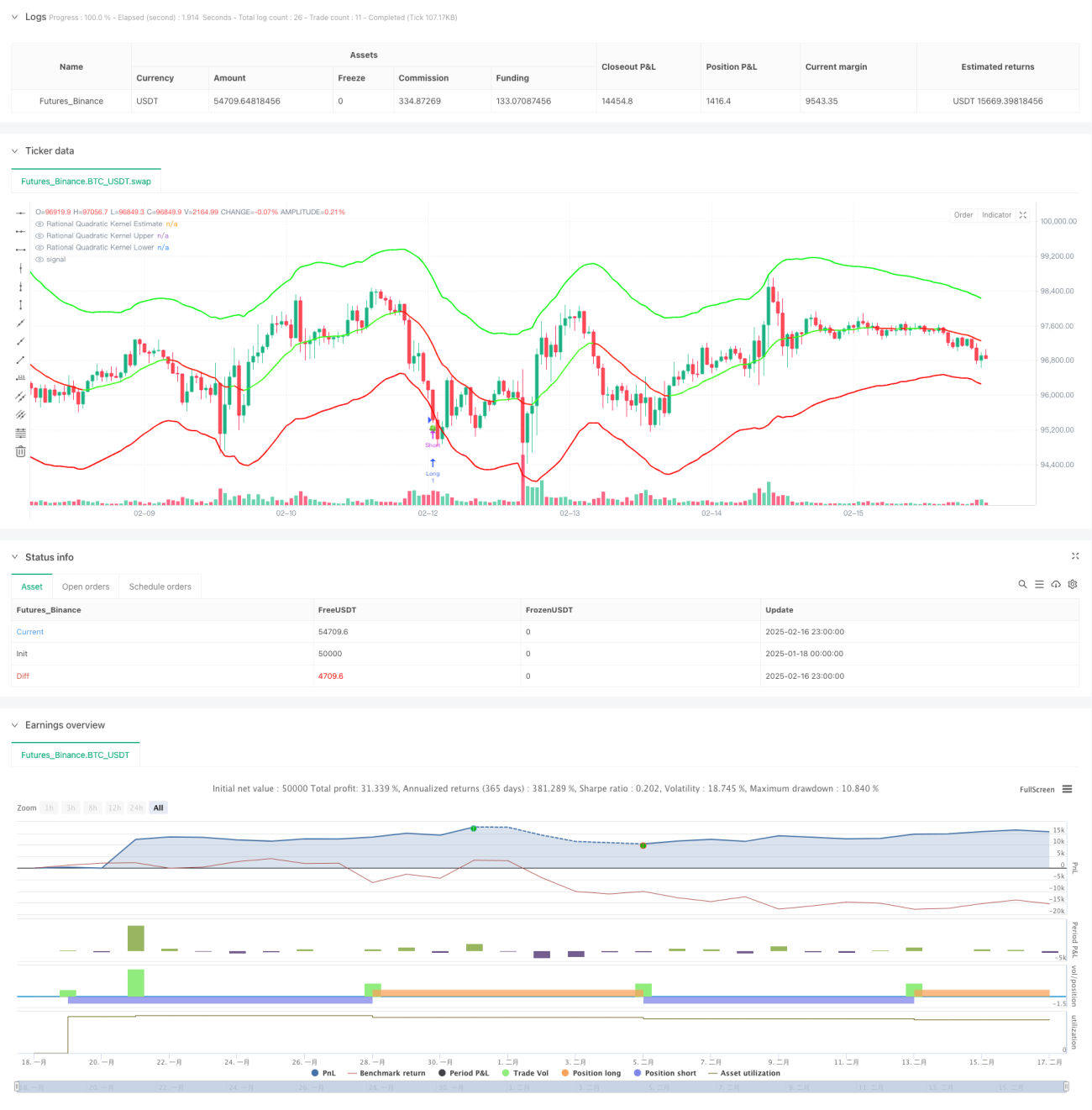
A estratégia é um sistema de rastreamento de tendências adaptativo que combina a regressão nuclear de Nadaraya-Watson e o espectro de ondas dinâmicas do ATR. Ele prevê tendências de preços por meio de funções de núcleo binário lógico e usa suporte e resistência dinâmicos baseados no ATR para identificar oportunidades de negociação. O sistema permite a modelagem precisa do mercado por meio de janelas de regressão configuráveis e parâmetros de peso.
O núcleo central da estratégia é a regressão de núcleo não paramétrica baseada no método Nadaraya-Watson, que usa funções de núcleo binário lógico para suavizar a sequência de preços. A regressão começa a ser calculada a partir da barra inicial definida e o grau de encaixe é controlado por dois parâmetros-chave, o lookback window (h) e o peso relativo ®. Ao mesmo tempo, em combinação com o indicador ATR, a construção de bandas dinâmicas é feita, com bandas superiores e inferiores regressando respectivamente ao valor estimado de adição e diminuição do ATR. O sistema ativa o sinal de negociação por meio de cruzamentos de bandas com preços - quando o preço quebra as bandas inferiores, faz mais, e quando as bandas superiores fazem menos.
A estratégia, combinando métodos de aprendizagem estatística com análise técnica, constrói um sistema de negociação com uma base sólida e prática. Suas características de adaptabilidade e configurabilidade permitem que ele se adapte a diferentes ambientes de mercado, mas precisa prestar atenção à otimização de parâmetros e controle de risco.
/*backtest
start: 2025-01-18 00:00:00
end: 2025-02-17 00:00:00
period: 1h
basePeriod: 1h
exchanges: [{"eid":"Futures_Binance","currency":"BTC_USDT"}]
*/
// This source code is subject to the terms of the Mozilla Public License 2.0 at https://mozilla.org/MPL/2.0/
// © Lupown
//@version=5
strategy("Nadaraya-Watson non repainting Strategy", overlay=true) // PARAMETER timeframe ODSTRÁNENÝ
//--------------------------------------------------------------------------------
// INPUTS
//--------------------------------------------------------------------------------
src = input.source(close, 'Source')
h = input.float(8., 'Lookback Window', minval=3., tooltip='The number of bars used for the estimation. This is a sliding value that represents the most recent historical bars. Recommended range: 3-50')
r = input.float(8., 'Relative Weighting', step=0.25, tooltip='Relative weighting of time frames. As this value approaches zero, the longer time frames will exert more influence on the estimation. As this value approaches infinity, the behavior of the Rational Quadratic Kernel will become identical to the Gaussian kernel. Recommended range: 0.25-25')
x_0 = input.int(25, "Start Regression at Bar", tooltip='Bar index on which to start regression. The first bars of a chart are often highly volatile, and omission of these initial bars often leads to a better overall fit. Recommended range: 5-25')
showMiddle = input.bool(true, "Show middle band")
smoothColors = input.bool(false, "Smooth Colors", tooltip="Uses a crossover based mechanism to determine colors. This often results in less color transitions overall.", inline='1', group='Colors')
lag = input.int(2, "Lag", tooltip="Lag for crossover detection. Lower values result in earlier crossovers. Recommended range: 1-2", inline='1', group='Colors')
lenjeje = input.int(32, "ATR Period", tooltip="Period to calculate upper and lower band", group='Bands')
coef = input.float(2.7, "Multiplier", tooltip="Multiplier to calculate upper and lower band", group='Bands')
//--------------------------------------------------------------------------------
// ARRAYS & VARIABLES
//--------------------------------------------------------------------------------
float y1 = 0.0
float y2 = 0.0
srcArray = array.new<float>(0)
array.push(srcArray, src)
size = array.size(srcArray)
//--------------------------------------------------------------------------------
// KERNEL REGRESSION FUNCTIONS
//--------------------------------------------------------------------------------
kernel_regression1(_src, _size, _h) =>
float _currentWeight = 0.
float _cumulativeWeight = 0.
for i = 0 to _size + x_0
y = _src[i]
w = math.pow(1 + (math.pow(i, 2) / ((math.pow(_h, 2) * 2 * r))), -r)
_currentWeight += y * w
_cumulativeWeight += w
[_currentWeight, _cumulativeWeight]
[currentWeight1, cumulativeWeight1] = kernel_regression1(src, size, h)
yhat1 = currentWeight1 / cumulativeWeight1
[currentWeight2, cumulativeWeight2] = kernel_regression1(src, size, h - lag)
yhat2 = currentWeight2 / cumulativeWeight2
//--------------------------------------------------------------------------------
// TREND & COLOR DETECTION
//--------------------------------------------------------------------------------
// Rate-of-change-based
bool wasBearish = yhat1[2] > yhat1[1]
bool wasBullish = yhat1[2] < yhat1[1]
bool isBearish = yhat1[1] > yhat1
bool isBullish = yhat1[1] < yhat1
bool isBearishChg = isBearish and wasBullish
bool isBullishChg = isBullish and wasBearish
// Crossover-based (for "smooth" color changes)
bool isBullishCross = ta.crossover(yhat2, yhat1)
bool isBearishCross = ta.crossunder(yhat2, yhat1)
bool isBullishSmooth = yhat2 > yhat1
bool isBearishSmooth = yhat2 < yhat1
color c_bullish = input.color(#3AFF17, 'Bullish Color', group='Colors')
color c_bearish = input.color(#FD1707, 'Bearish Color', group='Colors')
color colorByCross = isBullishSmooth ? c_bullish : c_bearish
color colorByRate = isBullish ? c_bullish : c_bearish
color plotColor = smoothColors ? colorByCross : colorByRate
// Middle Estimate
plot(showMiddle ? yhat1 : na, "Rational Quadratic Kernel Estimate", color=plotColor, linewidth=2)
//--------------------------------------------------------------------------------
// UPPER / LOWER BANDS
//--------------------------------------------------------------------------------
upperjeje = yhat1 + coef * ta.atr(lenjeje)
lowerjeje = yhat1 - coef * ta.atr(lenjeje)
plotUpper = plot(upperjeje, "Rational Quadratic Kernel Upper", color=color.rgb(0, 247, 8), linewidth=2)
plotLower = plot(lowerjeje, "Rational Quadratic Kernel Lower", color=color.rgb(255, 0, 0), linewidth=2)
//--------------------------------------------------------------------------------
// SYMBOLS & ALERTS
//--------------------------------------------------------------------------------
plotchar(ta.crossover(close, upperjeje), char="🥀", location=location.abovebar, size=size.tiny)
plotchar(ta.crossunder(close, lowerjeje), char="🍀", location=location.belowbar, size=size.tiny)
// Alerts for Color Changes (estimator)
alertcondition(smoothColors ? isBearishCross : isBearishChg, title="Bearish Color Change", message="Nadaraya-Watson: {{ticker}} ({{interval}}) turned Bearish ▼")
alertcondition(smoothColors ? isBullishCross : isBullishChg, title="Bullish Color Change", message="Nadaraya-Watson: {{ticker}} ({{interval}}) turned Bullish ▲")
// Alerts when price crosses upper and lower band
alertcondition(ta.crossunder(close, lowerjeje), title="Price close under lower band", message="Nadaraya-Watson: {{ticker}} ({{interval}}) crossed under lower band 🍀")
alertcondition(ta.crossover(close, upperjeje), title="Price close above upper band", message="Nadaraya-Watson: {{ticker}} ({{interval}}) Crossed above upper band 🥀")
//--------------------------------------------------------------------------------
// STRATEGY LOGIC (EXAMPLE)
//--------------------------------------------------------------------------------
if ta.crossunder(close, lowerjeje)
// zatvoriť short
strategy.close("Short")
// otvoriť long
strategy.entry("Long", strategy.long)
if ta.crossover(close, upperjeje)
// zatvoriť long
strategy.close("Long")
// otvoriť short
strategy.entry("Short", strategy.short)