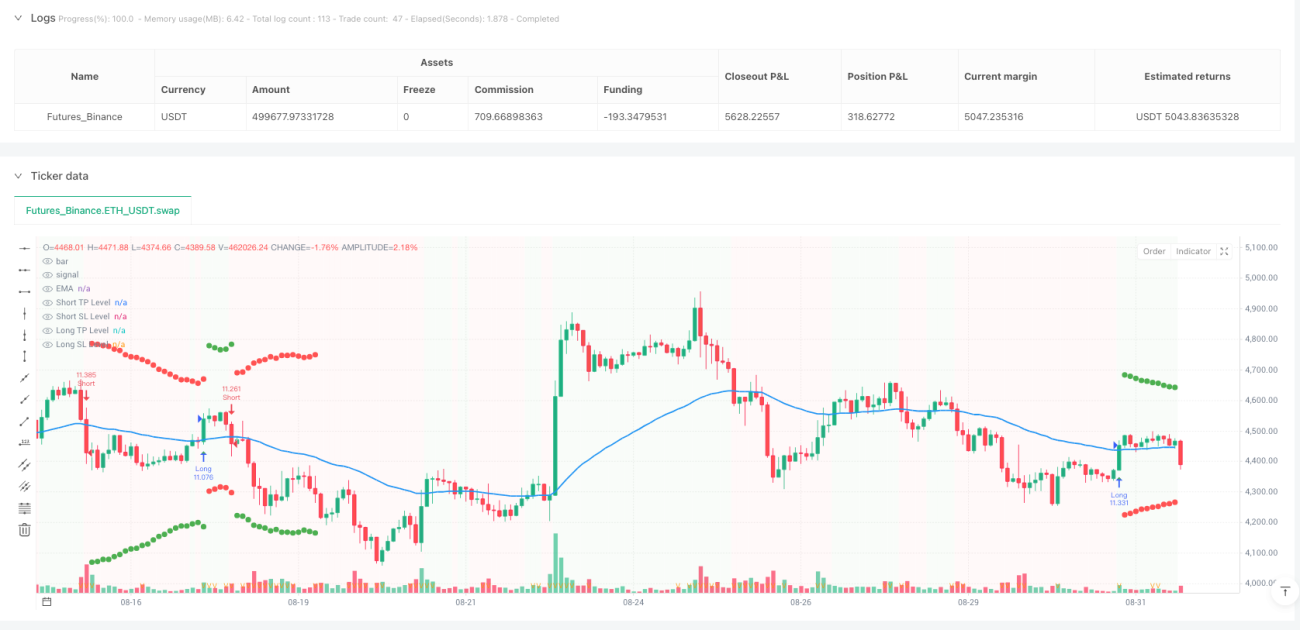
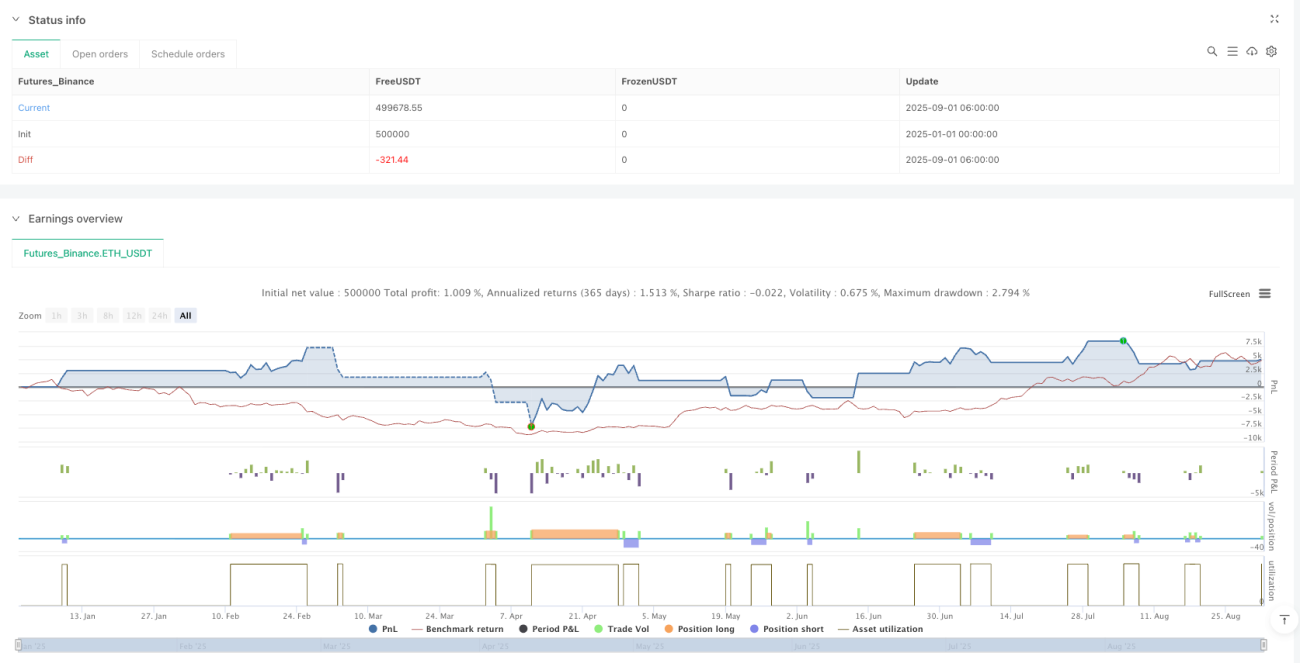
Você sabe, a maioria das pessoas só olha para o preço com a EMA, mas onde está a força desta estratégia? Ela pode calcular a EMA a partir de seis fontes de dados diferentes! É como cozinhar com sal, mas também com açúcar, alho e óleo de coco, dando-lhe um sinal de negociação mais rico.
Esses seis tipos de dados incluem: preço médio, volume de negócios, taxa de mudança, preço médio de linha K, volume médio de negócios de linha K, taxa de mudança de linha K. Cada um tem uma visão diferente do mercado!
A estratégia não é de dar sinais ao acaso!
Primeira linha: A avaliação da tendência da EMA 📈 É como ver a previsão do tempo, para saber se vai chover ou não.
Segundo: Filtragem de intensidade ADX 💪
O ADX é como um instrumento para medir o vento, só quando a tendência é forte o suficiente (default acima de 25), é que ele emite um sinal.
Terceiro caminho: confirmação de transação 🔊 A explosão do volume de negócios é como se as ações estivessem “falando alto”, provando que o sinal é sério e não uma brincadeira.
A estratégia, que é mais familiar, oferece três saídas, como se o jogo tivesse três dificuldades: fácil, comum e difícil:
Modo 1: Reversão de sinal de saída 🔄 O mais simples e grosseiro, quando o sinal multi-cabeça vem, fica mais vazio, quando o sinal de cabeça vazia vem, fica mais vazio
Padrão 2: ATR Dinâmico Stop Loss 📏 Ajuste automático de acordo com a volatilidade do mercado, com pontos de relaxamento de stop loss quando oscilações são grandes e pontos de aperto quando oscilações são pequenas
Modo 3: Percentagem fixa de stop loss 📊 A melhor compreensão é que ganhar 2% é correr, perder 1.5% é ceder (customizavel)
Período de aplicaçãoTráfico de curto e médio prazo, especialmente para mercados com alguma volatilidade Guia para evitar poços“Conselho a todos os investidores a usarem o filtro ADX” AvançarO que é que eu tenho a dizer sobre o que aconteceu com o Google, e o que é que eu tenho a dizer?
A maior vantagem desta estratégia é a sua grande flexibilidade, permitindo-lhe escolher a fonte de dados e o modo de saída mais adequados, de acordo com as diferentes circunstâncias do mercado. Lembre-se de que não há estratégias perfeitas, apenas as mais adequadas para o mercado atual!
/*backtest
start: 2025-01-01 00:00:00
end: 2025-09-01 08:00:00
period: 2h
basePeriod: 2h
exchanges: [{"eid":"Futures_Binance","currency":"ETH_USDT","balance":500000}]
*/
//@version=5
//@fenyesk
strategy("EMA inFusion Pro - Source Selection", overlay=true, initial_capital=10000, default_qty_type=strategy.percent_of_equity, default_qty_value=10)
// =============================================
// === INPUT PARAMETERS =======================
// =============================================
// Moving Average Source Selection
maSourceSelection = input.string("Price", "Moving Average Source",
options=["Price", "Volume", "Rate of Change", "Heikin Ashi Price", "Heikin Ashi Volume", "Heikin Ashi Rate of Change"],
tooltip="Select data source for EMA calculation")
// EMA Settings
emaLength = input.int(50, title="EMA Length", minval=1, maxval=200)
rocLength = input.int(1, title="Rate of Change Length", minval=1, maxval=50, tooltip="Length for ROC calculation")
// ADX Filter Settings
useAdxFilter = input.bool(true, title="Use ADX Filter", group="ADX Settings")
adxLength = input.int(14, title="ADX Length", minval=1, maxval=50, group="ADX Settings")
adxThreshold = input.float(25, title="ADX Threshold", minval=10, maxval=50, step=0.5, group="ADX Settings")
// Volume Spike Settings
useVolumeFilter = input.bool(true, title="Use Volume Spike Filter", group="Volume Settings")
volumeMultiplier = input.float(1.0, title="Volume Spike Multiplier", minval=1.0, maxval=5.0, step=0.1, group="Volume Settings")
volumeSmaLength = input.int(20, title="Volume SMA Length", minval=5, maxval=100, group="Volume Settings")
// Trading Exit Mode Selector
tradingMode = input.int(2, title="Trading Exit Mode", minval=1, maxval=3,
tooltip="1: Exit on reverse signal\n2: ATR based TP/SL\n3: Percent based TP/SL",
group="Exit Strategy")
// Mode 3: Percent-Based Settings
takeProfitPercent = input.float(2.0, title="Take Profit %", minval=0.1, maxval=10.0, step=0.1, group="Percent Exit")
stopLossPercent = input.float(1.5, title="Stop Loss %", minval=0.1, maxval=10.0, step=0.1, group="Percent Exit")
// Mode 2: ATR-Based Settings
atrLength = input.int(14, title="ATR Length", minval=1, maxval=50, group="ATR Exit")
atrMultiplierTp = input.float(4.0, title="ATR Take Profit Multiplier", minval=0.1, maxval=10.0, step=0.1, group="ATR Exit")
atrMultiplierSl = input.float(4.0, title="ATR Stop Loss Multiplier", minval=0.1, maxval=10.0, step=0.1, group="ATR Exit")
// =============================================
// === SOURCE CALCULATIONS ====================
// =============================================
// Rate of Change calculation
roc(src, length) =>
change = src - src[length]
src[length] != 0 ? (change / src[length] * 100) : 0
// Standard Rate of Change
rocPrice = roc(close, rocLength)
rocVolume = roc(volume, rocLength)
// Heikin Ashi calculations
haClose = (open + high + low + close) / 4
var float haOpen = na
haOpen := na(haOpen[1]) ? (open + close) / 2 : (haOpen[1] + haClose[1]) / 2
haHigh = math.max(high, math.max(haOpen, haClose))
haLow = math.min(low, math.min(haOpen, haClose))
// Heikin Ashi Rate of Change
haRocPrice = roc(haClose, rocLength)
haRocVolume = roc(volume, rocLength) // Volume remains same for HA
// Define EMA source based on selection
emaSource = switch maSourceSelection
"Price" => close
"Volume" => volume
"Rate of Change" => rocPrice
"Heikin Ashi Price" => haClose
"Heikin Ashi Volume" => volume // Volume doesn't change in HA
"Heikin Ashi Rate of Change" => haRocPrice
=> close // Default fallback
// =============================================
// === INDICATOR CALCULATIONS =================
// =============================================
// Core Indicators
emaValue = ta.ema(emaSource, emaLength)
[diPlus, diMinus, adx] = ta.dmi(adxLength, adxLength)
volumeSma = ta.sma(volume, volumeSmaLength)
volumeSpike = volume > (volumeSma * volumeMultiplier)
atrValue = ta.atr(atrLength)
// Trend Conditions (adjusted for different source types)
bullishTrend = switch maSourceSelection
"Price" => close > emaValue
"Heikin Ashi Price" => haClose > emaValue
"Volume" => volume > emaValue
"Heikin Ashi Volume" => volume > emaValue
"Rate of Change" => rocPrice > emaValue
"Heikin Ashi Rate of Change" => haRocPrice > emaValue
=> close > emaValue
bearishTrend = not bullishTrend
// Cross conditions (adjusted for source type)
emaCrossUp = switch maSourceSelection
"Price" => ta.crossover(close, emaValue)
"Heikin Ashi Price" => ta.crossover(haClose, emaValue)
"Volume" => ta.crossover(volume, emaValue)
"Heikin Ashi Volume" => ta.crossover(volume, emaValue)
"Rate of Change" => ta.crossover(rocPrice, emaValue)
"Heikin Ashi Rate of Change" => ta.crossover(haRocPrice, emaValue)
=> ta.crossover(close, emaValue)
emaCrossDown = switch maSourceSelection
"Price" => ta.crossunder(close, emaValue)
"Heikin Ashi Price" => ta.crossunder(haClose, emaValue)
"Volume" => ta.crossunder(volume, emaValue)
"Heikin Ashi Volume" => ta.crossunder(volume, emaValue)
"Rate of Change" => ta.crossunder(rocPrice, emaValue)
"Heikin Ashi Rate of Change" => ta.crossunder(haRocPrice, emaValue)
=> ta.crossunder(close, emaValue)
// Filters
strongTrend = useAdxFilter ? adx >= adxThreshold : true
volumeConfirm = useVolumeFilter ? volumeSpike : true
// Entry Signals
longCondition = emaCrossUp and strongTrend and volumeConfirm
shortCondition = emaCrossDown and strongTrend and volumeConfirm
// =============================================
// === STRATEGY EXECUTION WITH EXIT MODES =====
// =============================================
// MODE 1: EXIT ON REVERSE SIGNAL
if (tradingMode == 1)
if (longCondition)
strategy.entry("Long", strategy.long)
strategy.close("Short")
if (shortCondition)
strategy.entry("Short", strategy.short)
strategy.close("Long")
// MODE 2: ATR-BASED TAKE PROFIT & STOP LOSS
else if (tradingMode == 2)
if (longCondition)
strategy.entry("Long", strategy.long)
strategy.exit("Long TP/SL", "Long",
profit=atrMultiplierTp * atrValue / syminfo.mintick,
loss=atrMultiplierSl * atrValue / syminfo.mintick)
if (shortCondition)
strategy.entry("Short", strategy.short)
strategy.exit("Short TP/SL", "Short",
profit=atrMultiplierTp * atrValue / syminfo.mintick,
loss=atrMultiplierSl * atrValue / syminfo.mintick)
// MODE 3: PERCENT-BASED TAKE PROFIT & STOP LOSS
else if (tradingMode == 3)
if (longCondition)
longTpPrice = close * (1 + takeProfitPercent / 100)
longSlPrice = close * (1 - stopLossPercent / 100)
strategy.entry("Long", strategy.long)
strategy.exit("Long TP/SL", "Long", limit=longTpPrice, stop=longSlPrice)
if (shortCondition)
shortTpPrice = close * (1 - takeProfitPercent / 100)
shortSlPrice = close * (1 + stopLossPercent / 100)
strategy.entry("Short", strategy.short)
strategy.exit("Short TP/SL", "Short", limit=shortTpPrice, stop=shortSlPrice)
// =============================================
// === VISUALIZATIONS =========================
// =============================================
// Plot EMA with dynamic color based on source type
emaColor = switch maSourceSelection
"Price" => color.blue
"Volume" => color.orange
"Rate of Change" => color.purple
"Heikin Ashi Price" => color.green
"Heikin Ashi Volume" => color.red
"Heikin Ashi Rate of Change" => color.maroon
=> color.blue
plot(emaValue, title="EMA", color=emaColor, linewidth=2)
// Plot source data for reference (in separate pane when not price-based)
sourceColor = maSourceSelection == "Price" or maSourceSelection == "Heikin Ashi Price" ? na : color.gray
plot(str.contains(maSourceSelection, "Price") ? na : emaSource, title="Source Data", color=sourceColor)
// Background color based on trend
bgcolor(bullishTrend ? color.new(color.green, 95) : color.new(color.red, 95), title="Trend Background")
// Entry signals
plotshape(longCondition, title="Long Signal", style=shape.triangleup, location=location.belowbar, color=color.green, size=size.small)
plotshape(shortCondition, title="Short Signal", style=shape.triangledown, location=location.abovebar, color=color.red, size=size.small)
// Volume spikes
plotchar(useVolumeFilter and volumeSpike, title="Volume Spike", char="V", location=location.bottom, color=color.orange, size=size.tiny)
// ATR-based levels for Mode 2
plot(tradingMode == 2 and strategy.position_size > 0 ? strategy.position_avg_price + (atrMultiplierTp * atrValue) : na,
title="Long TP Level", color=color.green, style=plot.style_circles, linewidth=1)
plot(tradingMode == 2 and strategy.position_size > 0 ? strategy.position_avg_price - (atrMultiplierSl * atrValue) : na,
title="Long SL Level", color=color.red, style=plot.style_circles, linewidth=1)
plot(tradingMode == 2 and strategy.position_size < 0 ? strategy.position_avg_price - (atrMultiplierTp * atrValue) : na,
title="Short TP Level", color=color.green, style=plot.style_circles, linewidth=1)
plot(tradingMode == 2 and strategy.position_size < 0 ? strategy.position_avg_price + (atrMultiplierSl * atrValue) : na,
title="Short SL Level", color=color.red, style=plot.style_circles, linewidth=1)
// Alert conditions
alertcondition(longCondition, title="Long Entry", message="EMA Fusion Pro: Long entry signal")
alertcondition(shortCondition, title="Short Entry", message="EMA Fusion Pro: Short entry signal")