Overview
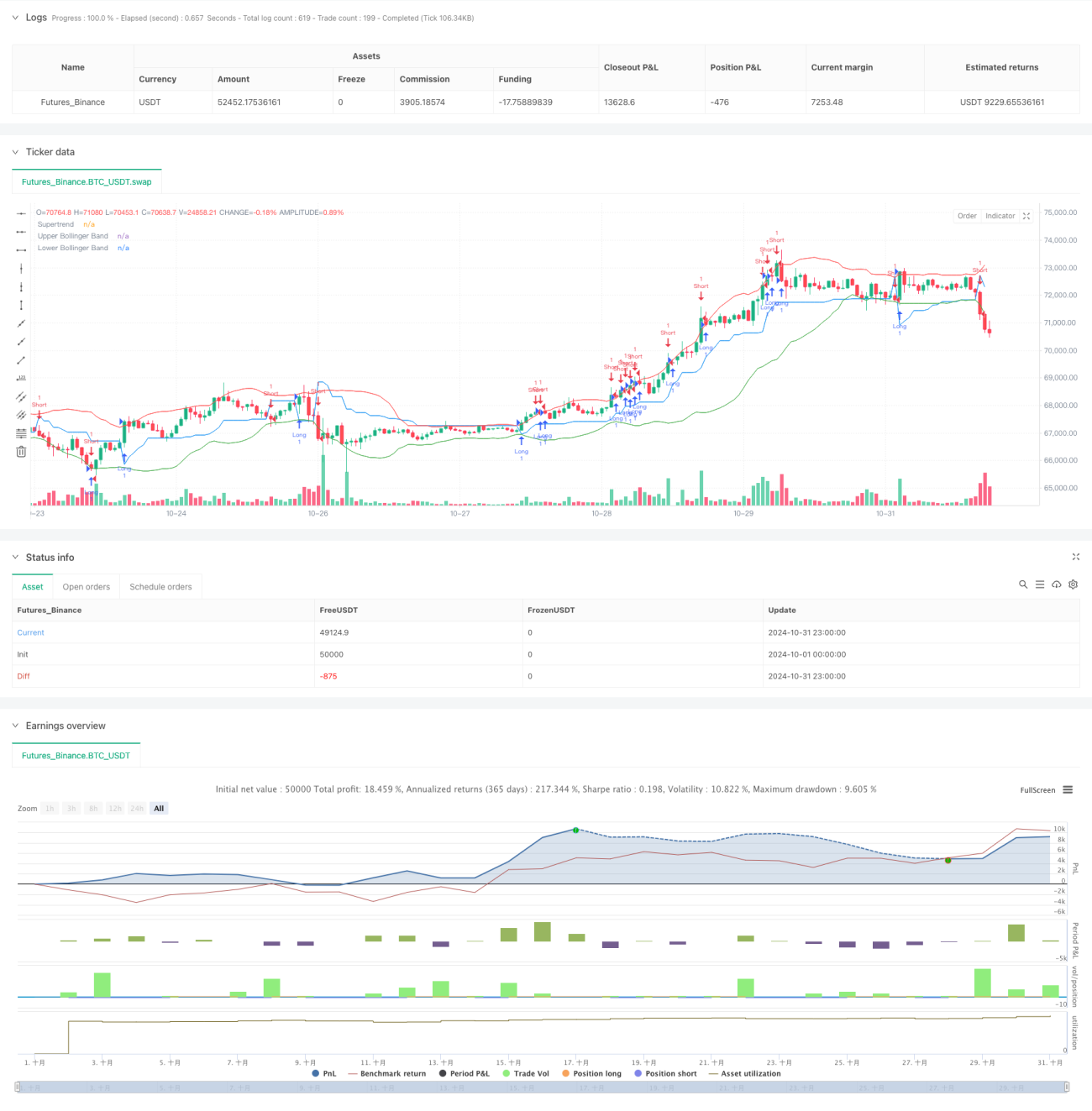
This strategy is an adaptive trading system that combines AI optimization with multiple technical indicators. It primarily uses Bollinger Bands, Relative Strength Index (RSI), and Supertrend indicators to generate trading signals, with AI optimization for parameter adjustment. The system includes an ATR-based adaptive stop-loss mechanism, allowing the strategy to automatically adjust risk management parameters based on market volatility.
Strategy Principles
The strategy employs a multi-layer filtering mechanism to determine trading signals. First, Bollinger Bands are used to identify market volatility ranges, generating long signals when price breaks below the lower band and RSI is in oversold territory. Conversely, short signals are considered when price breaks above the upper band and RSI is in overbought territory. The Supertrend indicator serves as a trend confirmation tool, executing trades only when the price-to-Supertrend relationship aligns with the trading direction. The AI module optimizes various parameters to enhance strategy adaptability. Both stop-loss and profit targets are dynamically calculated based on ATR, ensuring risk management measures adapt to changes in market volatility.
Strategy Advantages
- Multiple technical indicators reduce the impact of false signals
- AI optimization module enhances strategy adaptability and stability
- ATR-based dynamic stop-loss mechanism effectively controls risk
- Strategy parameters can be flexibly adjusted based on actual needs
- Comprehensive risk management system including stop-loss and take-profit settings
- Good visualization effects for monitoring and analysis
Strategy Risks
- Over-optimization of parameters may lead to overfitting
- Multiple indicators may generate conflicting signals during extreme volatility
- AI module requires sufficient historical data for training
- High-frequency trading may incur significant transaction costs
- Stop-losses may experience slippage during rapid market changes
- High system complexity requires regular maintenance and adjustment
Optimization Directions
- Introduce more market sentiment indicators to improve signal accuracy
- Optimize AI module training methods and parameter selection
- Add volume analysis to support decision-making
- Implement additional risk control measures
- Develop adaptive parameter adjustment mechanisms
- Optimize computational efficiency to reduce resource consumption
Summary
This is a comprehensive trading strategy that combines traditional technical analysis with modern artificial intelligence technology. Through the coordinated use of multiple technical indicators, the strategy can effectively identify market opportunities, while the AI optimization module provides strong adaptability. The dynamic stop-loss mechanism provides excellent risk control capabilities. Although there are still aspects that need optimization, the overall design approach is rational, offering good practical value and development potential.
- 1

