
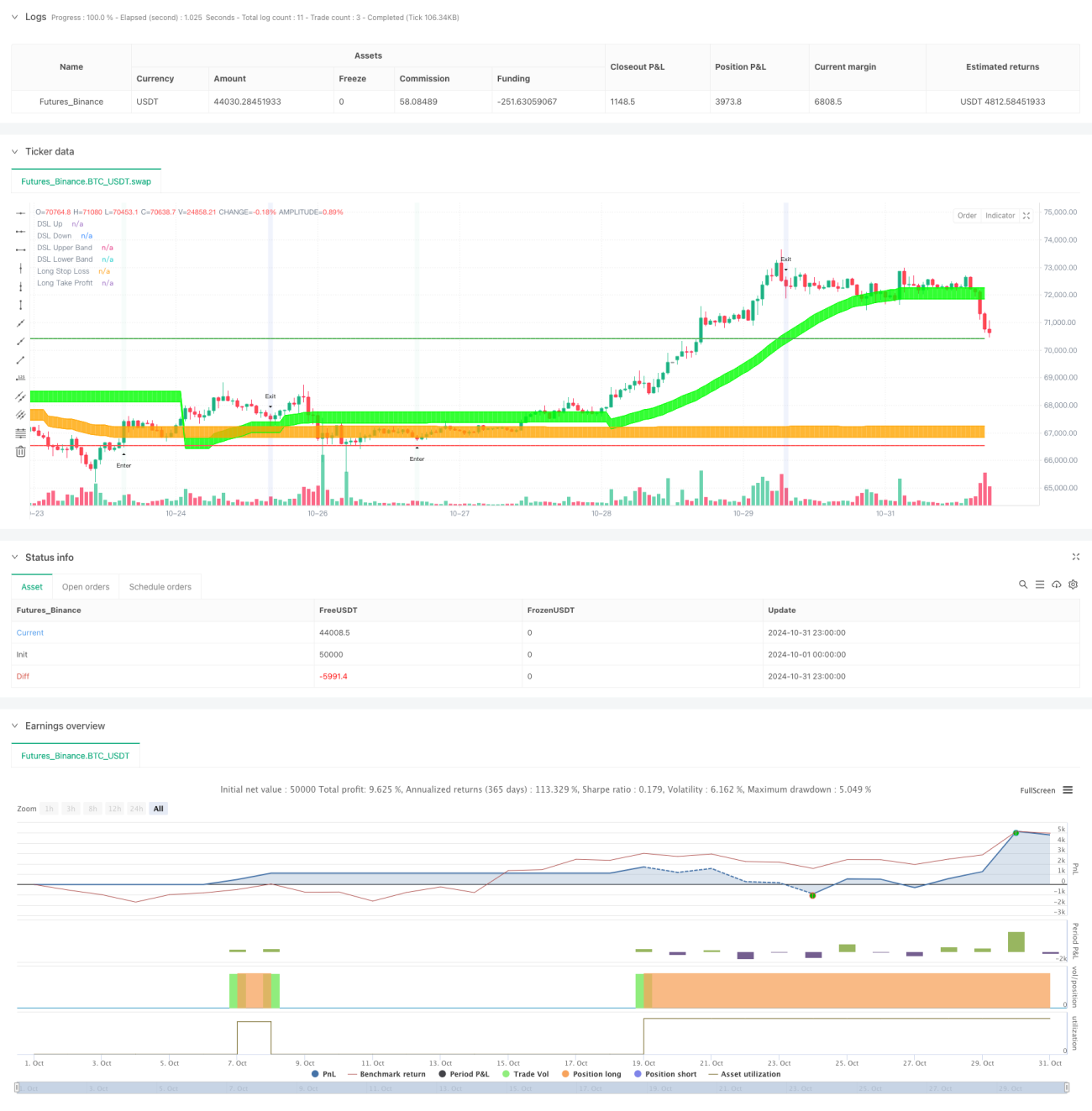
Overview
This strategy is a comprehensive trading system that combines Dynamic Signal Lines (DSL), volatility, and momentum indicators. It effectively identifies market trends through dynamic thresholds and adaptive volatility bands, while using momentum indicators for signal filtering to achieve precise trade timing. The system incorporates a complete risk management mechanism, including dynamic stop-loss and profit targets based on risk-reward ratios.
Strategy Principles
The core logic is built on three main components:
First, the Dynamic Signal Line system calculates dynamic upper and lower channel lines based on moving averages. These channel lines automatically adjust their position based on recent market highs and lows, achieving adaptive trend tracking. The system also incorporates ATR-based dynamic volatility bands to confirm trend strength and set stop-loss positions.
Second, the momentum analysis system uses an RSI indicator optimized with Zero-Lag Exponential Moving Average (ZLEMA). By applying the dynamic signal line concept to RSI, the system can more accurately identify overbought and oversold regions and generate momentum breakthrough signals.
Third, the signal integration mechanism. Trade signals must simultaneously satisfy both trend confirmation and momentum breakthrough conditions to trigger. Long entry requires price breakthrough above the upper band and maintenance above the channel, while RSI breaks through the lower dynamic signal line. Short signals require the opposite conditions to be met simultaneously.
Strategy Advantages
- Strong Adaptability: Dynamic signal lines and volatility bands automatically adjust to market conditions, enabling the strategy to adapt to different market environments.
- False Signal Filtering: By requiring dual confirmation of trend and momentum, significantly reduces the probability of false signals.
- Comprehensive Risk Management: Integrates ATR-based dynamic stop-loss and profit targets based on risk-reward ratios, achieving systematic risk control.
- Flexible Customization: Strategy parameters can be optimized for different markets and time periods.
Strategy Risks
- Trend Reversal Risk: During severe market reversals, dynamic signal line adjustments may not be timely enough, leading to larger drawdowns.
- Range-Bound Market Risk: In range-bound markets, frequent breakouts may result in multiple stop-losses.
- Parameter Sensitivity: Strategy performance is sensitive to parameter settings, improper parameters may affect strategy effectiveness.
Strategy Optimization Directions
- Market Environment Recognition: Add market environment classification mechanism to use different parameter settings in different market states.
- Dynamic Parameter Optimization: Introduce adaptive parameter adjustment mechanism to automatically optimize signal line and volatility band parameters based on market volatility.
- Multiple Timeframe Analysis: Integrate signals from multiple timeframes to improve trading decision reliability.
- Volatility Adaptation: Adjust stop-loss ranges and risk-reward ratios during high volatility periods to improve risk-adjusted returns.
Conclusion
This strategy achieves effective market trend capture through innovative combination of dynamic signal lines and momentum indicators. The comprehensive risk management mechanism and signal filtering system give it strong practical application value. Through continuous optimization and parameter adjustment, the strategy can maintain stable performance in different market environments. While certain risk points exist, they are controllable through reasonable parameter settings and risk control measures.
- 1