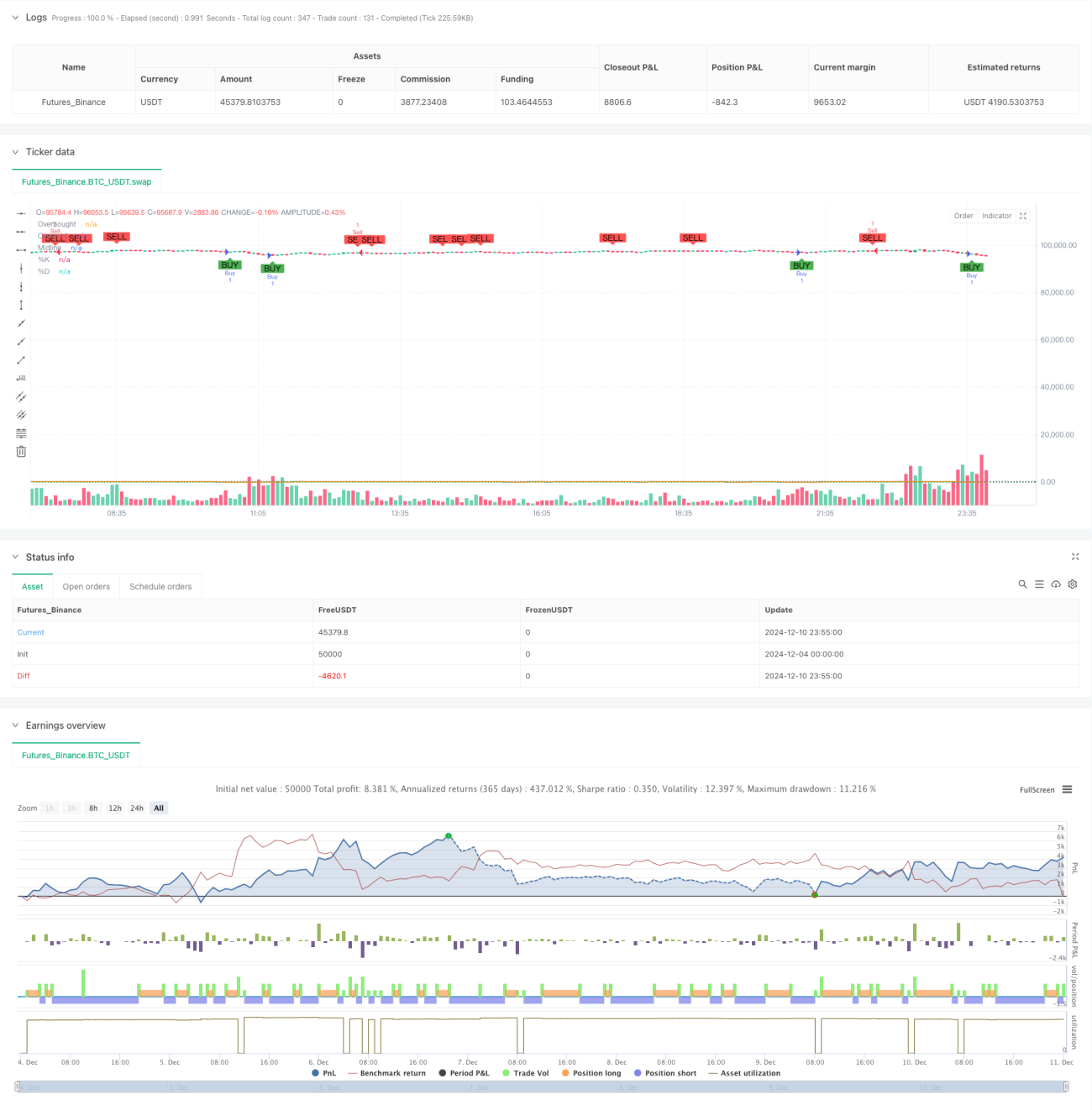
Dual Timeframe Stochastic Momentum Trading Strategy
Overview
This strategy is a dual timeframe momentum trading system based on the Stochastic indicator. It identifies potential trading opportunities by analyzing Stochastic crossover signals across different timeframes, combining momentum principles and trend-following methods for more accurate market trend judgment and trade timing. The strategy also incorporates risk management mechanisms, including take-profit and stop-loss settings, for better money management.
Strategy Principles
The core logic is based on the following key elements:
- Uses Stochastic indicators on two timeframes: longer timeframe for overall trend confirmation, shorter timeframe for specific trade signal generation.
- Trade signal generation rules:
- Long signals: when short-period %K crosses above %D from oversold area (below 20), while longer timeframe shows uptrend.
- Short signals: when short-period %K crosses below %D from overbought area (above 80), while longer timeframe shows downtrend.
- Sets 14 periods as the base period for Stochastic indicator, 3 periods as smoothing factor.
- Integrates candlestick pattern confirmation mechanism to enhance signal reliability.
Strategy Advantages
- Multiple confirmation mechanism: provides more reliable signals through dual timeframe analysis.
- Trend following capability: effectively captures market trend turning points.
- High flexibility: parameters can be adjusted for different market conditions.
- Comprehensive risk control: integrated take-profit and stop-loss mechanisms.
- Clear signals: trading signals are explicit and easy to execute.
- Strong adaptability: applicable to multiple timeframe combinations.
Strategy Risks
- False breakout risk: may generate false signals in ranging markets.
- Lag risk: signals may have some delay due to moving average smoothing factors.
- Parameter sensitivity: different parameter settings significantly affect strategy performance.
- Market environment dependency: performs better in trending markets but may underperform in ranging markets.
Strategy Optimization Directions
- Introduce volatility indicators: add ATR indicator for dynamic stop-loss adjustment.
- Optimize signal filtering: add volume confirmation mechanism.
- Add trend strength filtering: incorporate trend strength indicators like ADX.
- Improve risk management: implement dynamic position sizing mechanism.
- Optimize parameter adaptation: dynamically adjust parameters based on market conditions.
Summary
This is a well-structured trading strategy with clear logic, capturing market opportunities through dual timeframe Stochastic indicator analysis. The strategy's strengths lie in its multiple confirmation mechanisms and comprehensive risk control, but attention must be paid to risks such as false breakouts and parameter sensitivity. Through continuous optimization and improvement, the strategy has the potential to achieve better trading results.
- 1

