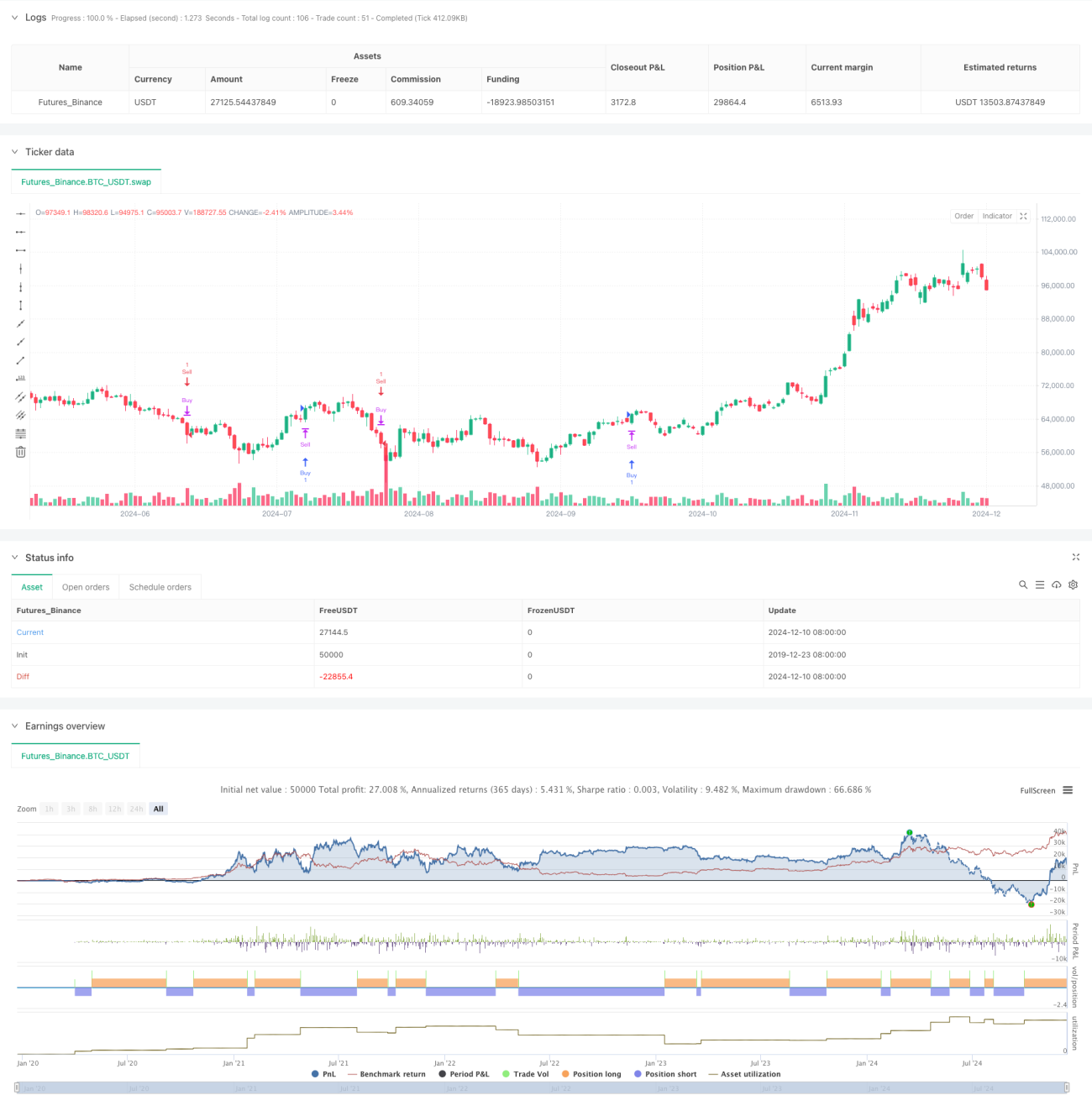
Dynamic Volatility Index (VIDYA) with ATR Trend-Following Reversal Strategy
Overview
This strategy is a trend-following trading system based on the Variable Index Dynamic Average (VIDYA), combined with ATR bands to enhance trend identification and risk management capabilities. The strategy dynamically adjusts its response to market volatility while maintaining trend-following capabilities and capturing market reversal signals. The system uses VIDYA as its core indicator and ATR bands for dynamic stop-loss placement.
Strategy Principles
The core principle lies in utilizing VIDYA's dynamic characteristics for trend identification. VIDYA adjusts moving average weights through momentum calculations, providing different sensitivities in various market conditions:
- Uses Chande Momentum Oscillator (CMO) for price momentum calculation
- Calculates adaptive factor alpha based on momentum
- Constructs dynamic volatility bands using ATR
- Generates long signals on upper band breakout and short signals on lower band breakout
- Employs position reversal logic - new signals close existing positions and open new ones
Strategy Advantages
- Strong Dynamic Adaptation: VIDYA automatically adjusts parameters based on market volatility
- Comprehensive Risk Control: Uses ATR dynamic bands for stop-loss adaptation
- Clear Signals: Employs trend reversal logic with distinct trading signals
- Excellent Visualization: Distinguishes upward and downward trends through color coding
- Flexible Parameters: Key parameters can be optimized for different market characteristics
Strategy Risks
- Choppy Market Risk: Prone to false signals in ranging markets
- Slippage Impact: Dual-direction trades on each signal increase slippage exposure
- Money Management Risk: Fixed position sizing may lead to significant losses in volatile markets
- Parameter Sensitivity: Strategy performance heavily depends on VIDYA and ATR parameters
- Market Environment Dependency: Performs well in trending markets but may struggle in others
Optimization Directions
- Add Trend Filters: Implement long-term trend assessment to filter signals in ranging markets
- Improve Position Management: Introduce dynamic position sizing based on market volatility
- Enhance Entry Logic: Add technical indicator confirmation for improved signal reliability
- Refine Stop-Loss Mechanism: Consider trailing stops or volatility-based dynamic stops
- Include Time Filters: Adjust strategy parameters based on different time period characteristics
Summary
This strategy achieves dynamic trend tracking and risk control by combining VIDYA and ATR. Its core strength lies in adapting to market volatility while maintaining trend-following capabilities and capturing reversal opportunities. Though it may face risks in certain market conditions, the strategy maintains practical value through proper parameter optimization and risk management measures. Investors should focus on risk control, appropriate parameter settings, and timely strategy adjustments based on market conditions in live trading.
- 1

