
Overview
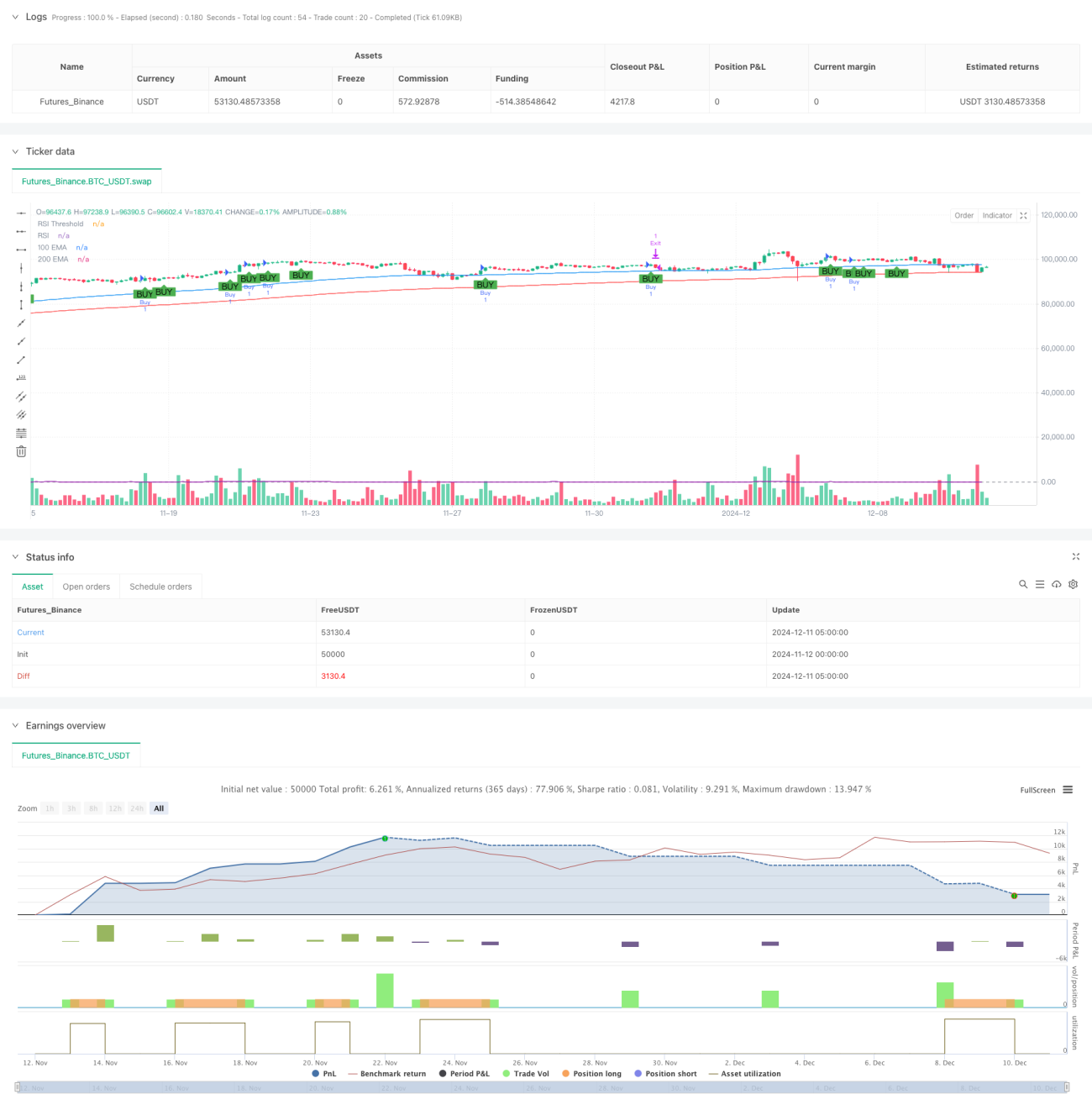
This strategy is a trend-following system based on technical analysis, combining moving averages, RSI momentum indicator, and ATR volatility indicator to validate trading opportunities through multiple signal confirmations. The strategy uses multi-period moving average crossovers to determine market trends, combines RSI momentum to confirm price strength, and finally uses ATR to dynamically set stop-loss and take-profit levels, forming a complete trading system.
Strategy Principles
The core logic of the strategy includes three key components:
- Trend Determination: Uses 100-period and 200-period Exponential Moving Average (EMA) crossovers to confirm market trend direction. When the short-term EMA is above the long-term EMA, it indicates an upward market trend.
- Entry Signals: Based on trend confirmation, the strategy looks for bullish engulfing patterns as specific entry points and uses the RSI indicator for signal filtering. When the RSI value is above 50, it indicates sufficient upward momentum in the market.
- Position Management: Uses 14-period ATR to measure market volatility and dynamically sets stop-loss and profit levels accordingly. Stop-loss is set at 1.1 times ATR, and profit target at 2.0 times ATR, ensuring a risk-reward ratio greater than 1.
Strategy Advantages
- Multiple Signal Validation: Combining trend, price patterns, and momentum indicators significantly reduces the impact of false signals.
- Dynamic Risk Management: ATR-based stop-loss and profit settings can adaptively adjust according to market volatility, avoiding limitations of fixed levels.
- Trend Following Characteristics: Using moving average systems to judge trends effectively avoids unnecessary trades in sideways or downward markets.
- Complete Trading Framework: Includes a complete strategy system covering entry, exit, and position management.
Strategy Risks
- Trend Delay: EMA as a lagging indicator may lead to delayed entry timing, potentially missing optimal entry points in rapidly volatile markets.
- Sideways Market Risk: Frequent moving average crossovers in sideways markets may lead to overtrading.
- False Breakout Risk: Bullish engulfing patterns may produce false breakouts, requiring strict risk control management.
- Stop-Loss Setting Risk: Too small ATR multipliers may lead to frequent stop-losses, while too large multipliers may bear excessive risk.
Strategy Optimization Directions
- Introduce Volume Indicators: Can improve signal reliability by adding volume confirmation.
- Optimize Moving Average Periods: Can adjust moving average periods according to different market characteristics to better adapt to market rhythm.
- Improve Stop-Loss Mechanism: Consider adding trailing stops to protect profits during trend continuation.
- Add Market Environment Filtering: Introduce volatility range judgment to reduce trading frequency in excessively volatile market environments.
- Optimize RSI Parameters: Can seek optimal RSI thresholds and calculation periods through historical data backtesting.
Summary
This strategy constructs a logically complete trend-following system by integrating multiple technical indicators. The strategy's advantages lie in multiple signal validation and dynamic risk management, but attention must also be paid to handling trend delays and false breakouts. Through adding volume confirmation and optimizing parameter settings, the strategy still has significant room for improvement. Overall, this strategy is suitable for operating in clearly trending markets and has good application value for tracking medium to long-term trends.
- 1