Overview
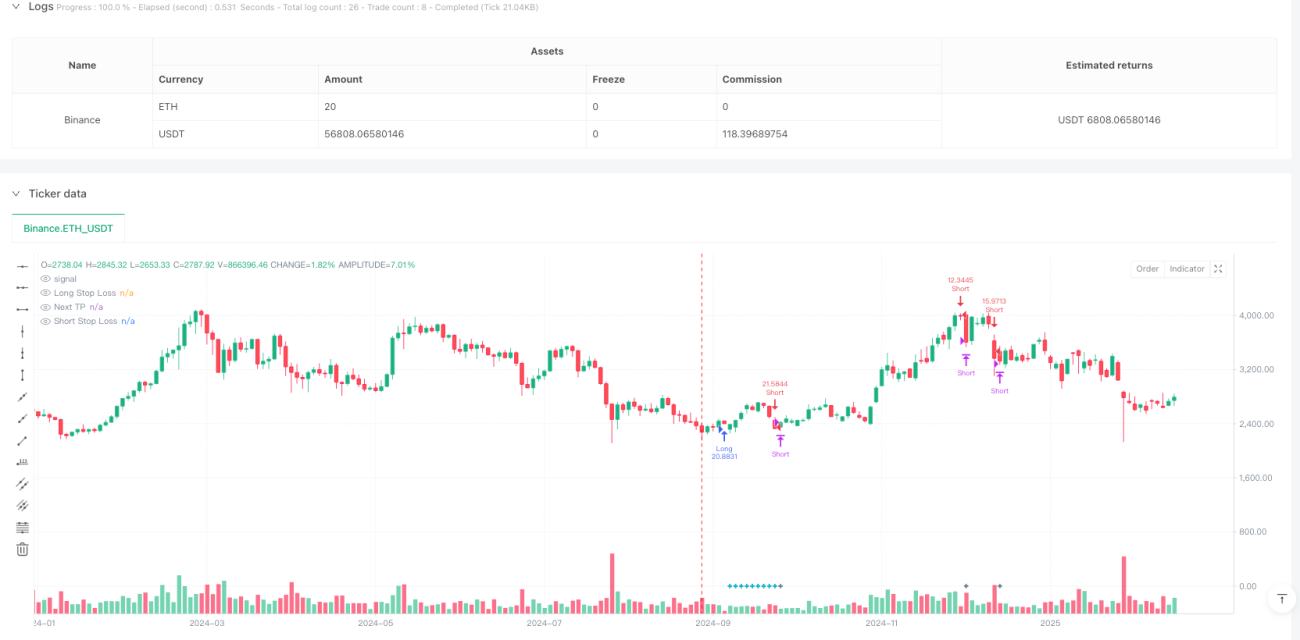
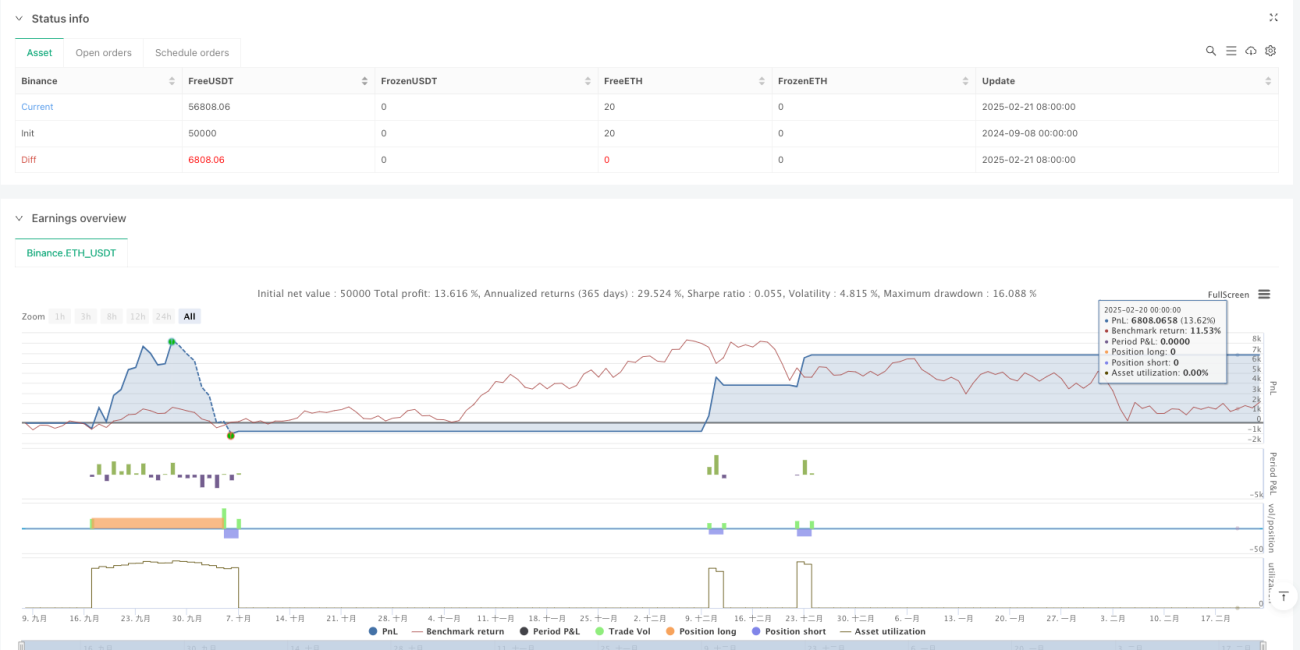
The Multi-Indicator Weighted Smart Trading Strategy is a comprehensive quantitative trading system that generates trading decisions by integrating signals from multiple technical indicators with different assigned weights. This strategy combines various technical analysis tools including MACD, Stochastic RSI, EMA, Supertrend, and moving average crossovers to form a comprehensive trading framework. The system not only supports multi-level take-profit and dynamic stop-loss mechanisms but also automatically adjusts trading parameters based on market conditions, maintaining high adaptability across different market environments. This strategy is particularly suitable for medium to long-term traders, using a weight allocation system to make trading decisions more robust and reliable.
Strategy Principle
The core of this strategy lies in its weighted signal system, which generates trading signals through five different sub-strategies:
-
MACD Strategy: Utilizes the crossover between the MACD line and the signal line to determine market trend direction. When the MACD line crosses above the signal line, it generates a buy signal; when it crosses below, it generates a sell signal.
-
Stochastic RSI Strategy: Combines the advantages of RSI and stochastic indicators to monitor market overbought and oversold conditions. Buy signals are generated when the Stochastic RSI falls below the set oversold threshold, and sell signals when it rises above the overbought threshold.
-
EMA Overbought/Oversold Strategy: Uses EMA to identify the degree of price deviation from the mean. Buy signals occur when RSI falls below the set oversold threshold, and sell signals when it rises above the overbought threshold.
-
Supertrend Strategy: Sets up a price channel based on ATR multiples and determines trading direction through trend changes. Buy signals are generated when the Supertrend indicator changes from negative to positive, and sell signals when it changes from positive to negative.
-
Moving Average Crossover Strategy: Uses the crossover of two moving averages with different periods to determine market trends. Buy signals occur when the short-term moving average crosses above the long-term moving average, and sell signals when it crosses below.
The strategy calculates weighted sums of signals from each sub-strategy using a customizable weight system, triggering trades only when the weighted sum exceeds a set threshold. Additionally, the strategy includes a potential top/bottom identification mechanism that adjusts positions when the market may reverse.
This multi-layered signal confirmation mechanism effectively reduces false signals, improving the reliability of the trading system, while flexible parameter settings allow the strategy to adapt to different trading instruments and time periods.
Strategy Advantages
-
Multiple Signal Confirmation: By calculating weighted signals generated from five independent technical indicators, the strategy reduces the potential misleading effects of single indicators, improving the quality and reliability of trading signals.
-
Adaptive Weight System: Each sub-strategy can be assigned different weights, allowing traders to adjust the strategy's focus based on their confidence in different indicators and historical performance, enhancing the strategy's flexibility.
-
Comprehensive Risk Management: The strategy incorporates multi-layered risk control mechanisms, including stop-loss, multi-level take-profit, and dynamic stop-loss adjustment functions, ensuring rapid risk control during adverse market movements.
-
Automated Potential Top/Bottom Identification: Through comprehensive analysis of RSI, trading volume, and price trends, the strategy can identify potential market tops and bottoms, partially closing positions at appropriate times to lock in profits or reduce losses.
-
High Customizability: Almost all parameters can be adjusted, including indicator calculation periods, weight values, take-profit and stop-loss percentages, allowing traders to optimize the strategy according to personal style and different market conditions.
-
Built-in Delay Mechanism: To avoid entering trades too early or based on noise signals, the strategy employs a delay confirmation mechanism, ensuring that only persistent signals trigger trades, reducing the impact of short-term fluctuations.
-
Time Filtering Function: The strategy allows setting start and end dates for trading, enabling traders to backtest performance for specific time periods based on historical data or avoid known periods of abnormal market volatility.
Strategy Risks
-
Parameter Over-Optimization Risk: With numerous parameters, there is a risk of overfitting historical data, potentially leading to poor performance in live trading. The solution is to backtest across multiple time periods and instruments, adopt relatively robust parameter settings, and avoid excessive optimization for specific historical data.
-
Market Condition Change Risk: The strategy's performance may vary between trending and ranging markets, and sudden changes in market state can lead to decreased effectiveness. The solution is to introduce a market environment recognition mechanism that adjusts parameters or pauses trading under different market conditions.
-
Signal Conflict Risk: Using multiple indicators simultaneously may produce contradictory signals, leading to confused decision-making. The solution is to set reasonable weights for each indicator, emphasize more reliable indicators, and ensure appropriate signal threshold settings to reduce conflict probability.
-
Improper Fund Management Risk: Despite the strategy's stop-loss mechanisms, unreasonable fund management can still lead to rapid depletion of capital. The solution is to strictly control the proportion of funds for each trade, ensuring that the maximum risk per trade is within an acceptable range.
-
Technical Failure Risk: Automated trading systems may face technical issues such as network interruptions and data delays. The solution is to set up manual intervention mechanisms, regularly monitor system operation status, and promptly address abnormal situations.
Strategy Optimization Directions
-
Incorporate Market Environment Filter: Develop an indicator that can identify whether the current market is trending or ranging, dynamically adjusting the weights of each sub-strategy based on market state, strengthening trend-following strategies in trending markets and oscillating strategies in ranging markets.
-
Introduce Machine Learning Optimization: Utilize machine learning techniques to automatically adjust parameters and weights of various indicators, enabling the strategy to continuously learn and adapt based on the latest market data, improving its dynamic adaptation capability.
-
Add Volume Analysis: Use volume changes as additional confirmation signals, executing trades only when supported by expected volume, increasing the credibility of signals.
-
Optimize Potential Top/Bottom Identification Algorithm: Improve the existing top/bottom identification logic by adding more confirmation factors, such as price patterns and multi-period confirmation, enhancing identification accuracy.
-
Add Sentiment Indicators: Integrate market sentiment indicators, such as the VIX (fear index) and the call-put ratio, to adjust trading strategies or pause trading during extreme market sentiment, avoiding excessive trading during high volatility periods.
-
Develop Dynamic Take-Profit and Stop-Loss Mechanisms: Automatically adjust take-profit and stop-loss levels based on market volatility, widening stop-loss ranges in high-volatility markets and tightening them in low-volatility markets, making risk management more flexible and effective.
-
Time Period Optimization: Add multi-timeframe analysis functionality, requiring signal confirmation from both higher and lower timeframes simultaneously, reducing false breakouts and false signals.
Summary
The Multi-Indicator Weighted Smart Trading Strategy constructs a comprehensive and flexible trading system by integrating various technical analysis tools with different weights. This strategy not only features multiple signal confirmation, an adaptive weight system, and comprehensive risk management functions but also includes an automated potential top/bottom identification mechanism, demonstrating strong adaptability in complex and changing market environments.
Although there are potential risks such as parameter over-optimization, market condition changes, and signal conflicts, these risks can be effectively controlled through reasonable parameter settings, market environment recognition, and strict fund management. Future optimization directions include incorporating market environment filters, introducing machine learning techniques, enhancing volume analysis, and optimizing potential top/bottom identification algorithms. These improvements will further enhance the strategy's stability and profitability.
For investors seeking systematic trading methods, this multi-indicator weighted smart trading strategy provides a framework worth considering. It not only reduces the impact of emotional factors on trading decisions but also continuously optimizes trading performance through a data-driven approach. When implementing this strategy, it is recommended to start with conservative parameter settings, gradually adjust and closely monitor strategy performance to find the configuration that best suits personal risk preferences and market conditions.
/*backtest
start: 2024-09-08 00:00:00
end: 2025-02-23 08:00:00
period: 2d
basePeriod: 2d
exchanges: [{"eid":"Binance","currency":"ETH_USDT"}]
*/
// **********************************************************************************************************************************************************************************************************************************************************************
// Last update: 08/03/2022
// *************************************************************************************************************************************************************************************************************************************************************************
//@version=5- 1

