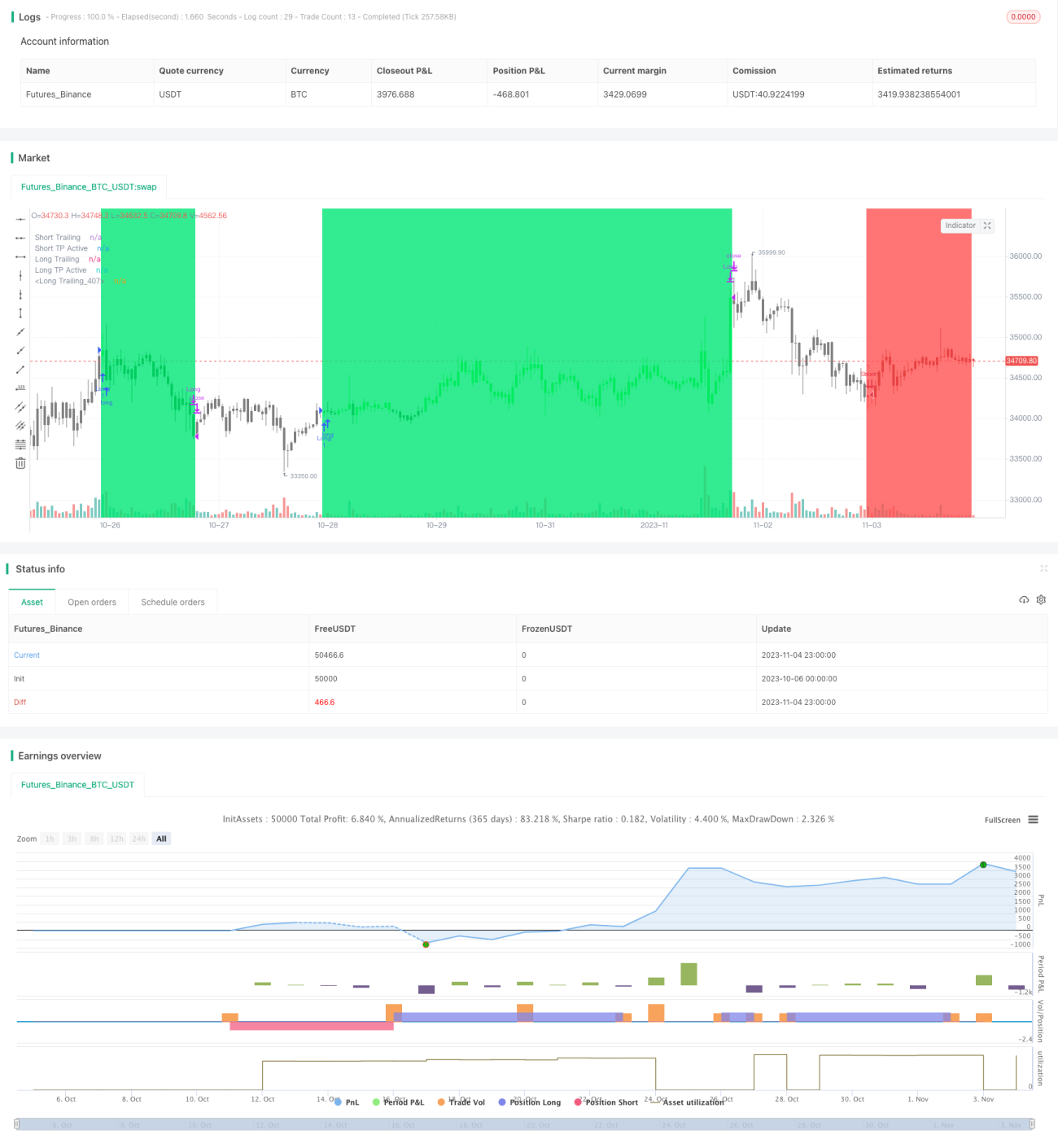
Strategie des Volumenhandels mit mehreren MAs


Erstellungsdatum: 2023-11-06 16:04:46 zuletzt geändert: 2023-11-06 16:04:46
Kopie: 0 Klicks: 697
1
konzentrieren Sie sich auf
1617
Anhänger

Strategie des Volumenhandels mit mehreren MAs

Überblick

Diese Handelsstrategie verwendet eine Kombination aus mehreren Moving Averages und Dynamic Indicators, um die Richtung und Stärke eines Trends zu identifizieren, Positionen zu erstellen, wenn ein Trend beginnt, und dann die Gewinnoptimierung und Risikokontrolle mit Hilfe von Moving Stop Losses, Moving Stops usw. durchzuführen. Das Ziel ist es, erhebliche Preisbewegungen in mittleren und langen Trends zu erfassen.

Strategieprinzip

  1. Fast- und Slow-Lines werden mit einer Kombination von Moving Averages mit zwei unterschiedlichen Parameter-Sätzen erstellt:

    • Die Schnelllinien bestehen aus einem 5-Perioden-Indikator-Moving-Average und einem 25-Perioden-Wert-Moving-Average und stellen kurzfristige Trends dar.
    • Die langsame Linie besteht aus einem 28-periodischen Index-Moving-Average und einem 72-periodischen gewichteten Moving-Average und repräsentiert die mittleren und langen Trends
  2. Wenn die kurze Linie die langsame Linie durchbricht, zeigt dies an, dass der kurzfristige Trend stärker wird als der mittlere und langfristige Trend, was als Einstiegssignal gilt.

  3. In Kombination mit dem Dynamik-Indikator RSI wird nur bei einem niedrigen RSI (Buy-Signal) oder einem hohen RSI (Sell-Signal) eingegeben, um falsche Durchbrüche zu filtern.

  4. Nach dem Eintritt wird der Verlust mit einem mobilen Stop verringert und der Gewinn mit einem mobilen Stop gesperrt.

  5. Wenn die schnelle Linie unter der langsamen Linie durchbricht, wird die Trendwende angezeigt, und dann wird der Stopp oder der Stopp ausgegeben.

Analyse der Stärken

  1. Der Doppel-Moving-Average kombiniert das Filtern von Geräuschen, um die Richtung und Stärke der mittleren Trendsegmente zu erkennen.
  2. Nur in der Anfangsphase des Trends Positionen aufbauen, um unnötige Verluste durch falsche Durchbrüche zu vermeiden.
  3. Die Dynamik-Indikatoren werden in Verbindung mit den Filtern der Entries verwendet, um die Qualität der Entries zu verbessern.
  4. Mobile Stop-Losses komprimieren Einzelschäden und reduzieren die Verluste, die durch einzelne Verluste entstehen.
  5. Die mobile Stop-Loss-Lösung ermöglicht einen beträchtlichen Gewinn, der in guten Zeiten erhöht wird.

Risikoanalyse

  1. Der Doppel-Moving-Average kann an Trendwendepunkten zurückbleiben und die Chance auf eine Umkehr verpassen.
    • Der Moving-Average-Prozess kann entsprechend verkürzt werden, um ihn empfindlicher zu machen.
  2. Ein falscher Einbruch führt zu einer unnötigen Einreise.
    • Weitere Filterindikatoren können hinzugefügt werden.
  3. Die Stopp- oder Bremsdistanz ist nicht optimiert und kann zu locker oder zu eng sein.
    • Die optimale Stop-Loss-Distanz kann durch Rückmessung der Optimierungsparameter gefunden werden.
  4. Die Strategie ist richtungsorientiert und nur für Trendmärkte geeignet.
    • Die Auswahl der Strategie hängt von der Lage der großen Wetten ab.

Optimierungsrichtung

  1. Optimieren Sie die Moving Average-Parameter, um die beste Kombination von Parametern für die Repräsentation von Trends zu finden.
  2. Hinzufügen von Trendfilterindikatoren wie ATR-Dynamikstopp, Energiemodusindikatoren usw.
  3. Optimierung der Stop-Loss-Stopp-Parameter, um die optimale Kombination zu finden.
  4. Die Strategie wurde von der Regierung der Vereinigten Staaten von Amerika und der US-Regierung der Vereinigten Staaten von Amerika unterstützt.
  5. Erhöhung der Gesamtbeurteilung für mehrere Zeiträume und Verwendung von Trends auf einer größeren Ebene zur Orientierung von kurzfristigen Strategien.

Zusammenfassen

Die Strategie integriert Moving Averages und Dynamic Indicators mit dem Ziel, frühe Eingänge während aufkommender Trends zu identifizieren und Risiken und Gewinne durch rechtzeitige Stopps und Stopps zu verwalten. Obwohl die Parameter und Regeln noch optimiert werden müssen, um sich an die breiteren Marktbedingungen anzupassen, verfügt die Strategie über einen grundlegenden Rahmen und eine Richtung, um mittlere und lange Trends zu erfassen.

Strategiequellcode
/*backtest
start: 2023-10-06 00:00:00
end: 2023-11-05 00:00:00
period: 1h
basePeriod: 15m
exchanges: [{"eid":"Futures_Binance","currency":"BTC_USDT"}]
*/

//@version=3
strategy(title="[WAI GUA]", shorttitle="[EOS] 1.0", overlay=true)

//study(title="[WAI GUA]", shorttitle="[EOS] 1.0", overlay=true)


//
// Use Alternate Anchor TF for MAs 
uRenko    = input(true, title="IS This a RENKO Chart")
//
anchor     = input(0,minval=0,maxval=1440,title="Alternate TimeFrame Multiplier (0=none)")
//
src          = close //input(close, title="EMA Source")
showRibbons  = input(false,title="Show Coloured MA Ribbons")
showAvgs     = input(false,title="Show Ribbon Median MA Lines")

//
// Fast Ribbon MAs
// Lower MA - type, length
typeF1    = input(defval="EMA", title="FAST MA Ribbon Type: ", options=["SMA", "EMA", "WMA", "VWMA", "SMMA", "DEMA", "TEMA", "LAGMA", "HullMA", "ZEMA", "TMA", "SSMA"])
lenF1     = input(defval=5, title="FAST Ribbon Lower MA Length", minval=1)
gammaF1   = 0.33 //input(defval=0.33,title="Fast MA - Gamma for LAGMA")

// Upper MA - type, length
typeF11   = typeF1 //input(defval="WMA", title="FAST Ribbon Upper MA Type: ", options=["SMA", "EMA", "WMA", "VWMA", "SMMA", "DEMA", "TEMA", "LAGMA", "HullMA", "ZEMA", "TMA", "SSMA"])
lenF11    = input(defval=25, title="FAST Ribbon Upper Length", minval=2)
gammaF11  = 0.77 //input(defval=0.77,title="Slow MA - Gamma for LAGMA")

// Slow Ribbon MAs
// Lower MA - type, length
typeS1   = input(defval="EMA", title="SLOW MA Ribbon Type: ", options=["SMA", "EMA", "WMA", "VWMA", "SMMA", "DEMA", "TEMA", "LAGMA", "HullMA", "ZEMA", "TMA", "SSMA"])
lenS1    = input(defval=28, title="SLOW Ribbon Lower MA Length", minval=1)
gammaS1  = 0.33 //input(defval=0.33,title="Fast MA - Gamma for LAGMA")

// Upper MA - type, length
typeS16   = typeS1 //input(defval="WMA", title="SLOW Ribbon Upper MA Type: ", options=["SMA", "EMA", "WMA", "VWMA", "SMMA", "DEMA", "TEMA", "LAGMA", "HullMA", "ZEMA", "TMA", "SSMA"])
lenS16    = input(defval=72, title="SLOW Ribbon Upper Length", minval=2)
gammaS16  = 0.77 //input(defval=0.77,title="Slow MA - Gamma for LAGMA")

// - Constants
gold = #FFD700

// - FUNCTIONS
// - variant(type, src, len, gamma)
// 返回MA输入选择变量,默认为SMA,如果空白或键入。

// SuperSmoother filter
variant_supersmoother(src,len) =>
    a1 = exp(-1.414*3.14159 / len)
    b1 = 2*a1*cos(1.414*3.14159 / len)
    c2 = b1
    c3 = (-a1)*a1
    c1 = 1 - c2 - c3
    v9 = 0.0
    v9 := c1*(src + nz(src[1])) / 2 + c2*nz(v9[1]) + c3*nz(v9[2])
    v9
    
variant_smoothed(src,len) =>
    v5 = 0.0
    v5 := na(v5[1]) ? sma(src, len) : (v5[1] * (len - 1) + src) / len
    v5

variant_zerolagema(src,len) =>
    ema1 = ema(src, len)
    ema2 = ema(ema1, len)
    v10 = ema1+(ema1-ema2)
    v10
    
variant_doubleema(src,len) =>
    v2 = ema(src, len)
    v6 = 2 * v2 - ema(v2, len)
    v6

variant_tripleema(src,len) =>
    v2 = ema(src, len)
    v7 = 3 * (v2 - ema(v2, len)) + ema(ema(v2, len), len)               // Triple Exponential
    v7
    
//calc Laguerre
variant_lag(p,g) =>
    L0 = 0.0
    L1 = 0.0
    L2 = 0.0
    L3 = 0.0
    L0 := (1 - g)*p+g*nz(L0[1])
    L1 := -g*L0+nz(L0[1])+g*nz(L1[1])
    L2 := -g*L1+nz(L1[1])+g*nz(L2[1])
    L3 := -g*L2+nz(L2[1])+g*nz(L3[1])
    f = (L0 + 2*L1 + 2*L2 + L3)/6
    f

// return variant, defaults to SMA 
variant(type, src, len, g) =>
    type=="EMA"     ? ema(src,len) : 
      type=="WMA"   ? wma(src,len): 
      type=="VWMA"  ? vwma(src,len) : 
      type=="SMMA"  ? variant_smoothed(src,len) : 
      type=="DEMA"  ? variant_doubleema(src,len): 
      type=="TEMA"  ? variant_tripleema(src,len): 
      type=="LAGMA" ? variant_lag(src,g) :
      type=="HullMA"? wma(2 * wma(src, len / 2) - wma(src, len), round(sqrt(len))) :
      type=="SSMA"  ? variant_supersmoother(src,len) : 
      type=="ZEMA"  ? variant_zerolagema(src,len) : 
      type=="TMA"   ? sma(sma(src,len),len) : 
                      sma(src,len)

// - /variant 

// If have anchor specified, calculate the base multiplier.
//mult  = isintraday ? anchor==0 or interval<=0 or interval>=anchor or anchor>1440? 1 : round(anchor/interval) : 1
//mult := isdwm?  1 : mult  // Only available Daily or less
mult = anchor>0 ? anchor : 1 

//
high_  = uRenko? max(close,open) : high
low_   = uRenko? min(close,open) : low


//用锚乘器调整MA长度

//Fast MA Ribbon
emaF1 = variant(typeF1, src, lenF1*mult, gammaF1)
emaF11 = variant(typeF11, src, lenF11*mult,gammaF11)
emafast = (emaF1+emaF11)/2 // Average of Upper and Lower MAs
//
//Slow MA Ribbon
emaS1 = variant(typeS1,src, lenS1*mult,gammaS1)
emaS16 = variant(typeS16, src, lenS16*mult, gammaS16)
emaslow = (emaS1+emaS16)/2 // Average of Upper and Lower MAs
//
// Count crossover candles
xup = 0
xdn = 0
fup = 0
fdn = 0
sup = 0
sdn = 0
// 
xup := (emafast-emaslow)>0 and (emafast-emaslow)>(emafast[1]-emaslow[1]) ? nz(xup[1])+1 : 0
xdn := (emafast-emaslow)<0 and (emafast-emaslow)<(emafast[1]-emaslow[1]) ? nz(xdn[1])+1 : 0
fup := (emaF1-emaF11)>0 and (emaF1-emaF11)>(emaF1[1]-emaF11[1]) ? nz(fup[1])+1 : 0
fdn := (emaF1-emaF11)<0 and (emaF1-emaF11)<(emaF1[1]-emaF11[1]) ? nz(fdn[1])+1 : 0
sup := (emaS1-emaS16)>0 and (emaS1-emaS16)>(emaS1[1]-emaS16[1]) ? nz(sup[1])+1 : 0
sdn := (emaS1-emaS16)<0 and (emaS1-emaS16)<(emaS1[1]-emaS16[1]) ? nz(sdn[1])+1 : 0

//Fast EMA Final Color Rules
colFinal = fup>=2 ? aqua : fdn>=2 ? blue : gray
//Slow EMA Final Color Rules
colFinal2 = sup>=2 ? lime : sdn>=2 ? red : gray

//Fast EMA Plots
p1=plot(showRibbons?emaF1:na, title="Fast Ribbon Lower MA", style=line, linewidth=1, color=colFinal,transp=10)
p2=plot(showRibbons?emaF11:na, title="Fast Ribbon Upper MA", style=line, linewidth=1, color=colFinal,transp=10)
plot(showAvgs?emafast:na, title="Fast Ribbon Avg MA", style=circles,join=true, linewidth=1, color=gold,transp=10)

//
//fill(p1,p2,color=colFinal, transp=90)

//Slow EMA Plots
p3=plot(showRibbons?emaS1:na, title="Slow Ribbon Lower MA", style=line, linewidth=1, color=colFinal2,transp=10)
p4=plot(showRibbons?emaS16:na, title="Slow Ribbon Upper MA", style=line, linewidth=1, color=colFinal2,transp=10)
plot(showAvgs?emaslow:na, title="Slow Ribbon Avg MA", style=circles,join=true, linewidth=1, color=fuchsia,transp=10)
//
//fill(p3,p4, color=colFinal2, transp=90)

// Generate Buy Sell signals, 
buy = 0
sell=0
//
buy  := xup>=2 and sup>=2 and fup>=2 ? nz(buy[1])>0?buy[1]+1  :1 : 0
sell := xdn>=2 and sdn>=2 and fdn>=2 ? nz(sell[1])>0?sell[1]+1 :1 : 0

////////////////////////
//* 反测试周期选择器 *//
////////////////////////

testStartYear = input(2018, "Backtest Start Year",minval=1980)
testStartMonth = input(1, "Backtest Start Month",minval=1,maxval=12)
testStartDay = input(1, "Backtest Start Day",minval=1,maxval=31)
testPeriodStart = timestamp(testStartYear,testStartMonth,testStartDay,0,0)

testStopYear = 9999 //input(9999, "Backtest Stop Year",minval=1980)
testStopMonth = 12 // input(12, "Backtest Stop Month",minval=1,maxval=12)
testStopDay = 31 //input(31, "Backtest Stop Day",minval=1,maxval=31)
testPeriodStop = timestamp(testStopYear,testStopMonth,testStopDay,0,0)

testPeriod() => time >= testPeriodStart and time <= testPeriodStop ? true : false


///////////////
//* RSI策略 *//
///////////////

//指示器 1
lowerpc = lowest(low, 21)
upperpc = highest(high, 21)
midpc = avg(upperpc, lowerpc)

//指示器 2
ma = sma(close, 50)
petd = ema(close,13)
rangema = ema(tr, 50)
upperkc = ma + rangema * 0.25
lowerkc = ma - rangema * 0.25

//指示器 3
up = rma(max(change(close), 0), 5)
down = rma(-min(change(close), 0), 5)
rsi = down == 0 ? 100 : up == 0 ? 0 : 100 - (100 / (1 + up / down))

// PET-D
petdcolor = close > petd ? green : red
barcolor (petdcolor)


//Slope
SlopeL = midpc > midpc[5]
SlopeS = midpc < midpc[5]

//条件
CL = SlopeL == 1 and close > lowerkc and close < midpc and rsi < 35 
CS = SlopeS == 1 and close < upperkc and close > midpc and rsi > 65 

//Setup
RsiSL = CL == 1 and CL[1] != 1
RsiSS = CS == 1 and CS[1] != 1

/////////////////////
//* RSA抛物线指标 *//
/////////////////////
start = input(0.02)
increment = input(0.02)
maximum = input(0.2)

psar = sar(start, increment, maximum)

RSALE = false
RSASE = false
if (psar > high)
    RSALE = true
else
    RSALE = false

if (psar < low)
    RSASE = true
else
    RSASE = false


////////////////
//* 策略组件 *//
////////////////

AQUA = #00FFFFFF
BLUE = #0000FFFF
RED  = #FF0000FF
LIME = #00FF00FF
GRAY = #808080FF
DARKRED   = #8B0000FF
DARKGREEN = #006400FF
//
fastExit  = input(false,title="Use Opposite Trade as a Close Signal")
clrBars   = input(true,title="Colour Candles to Trade Order state")
orderType = input("Longs+Shorts",title="What type of Orders", options=["Longs+Shorts","LongsOnly","ShortsOnly","Flip"])
//
isLong   = (orderType != "ShortsOnly")
isShort  = (orderType != "LongsOnly")

//////////////////////////
//* 贸易状态引擎 *//
//////////////////////////

// 追踪当前贸易状态
longClose = false, longClose := nz(longClose[1],false)
shortClose = false, shortClose := nz(shortClose[1],false)
tradeState = 0, tradeState := nz(tradeState[1])
tradeState := tradeState==0 ?   buy==1 and (barstate.isconfirmed or barstate.ishistory) and isLong and not longClose and not shortClose? 1 :
                               sell==1  and (barstate.isconfirmed or barstate.ishistory) and isShort and not longClose and not shortClose? -1 : 
                          tradeState : tradeState
                          
////////////////////////////////////
//* 在这里设置入口和特殊出口条件 *//
////////////////////////////////////

//进入状态,当状态改变方向时。
longCondition  = false
shortCondition = false
//longCondition  := longCondition != true ? change(tradeState) and tradeState==1 : true
//shortCondition := shortCondition != true ? change(tradeState) and tradeState==-1 : true
longCondition  := change(tradeState) and tradeState==1
shortCondition := change(tradeState) and tradeState==-1
if orderType=="Flip"
    temp = longCondition
    longCondition  := shortCondition
    shortCondition := temp
//end if

// 卖出信号退出
longExitC  =  (emafast[1]<emaslow[1] and open<emaslow[1]) ? 1 : 0
shortExitC = (emafast[1]>emaslow[1] and open>emaslow[1]) ? 1 : 0

// change退出条件。
longExit = change(longExitC) and longExitC==1 and tradeState==1
shortExit = change(shortExitC) and shortExitC==1 and tradeState==-1

// -- debugs
//plotchar(tradeState,"tradeState at Event",location=location.bottom, color=#FF0000FF)
//plotchar(longCondition, title="longCondition",color=#FF0000FF)
//plotchar(shortCondition, title="shortCondition",color=#FF0000FF)
//plotchar(tradeState, title="tradeState",color=#006400FF)
// -- /debugs

////////////////////////////////
//======[ 交易入门价格 ]======//
////////////////////////////////

last_open_longCondition = na
last_open_shortCondition = na
last_open_longCondition := longCondition ? close : nz(last_open_longCondition[1])
last_open_shortCondition := shortCondition ? close : nz(last_open_shortCondition[1])

////////////////////////////
//======[ 位置状态 ]======//
////////////////////////////

in_longCondition  = tradeState == 1 
in_shortCondition = tradeState == -1

////////////////////////
//======[ 尾停 ]======//
////////////////////////

isTS = input(true, "Trailing Stop")
ts = input(3.0, "Trailing Stop (%)", minval=0,step=0.1, type=float) /100

last_high = na
last_low = na
last_high_short = na
last_low_long = na
last_high := not in_longCondition ? na : in_longCondition and (na(last_high[1]) or high_ > nz(last_high[1])) ? high_ : nz(last_high[1])
last_high_short := not in_shortCondition ? na : in_shortCondition and (na(last_high[1]) or high_ > nz(last_high[1])) ? high_ : nz(last_high[1])
last_low := not in_shortCondition ? na : in_shortCondition and (na(last_low[1]) or low_ < nz(last_low[1])) ? low_ : nz(last_low[1])
last_low_long := not in_longCondition ? na : in_longCondition and (na(last_low[1]) or low_ < nz(last_low[1])) ? low_ : nz(last_low[1])

long_ts =  isTS and in_longCondition and not na(last_high) and (low_ <= last_high - last_high * ts) //and (last_high >= last_open_longCondition + last_open_longCondition * tsi)
short_ts = isTS and in_shortCondition and not na(last_low) and (high_ >= last_low + last_low * ts) //and (last_low <= last_open_shortCondition - last_open_shortCondition * tsi)


////////////////////////
//======[ 获利 ]======//
////////////////////////

isTP = input(true, "Take Profit")
tp = input(3.0, "Take Profit (%)",minval=0,step=0.1,type=float) / 100
ttp = input(1.0, "Trailing Profit (%)",minval=0,step=0.1,type=float) / 100
ttp := ttp>tp ? tp : ttp

long_tp =  isTP and in_longCondition  and (last_high >= last_open_longCondition + last_open_longCondition * tp)   and (low_ <= last_high - last_high * ttp)
short_tp = isTP and in_shortCondition and (last_low <= last_open_shortCondition - last_open_shortCondition * tp) and (high_ >= last_low + last_low * ttp)

////////////////////////////
//======[ 停止损耗 ]======//
////////////////////////////

isSL = input(false, "Stop Loss")
sl = input(3.0, "Stop Loss (%)", minval=0,step=0.1, type=float) / 100
long_sl =  isSL and in_longCondition and (low_ <= last_open_longCondition - last_open_longCondition * sl)
short_sl = isSL and in_shortCondition and (high_ >= last_open_shortCondition + last_open_shortCondition * sl)

////////////////////////
//======[ 对峙 ]======//
////////////////////////

//注:短出口信号不重漆,无需用力,如果锥体继续进行。
long_sos = (fastExit or (not isTS and not isSL)) and longExit and in_longCondition
short_sos = (fastExit or (not isTS and not isSL)) and shortExit and in_shortCondition 

////////////////////////////
//======[ 关闭信号 ]======//
////////////////////////////

// 为所有不同的关闭条件创建一个单独的关闭,这里的所有条件都不重漆。
longClose :=  isLong and (long_tp or long_sl or long_ts or long_sos) and not longCondition
shortClose := isShort and (short_tp or short_sl or short_ts or short_sos) and not shortCondition
////////////////////////////
//======[ 情节色彩 ]======//
////////////////////////////

longCloseCol = na
shortCloseCol = na
longCloseCol := long_tp ? green : long_sl ? maroon : long_ts ? purple : long_sos ? orange :longCloseCol[1]
shortCloseCol := short_tp ? green : short_sl ? maroon : short_ts ? purple : short_sos ? orange : shortCloseCol[1]
//
tpColor = isTP and in_longCondition ? lime : isTP and in_shortCondition ? lime : na
slColor = isSL and in_longCondition ? red : isSL and in_shortCondition ? red : na


//////////////////////////////////
//======[ 策略图 ]======//
//////////////////////////////////

plot(isTS and in_longCondition?
     last_high - last_high * ts : na, "Long Trailing", fuchsia, style=2, linewidth=2,offset=1)
plot(isTP and in_longCondition and last_high < last_open_longCondition + last_open_longCondition * tp ? 
     last_open_longCondition + last_open_longCondition * tp : na, "Long TP Active", tpColor, style=3,join=false, linewidth=2,offset=1)
plot(isTP and in_longCondition and last_high >= last_open_longCondition +  last_open_longCondition * tp ? 
     last_high - last_high * ttp : na, "Long Trailing", black, style=2, linewidth=2,offset=1)
plot(isSL and in_longCondition and last_low_long > last_open_longCondition - last_open_longCondition * sl ? 
     last_open_longCondition - last_open_longCondition * sl : na, "Long SL", slColor, style=3,join=false, linewidth=2,offset=1)

plot(isTS and in_shortCondition?
     last_low + last_low * ts : na, "Short Trailing", fuchsia, style=2, linewidth=2,offset=1)
plot(isTP and in_shortCondition and last_low > last_open_shortCondition - last_open_shortCondition * tp ? 
     last_open_shortCondition - last_open_shortCondition * tp : na, "Short TP Active", tpColor, style=3,join=false, linewidth=2,offset=1)
plot(isTP and in_shortCondition and last_low <= last_open_shortCondition -  last_open_shortCondition * tp ? 
     last_low + last_low * ttp : na, "Short Trailing", black, style=2, linewidth=2,offset=1)
plot(isSL and in_shortCondition and last_high_short < last_open_shortCondition + last_open_shortCondition * sl ? 
     last_open_shortCondition + last_open_shortCondition * sl : na, "Short SL", slColor, style=3,join=false, linewidth=2,offset=1)

bclr = not clrBars ? na : tradeState==0 ? GRAY : 
                          in_longCondition ? close<last_open_longCondition? DARKGREEN : LIME :
                          in_shortCondition ? close>last_open_shortCondition? DARKRED : RED : GRAY
barcolor(bclr,title="Trade State Bar Colouring")


//////////////////////////////////
//======[ 战略进入与退出 ]======//
//////////////////////////////////

if testPeriod() and isLong
    strategy.entry("Long", 1, when=longCondition)
    strategy.close("Long", when=longClose )

if testPeriod() and isShort
    strategy.entry("Short", 0,  when=shortCondition)
    strategy.close("Short", when=shortClose )
    
// --- Debugs
//plotchar(longExit,title="longExit",location=location.bottom,color=na)
//plotchar(longCondition,title="longCondition",location=location.bottom,color=na)
//plotchar(in_longCondition,title="in_longCondition",location=location.bottom,color=na)
//plotchar(longClose,title="longClose",location=location.bottom,color=na,color=na)
//plotchar(buy,title="buy",location=location.bottom,color=na)
// --- /Debugs
//开单时改变背景
bgcolor( in_longCondition ? lime : na, transp=90)
bgcolor( in_shortCondition ? red : na, transp=90)

////////////////////////////
//======[ 重置变量 ]======//
////////////////////////////


if longClose or not in_longCondition
    last_high := na
    last_high_short := na
    
if shortClose or not in_shortCondition
    last_low := na
    last_low_long := na
    
if longClose or shortClose
    tradeState := 0
    in_longCondition := false
    in_shortCondition := false

    
//plotchar(tradeState,"tradeState at EOF",location=location.bottom, color=na)
// EOF