Trendfolgestrategie basierend auf QQE und MA

Erstellungsdatum: 2023-12-29 16:36:47 zuletzt geändert: 2023-12-29 16:36:47
Kopie: 1 Klicks: 1320
1
konzentrieren Sie sich auf
1621
Anhänger

Trendfolgestrategie basierend auf QQE und MA

Überblick

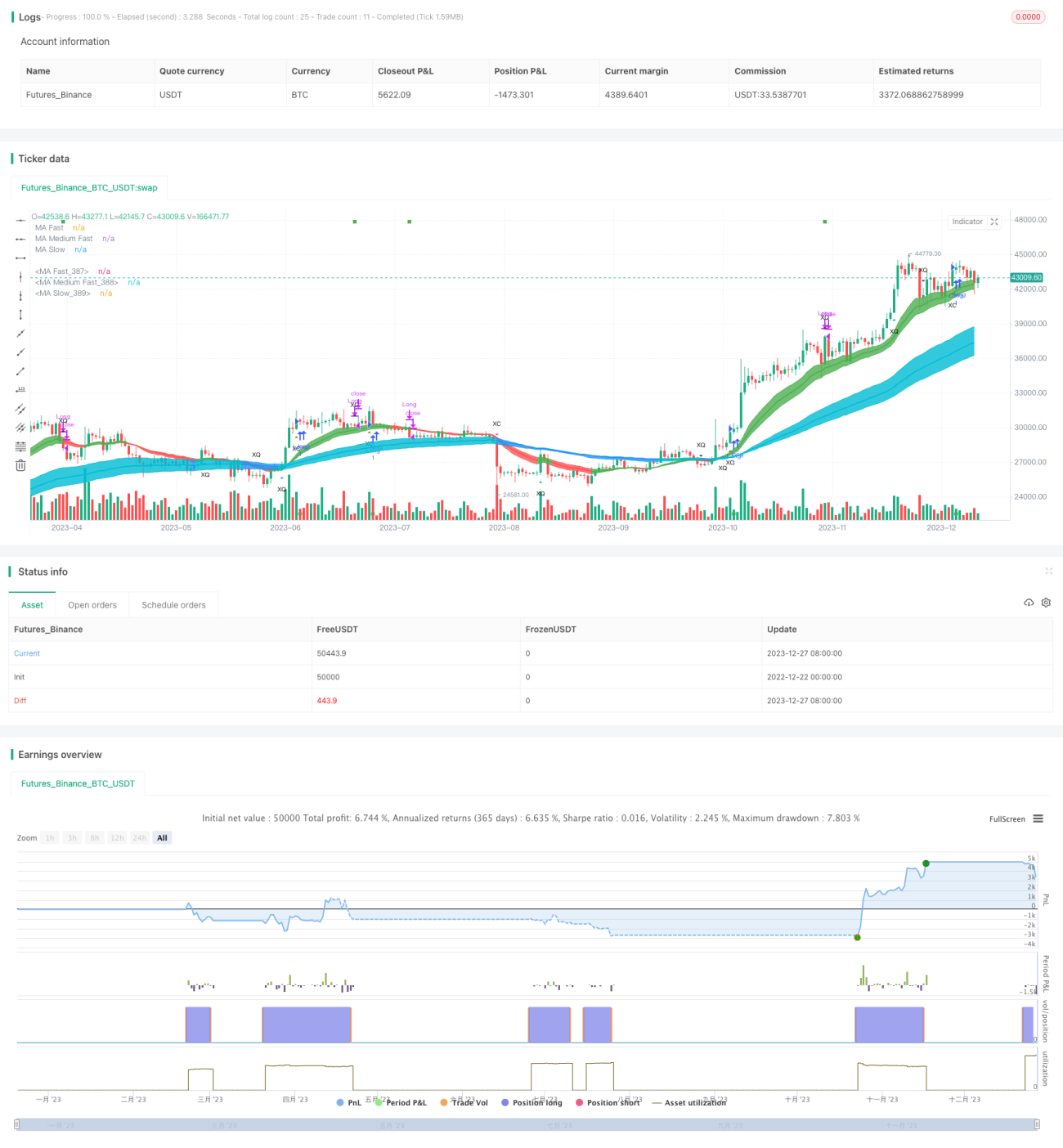
Die Strategie ist eine Trendverfolgungsstrategie, die auf QQE-Indikatoren und Moving Averages basiert. Durch die Kreuzung der schnellen QQE-Indikatoren und die Filterung der Richtung des Moving Averages wird die Richtung der Trends ermittelt und Kauf- und Verkaufssignale erzeugt.

Die Strategie kann die Kreuzung von drei QQE-Indikatoren auswählen, um die Signale zu beurteilen: 1) Glatte RSI-Kreuzung mit der 0-Achse; 2) Glatte RSI-Kreuzung mit der schnellen QQE-Linie; 3) Glatte RSI-Kreuzung aus dem RSI-Durchschnittskanal. Die Default ist die Verwendung der dritten Kreuzung zum Positionseröffnen und der zweiten Kreuzung zum Ausgleich der Position.

Kauf- und Verkaufssignale können zusätzlich durch den gleitenden Durchschnitt gefiltert werden: Der Schlusskurs wird erzeugt, wenn der schnelle gleitende Durchschnitt höher ist als der schnelle gleitende Durchschnitt, und der schnelle gleitende Durchschnitt höher ist als der schleppende gleitende Durchschnitt.

Die Strategie ist für die Verwendung von Signal-zu-Signal-Modellen für den automatisierten Handel geeignet.

Grundsätze

Der Kernindikator der Strategie ist QQE, dessen Berechnungsformel lautet:

Wilders_Period = RSILen * 2 - 1  

Rsi = rsi(close,RSILen)  
RSIndex = ema(Rsi, SF)  
AtrRsi = abs(RSIndex - RSIndex[1])  
MaAtrRsi = ema(AtrRsi, Wilders_Period)
DeltaFastAtrRsi = ema(MaAtrRsi,Wilders_Period) * QQEfactor

newshortband = RSIndex + DeltaFastAtrRsi 
newlongband = RSIndex - DeltaFastAtrRsi

Der RSILen ist die Länge der RSI-Periode, der SF ist der Flickenfaktor des RSI. QQE ist im Wesentlichen ein glatt bearbeiteter RSI. Es berechnet den Auf- und Abwärtstrend durch einen schnellen ATR, der als Kauf- oder Verkaufsmöglichkeit beurteilt wird, wenn der Preis den Kanal überschreitet.

Die Strategie verwendet eine Kreuzung von drei QQE-Systemen, um Handelssignale zu identifizieren:

  1. Glatter RSI-Indikator mit der 0-Achs-Kreuzung (XZ)
QQEzlong = RSIndex >= 50 ? QQEzlong + 1 : 0
QQEzshort = RSIndex < 50 ? QQEzshort + 1 : 0  
  1. Der glatte RSI-Indikator und der schnelle QQE-Indikator kreuzen sich (XQ), ähnlich wie ein vorgezogenes Swing-Signal
QQExlong = FastAtrRsiTL < RSIndex ? QQExlong + 1 : 0
QQExshort = FastAtrRsiTL > RSIndex ? QQExshort + 1 : 0
  1. Der RSI-Glattmacher verlässt den Threshold-Kanal (XC), ähnlich wie ein bestätigtes Schwankungssignal
threshhold = 10 
QQEclong = RSIndex > (50 + threshhold) ? QQEclong + 1 : 0
QQEcshort = RSIndex < (50 - threshhold) ? QQEcshort + 1 : 0

Sie können ein oder mehrere der drei oben genannten Kreuzungen verwenden, um ein Kauf-/Verkaufssignal und ein Niederlassungssignal zu identifizieren.

Bei Kauf- und Verkaufssignalen können Sie wählen, ob Sie zusätzliche Filter durch den Moving Average verwenden möchten:

// 过滤条件  
QQEflong = close > ma_medium 和  
            ma_medium > ma_slow 和  
            ma_fast > ma_medium
             
QQEfshort = close < ma_medium 和  
            ma_medium < ma_slow 和 
            ma_fast < ma_medium  

Das ist eine gute Möglichkeit, um falsche Signale zu vermeiden, wenn es zu Trübungen kommt.

Die Strategie ist geeignet für den automatisierten Handel, um Friedenspositionen zu eröffnen, die durch verschiedene QQE-Kreuzungen eröffnet werden:

开仓信号 = XC 或 XQ 或 XZ
平仓信号 = XQ 或 XZ

Vorteile

Diese Strategie hat folgende Vorteile:

  1. Die QQE-Indikatoren werden verwendet, um Trends und Kreuzungen zu beurteilen. QQE selbst hat die Eigenschaft, Geräusche zu reduzieren und Fehlsignale zu reduzieren.

  2. In Kombination mit einem Moving Average kann eine Filterung die falsche Signalqualität von Marktschwankungen weiter verhindern und die Signalqualität verbessern.

  3. Es gibt verschiedene QQE-Kreuzungen, die für die Eröffnung und Bewahrung von Positionen verwendet werden können, um automatische Transaktionen zu ermöglichen.

  4. Der flache RSI-Indikator ist nachlässig, so dass ein Kauf- und Verkaufssignal nicht übertragen wird.

  5. Optimierung in verschiedenen Zeitspannen, um die optimale Kombination von Parametern zu finden.

Die Gefahr

Die Strategie birgt auch Risiken:

  1. Wenn der Trend umkehrt, wird ein falsches Signal erzeugt, und ein Stop-Loss muss eingerichtet werden, um das Risiko zu kontrollieren.

  2. Die falsche Einstellung der Parameter beeinträchtigt die Strategie und erfordert mehrere Testoptimierungen, um die besten Parameter zu finden.

  3. Verschiedene Sorten und Zeitspanne-Parameter müssen getestet und optimiert werden.

  4. Automatischer Handel birgt das Risiko von Rücktritt und fortlaufenden Verlusten und erfordert eine Kapitalverwaltung.

Die entsprechenden Lösungen sind wie folgt:

  1. Ein Stop-Loss wird eingestellt, wenn der Verlust einen bestimmten Betrag erreicht.

  2. Verschiedene Parameterkombinationen werden detailliert getestet, um die besten Parameter zu finden.

  3. Anpassung der Parameter an die Sorte und die Periodizität.

  4. Das ist eine sehr wichtige Aufgabe, die man sich selbst übernehmen muss.

Optimierungsrichtung

Die Strategie kann in folgenden Richtungen optimiert werden:

  1. Optimierung der QQE-Parameter, einschließlich RSI-Länge, RSI-Gleichlänge, schnelle ATR-Länge, um die optimale Kombination der Parameter zu finden.

  2. Optimierung von Parametern wie beispielsweise Moving Average Parametern, Anpassungszyklen und Typen, um eine optimale Übereinstimmung mit den QQE-Indikatoren herzustellen.

  3. Verschiedene QQE-Kreuzungen werden getestet, um die stabilste Kombination zu finden.

  4. Die Parameter werden je nach Sorte und Handelsprozess verfeinert. Der Tageshandel kann die Zeiträume verkürzen und die getParameter verbessern.

  5. Die Einführung eines Stop-Loss-Mechanismus. Der Stop-Loss erfolgt, wenn ein bestimmter Prozentsatz des Verlustes erreicht wird.

  6. Um die Größe der Positionen angemessen zu reduzieren, werden verschiedene Positionsmanagementmethoden getestet.

Zusammenfassen

Die Strategie integriert QQE-Indikatoren, um Trends und Kreuzungen zu bestimmen, sowie die Filterung von Moving Averages, um Handelssignale zu erzeugen. Die Qualität des Signals kann durch Anpassung der Parameter in der Realität optimiert werden; und mit strenger Kapitalverwaltung wird das Risiko kontrolliert. Die Strategie eignet sich für die Verwendung als Signal-zu-Signal-Modell für den automatisierten Handel und kann auch zur Beurteilung im diskretionären Handel dienen.

Strategiequellcode
/*backtest
start: 2022-12-22 00:00:00
end: 2023-12-28 00:00:00
period: 1d
basePeriod: 1h
exchanges: [{"eid":"Futures_Binance","currency":"BTC_USDT"}]
*/

//@version=3
//

//*** START of COMMENT OUT [Alerts]
strategy(title="[Backtest]QQE Cross v6.0 by JustUncleL", shorttitle="[BT]QQEX v6.0", overlay=true)
//*** END of COMMENT OUT [Alerts]
//<<<<<<<<<<<<<<<<<<<<<<<<<<<<<<<<<<<<<<<<<<<<<<<<<<<<<<<<<<<<<<<<<<<<<<<<<<<<<//

//>>>>>>>>>>>>>>>>>>>>>>>>>>>>>>>>>>>>>>>>>>>>>>>>>>>>>>>>>>>>>>>>>>>>>>>>>>>>>//
//*** START of COMMENT OUT [BackTest]
//study(title="[Alerts]QQE Cross v6.0 by JustUncleL", shorttitle="[AL]QQEX v6.0", overlay=true,max_bars_back=2000)
//*** END of COMMENT OUT [BackTest]

//
// Author:  JustUncleL
// Date:    10-July-2016
// Version: v6, Major Release Nov-2018
//
// Description:
//  A following indicator is Trend following that uses fast QQE crosses with Moving Averages
//  for trend direction filtering. QQE or Qualitative Quantitative Estimation is based 
//  on the relative strength index (RSI), but uses a smoothing technique as an additional 
//  transformation. Three crosses can be selected (all selected by default): 
//    - Smooth RSI signal crossing ZERO (XZ)
//    - Smooth RSI signal crossing Fast QQE line (XQ), this is like an early warning swing signal.
//    - Smooth RSI signal exiting the RSI Threshhold Channel (XC), this is like a confirmed swing signal.
//      An optimumal Smooth RSI threshold level is between 5% and 10% (default=10), it helps reduce
//      the false swings.
//  These signals can be selected to Open Short/Long and/or Close a trade, default is XC open
//  trade and XQ (or opposite open) to Close trade.
//
//  The (LONG/SHORT) alerts can be optionally filtered by the Moving Average Ribbons:
//    - For LONG alert the Close must be above the fast MA Ribbon and 
//        fast MA Ribbon must be above the slow MA Ribbon.
//    - For SHORT alert the Close must be below the fast MA Ribbon and
//        fast MA Ribbon must be below the slow MA Ribbon.
//  and/or directional filter:
//    - For LONG alert the Close must be above the medium MA and the
//      directional of both MA ribbons must be Bullish.
//    - For SELL alert the Close must be below the medium MA and the
//      directional of both MA ribbons must be Bearish.
//
//  This indicator is designed to be used as a Signal to Signal trading BOT 
//  in automatic or semi-automatic way (start and stop when conditions are suitable).
//  - For LONG and SHORT alerts I recommend you use "Once per Bar" alarm option
//  - For CLOSE alerts I recommend you use "Once per Bar Close" alarm option
//  (* The script has been designed so that long/short signals come at start of candles *)
//  (* and close signals  come at the end of candles                                    *)
//
// Mofidifications:
//  6.0 - Major Release Version
//      - Added second MA ribbon to help filter signals to the trend direction.
//      - Modified Alert filtering to include second MA Ribbon
//      - Change default settings to reflect Signal to Signal BOT parameters.
//      - Removed older redunant alerts.
//
//  5.0 - Development series
//
//  4.1 - Fix bug with painting Buy/Sell arrows when non-repaint shunt mode selected.
//      - Added option to alert just the first Buy/Sell alert after a trend swing
//      - Added Long and Short Alarms. When combined with the "first Buy/Sell" in trend option,
//        It is now possible to use this indicator to interface with AutoView 
//        or ProfitView. I suggest using the "QQEX XZ Alert" alarm to exit Long or Short
//        trade. Use only "Once per bar Close" option for Alarms. This is not a full
//        fledged trading BOT though with TP/SL settings.
//
//      - Changed QQE defaults to be a bit smoother (8, 5, 3) instead of (6, 3, 2.618).
//
//  4.0 - Added implied GPL copyright notice.
//      - Changed defaults to use HullMAs instead of EMAs.
//  3.0 - No repaint on BUY/SELL alert, however, now trades should be taken when the BUY/SELL
//        Alert is displayed. The alarm is still generated on the previous candle so you can
//        still get a pre-warning, this enables you time to analyse the pending alert.
//      - Added option to test success of alerted trades, highlight successful and failed trade bars
//        and show simple stats: success rate and number of trades (out of 5000), this will help
//        tune the settings for timeframe and currency PAIR.
//  2.0 - Added code to use the medium moving average (EMA20) rising/falling for additional
//        trend direction filter.
//      - Remove Moving Average cross over signals and other options not used in this indicator.
//      - Added code to distinguish between the crosses, now only show Thresh Hold crosses as BUY/SELL
//        alerts.
//      - Modidied default settings to more well known MA's and slightly different QQE settings, these
//        work well at lower timeframes.
//      - Added circle plots at bottom of chart to show when actual BUY/SELL alerts occur.
//  1.0 - original
//
// References:
//  Some Code borrowed from:
//  - "Scalp Jockey - MTF MA Cross Visual Strategizer by JayRogers"
//  - "QQE MT4 by glaz"
//  Inspiration from:
//  - http://www.forexstrategiesresources.com/binary-options-strategies-ii/189-aurora-binary-trading/
//  - http://www.forexstrategiesresources.com/metatrader-4-trading-systems-v/652-qqe-smoothed-trading/
//  - http://dewinforex.com/forex-indicators/qqe-indicator-not-quite-grail-but-accurately-defines-trend-and-flat.html
//  - "Binary option trading by two previous bars" by radixvinni
//
//
// -----------------------------------------------------------------------------
// Copyright 2015 Glaz,JayRogers
//
// Copyright 2016,2017,2018 JustUncleL
//
// This program is free software: you can redistribute it and/or modify
// it under the terms of the GNU General Public License as published by
// the Free Software Foundation, either version 3 of the License, or
// any later version.
//
// This program is distributed in the hope that it will be useful,
// but WITHOUT ANY WARRANTY; without even the implied warranty of
// MERCHANTABILITY or FITNESS FOR A PARTICULAR PURPOSE.  See the
// GNU General Public License for more details.
// 
// The GNU General Public License can be found here
// <http://www.gnu.org/licenses/>.
//
// -----------------------------------------------------------------------------
//

// Use Alternate Anchor TF for MAs 
anchor     = input(4,minval=0,maxval=100,title="Relative TimeFrame Multiplier for Second MA Ribbon (0=none, max=100)")
//

// - INPUTS START
// Fast MA - type, source, length
showAvgs     = input(true,title="Show Moving Average Lines")
type1   = input(defval="EMA", title="Fast MA Type: ", options=["SMA", "EMA", "WMA", "VWMA", "SMMA", "DEMA", "TEMA", "HullMA", "ZEMA", "TMA", "SSMA"])
len1    = input(defval=16, title="Fast - Length", minval=1)
gamma1  = 0.33
// Medium Fast MA - type, source, length
type2   = input(defval="EMA", title="Medium MA Type: ", options=["SMA", "EMA", "WMA", "VWMA", "SMMA", "DEMA", "TEMA", "HullMA", "ZEMA", "TMA", "SSMA"])
len2    = input(defval=21, title="Medium - Length", minval=1)
gamma2  = 0.55
// Slow MA - type, source, length
type3   = input(defval="EMA", title="Slow MA Type: ", options=["SMA", "EMA", "WMA", "VWMA", "SMMA", "DEMA", "TEMA", "HullMA", "ZEMA", "TMA", "SSMA"])
len3    = input(defval=26, title="Slow Length", minval=1)
gamma3  = 0.77
//
// QQE rsi Length, Smoothing, fast ATR factor, source
RSILen  = input(14,title='RSI Length')
SF      = input(8,title='RSI Smoothing Factor')
QQEfactor  = input(5.0,type=float,title='Fast QQE Factor')
threshhold = input(10, title="RSI Threshhold")
//
sQQEx   = input(true,title="Show QQE Signal crosses")
sQQEz   = input(false,title="Show QQE Zero crosses")
sQQEc   = input(true,title="Show QQE Thresh Hold Channel Exits")
//
tradeSignal = input("XC", title="Select which QQE signal to Buy/Sell", options=["XC","XQ","XZ"])
closeSignal = input("XQ", title="Select which QQE signal to Close Order", options=["XC","XQ","XZ"])
//
xfilter = input(true, title="Filter XQ Buy/Sell Orders by Threshold" )
filter  = input(false,title="Use Moving Average Filter")
dfilter = input(true, title="Use Trend Directional Filter" )
ufirst  = input(false, title="Only Alert First Buy/Sell in a new Trend")
RSIsrc  = input(close,title="Source")

src     = RSIsrc // MA source
srcclose= RSIsrc

///////////////////////////////////////////////
//* Backtesting Period Selector | Component *//
///////////////////////////////////////////////

//* https://www.tradingview.com/script/eCC1cvxQ-Backtesting-Period-Selector-Component *//
//* https://www.tradingview.com/u/pbergden/ *//
//* Modifications made by JustUncleL*//


//>>>>>>>>>>>>>>>>>>>>>>>>>>>>>>>>>>>>>>>>>>>>>>>>>>>>>>>>>>>>>>>>>>>>>>>>>>>>>//
//*** START of COMMENT OUT [Alerts]

testStartYear = input(2018, "Backtest Start Year",minval=1980)
testStartMonth = input(6, "Backtest Start Month",minval=1,maxval=12)
testStartDay = input(12, "Backtest Start Day",minval=1,maxval=31)
testPeriodStart = timestamp(testStartYear,testStartMonth,testStartDay,0,0)

testStopYear = 9999 //input(9999, "Backtest Stop Year",minval=1980)
testStopMonth = 12 // input(12, "Backtest Stop Month",minval=1,maxval=12)
testStopDay = 31 //input(31, "Backtest Stop Day",minval=1,maxval=31)
testPeriodStop = timestamp(testStopYear,testStopMonth,testStopDay,0,0)

testPeriod = time >= testPeriodStart and time <= testPeriodStop ? true : false

//*** END of COMMENT OUT [Alerts]
//<<<<<<<<<<<<<<<<<<<<<<<<<<<<<<<<<<<<<<<<<<<<<<<<<<<<<<<<<<<<<<<<<<<<<<<<<<<<<//

// - INPUTS END


gold = #FFD700
AQUA = #00FFFFFF
BLUE = #0000FFFF
RED  = #FF0000FF
LIME = #00FF00FF
GRAY = #808080FF

// - FUNCTIONS

// - variant(type, src, len, gamma)
// Returns MA input selection variant, default to SMA if blank or typo.

// SuperSmoother filter
// © 2013  John F. Ehlers
variant_supersmoother(src,len) =>
    a1 = exp(-1.414*3.14159 / len)
    b1 = 2*a1*cos(1.414*3.14159 / len)
    c2 = b1
    c3 = (-a1)*a1
    c1 = 1 - c2 - c3
    v9 = 0.0
    v9 := c1*(src + nz(src[1])) / 2 + c2*nz(v9[1]) + c3*nz(v9[2])
    v9
    
variant_smoothed(src,len) =>
    v5 = 0.0
    v5 := na(v5[1]) ? sma(src, len) : (v5[1] * (len - 1) + src) / len
    v5

variant_zerolagema(src,len) =>
    ema1 = ema(src, len)
    ema2 = ema(ema1, len)
    v10 = ema1+(ema1-ema2)
    v10
    
variant_doubleema(src,len) =>
    v2 = ema(src, len)
    v6 = 2 * v2 - ema(v2, len)
    v6

variant_tripleema(src,len) =>
    v2 = ema(src, len)
    v7 = 3 * (v2 - ema(v2, len)) + ema(ema(v2, len), len)               // Triple Exponential
    v7
    
//calc Laguerre
variant_lag(p,g) =>
    L0 = 0.0
    L1 = 0.0
    L2 = 0.0
    L3 = 0.0
    L0 := (1 - g)*p+g*nz(L0[1])
    L1 := -g*L0+nz(L0[1])+g*nz(L1[1])
    L2 := -g*L1+nz(L1[1])+g*nz(L2[1])
    L3 := -g*L2+nz(L2[1])+g*nz(L3[1])
    f = (L0 + 2*L1 + 2*L2 + L3)/6
    f

// return variant, defaults to SMA 
variant(type, src, len, g) =>
    type=="EMA"     ? ema(src,len) : 
      type=="WMA"   ? wma(src,len): 
      type=="VWMA"  ? vwma(src,len) : 
      type=="SMMA"  ? variant_smoothed(src,len) : 
      type=="DEMA"  ? variant_doubleema(src,len): 
      type=="TEMA"  ? variant_tripleema(src,len): 
      type=="LAGMA" ? variant_lag(src,g) :
      type=="HullMA"? wma(2 * wma(src, len / 2) - wma(src, len), round(sqrt(len))) :
      type=="SSMA"  ? variant_supersmoother(src,len) : 
      type=="ZEMA"  ? variant_zerolagema(src,len) : 
      type=="TMA"   ? sma(sma(src,len),len) : 
                      sma(src,len)

// - /variant 

// If have anchor specified, calculate the base multiplier, base on time in mins
//mult  = isintraday ? anchor==0 or interval<=0 or interval>=anchor or anchor>1440? 1 : round(anchor/interval) : 1
//mult := not isintraday?  1 : mult  // Only available Daily or less

// Anchor is a relative multiplier based on current TF.
mult = anchor>0 ? anchor : 1 

// - FUNCTIONS END

 
// - Fast ATR QQE
//
Wilders_Period = RSILen * 2 - 1
//
Rsi = rsi(RSIsrc,RSILen)
RSIndex = ema(Rsi, SF)
AtrRsi = abs(RSIndex[1] - RSIndex)
MaAtrRsi = ema(AtrRsi, Wilders_Period)
DeltaFastAtrRsi = ema(MaAtrRsi,Wilders_Period) * QQEfactor
//
newshortband=  RSIndex + DeltaFastAtrRsi
newlongband= RSIndex - DeltaFastAtrRsi
longband = 0.0
shortband=0.0
trend = 0
longband:=RSIndex[1] > longband[1] and RSIndex > longband[1] ? max(longband[1],newlongband) : newlongband
shortband:=RSIndex[1] < shortband[1] and  RSIndex < shortband[1] ? min(shortband[1],newshortband) : newshortband
trend:=cross(RSIndex, shortband[1])? 1 : cross(longband[1], RSIndex) ? -1 : nz(trend[1],1)
FastAtrRsiTL = trend==1 ? longband : shortband


// - SERIES VARIABLES
// MA's
ma_fast    = variant(type1, srcclose, len1, gamma1)
ma_medium  = variant(type2, srcclose, len2, gamma2)
ma_slow    = variant(type3, srcclose, len3, gamma3)
// MA's
ma_fast_alt    = variant(type1, srcclose, len1*mult, gamma1)
ma_medium_alt  = variant(type2, srcclose, len2*mult, gamma2)
ma_slow_alt    = variant(type3, srcclose, len3*mult, gamma3)

// Get Direction From Medium Moving Average
direction = rising(ma_medium,3) ? 1 : falling(ma_medium,3) ? -1 : 0
altDirection = rising(ma_medium_alt,3) ? 1 : falling(ma_medium_alt,3) ? -1 : 0
//
// Find all the QQE Crosses
QQExlong  = 0, QQExlong := nz(QQExlong[1])
QQExshort = 0, QQExshort := nz(QQExshort[1])
QQExlong  := FastAtrRsiTL< RSIndex ? QQExlong+1 : 0
QQExshort := FastAtrRsiTL> RSIndex ? QQExshort+1 : 0
// Zero cross
QQEzlong  = 0, QQEzlong := nz(QQEzlong[1])
QQEzshort = 0, QQEzshort := nz(QQEzshort[1])
QQEzlong  := RSIndex>=50 ? QQEzlong+1 : 0
QQEzshort := RSIndex<50 ? QQEzshort+1 : 0
//  
// Thresh Hold channel Crosses give the BUY/SELL alerts.
QQEclong  = 0, QQEclong := nz(QQEclong[1])
QQEcshort = 0, QQEcshort := nz(QQEcshort[1])
QQEclong  := RSIndex>(50+threshhold) ? QQEclong+1 : 0
QQEcshort := RSIndex<(50-threshhold) ? QQEcshort+1 : 0

//
// Check Filtering.
QQEflong = mult == 1 ? (not filter or (srcclose>ma_medium and ma_medium>ma_slow and ma_fast>ma_medium)) and (not dfilter or (direction>0 )) :
                       (not filter or (ma_medium>ma_medium_alt and srcclose>ma_fast and ma_fast>ma_medium)) and (not dfilter or (direction>0 and altDirection>0 and srcclose>ma_medium))
QQEfshort = mult == 1 ? (not filter or (srcclose<ma_medium and ma_medium<ma_slow and ma_fast<ma_medium)) and (not dfilter or (direction<0 )) :
                       (not filter or (ma_medium<ma_medium_alt and srcclose<ma_fast and ma_fast<ma_medium)) and (not dfilter or (direction<0 and altDirection<0 and srcclose<ma_medium))
  
QQExfilter = (not xfilter or  RSIndex>(50+threshhold) or RSIndex<(50-threshhold))
//
// Get final BUY / SELL alert determination
buy_ = 0, buy_ := nz(buy_[1])
sell_ = 0, sell_ := nz(sell_[1])

// Make sure Buy/Sell are non-repaint and occur after close signal.
buy_  := tradeSignal=="XC"? (QQEclong[1]==1 and QQEflong[1] ? buy_+1 : 0) :
         tradeSignal=="XQ"? (QQExlong[1]==1 and QQEflong[1] and QQExfilter[1]? buy_+1 : 0) :
         tradeSignal=="XZ"? (QQEzlong[1]==1 and QQEflong[1] ? buy_+1 : 0) :  0
sell_ := tradeSignal=="XC"? (QQEcshort[1]==1 and QQEfshort[1] ? sell_+1 : 0) : 
         tradeSignal=="XQ"? (QQExshort[1]==1 and QQEfshort[1] and QQExfilter[1]? sell_+1 : 0) : 
         tradeSignal=="XZ"? (QQEzshort[1]==1 and QQEfshort[1] ? sell_+1 : 0) : 0
//
// Find the first Buy/Sell in trend swing.
Buy = 0, Buy := nz(Buy[1])
Sell = 0, Sell := nz(Sell[1])
Buy := sell_>0 ? 0 : buy_==1 or Buy>0  ? Buy+1 : Buy
Sell := buy_>0 ? 0 : sell_==1 or Sell>0 ? Sell+1 : Sell

// Select First or all buy/sell alerts.
buy = ufirst ? Buy : buy_
sell = ufirst ? Sell : sell_

closeLong = 0, closeLong := nz(closeLong[1])
closeShort = 0, closeShort := nz(closeShort[1])
closeLong  := closeSignal=="XC" ? (QQEcshort==1 ? closeLong+1 : 0)  :
              closeSignal=="XQ" ? tradeSignal=="XQ" ? (QQExshort==1 ? closeLong+1 : 0) : ((QQExshort==1 or QQEzshort or QQEcshort) ? closeLong+1 : 0)  :
              closeSignal=="XZ" ? (QQEzshort==1 ? closeLong+1 : 0)  : 0
closeShort := closeSignal=="XC" ? (QQEclong==1 ? closeShort+1 : 0)  :
              closeSignal=="XQ" ? tradeSignal=="XQ" ? (QQExlong==1 ? closeShort+1 : 0) : ((QQExlong==1  or QQEzlong or QQEclong==1) ? closeShort+1 : 0)  :
              closeSignal=="XZ" ? (QQEzlong==1 ? closeShort+1 : 0)  : 0


tradestate = 0, tradestate := nz(tradestate[1])
tradestate := tradestate==0 ? (buy==1 ? 1 : sell==1 ? 2 : 0) : (tradestate==1 and closeLong==1) or (tradestate==2 and closeShort==1)? 0 : tradestate 

isLong  = change(tradestate) and tradestate==1
isShort =  change(tradestate) and tradestate==2
isCloseLong =  change(tradestate) and tradestate==0 and nz(tradestate[1])==1
isCloseShort =  change(tradestate) and tradestate==0 and nz(tradestate[1])==2

// - SERIES VARIABLES END

// - PLOTTING
// Ma's
tcolor = direction<0?red:green
ma1=plot(showAvgs?ma_fast:na, title="MA Fast", color=tcolor, linewidth=1, transp=0)
ma2=plot(showAvgs?ma_medium:na, title="MA Medium Fast", color=tcolor, linewidth=2, transp=0)
ma3=plot(showAvgs?ma_slow:na, title="MA Slow", color=tcolor, linewidth=1, transp=0)
fill(ma1,ma3,color=tcolor,transp=90)
// Ma's
altTcolor=altDirection<0?blue:aqua
ma4=plot(showAvgs and mult>1?ma_fast_alt:na, title="MA Fast", color=altTcolor, linewidth=1, transp=0)
ma5=plot(showAvgs and mult>1?ma_medium_alt:na, title="MA Medium Fast", color=altTcolor, linewidth=2, transp=0)
ma6=plot(showAvgs and mult>1?ma_slow_alt:na, title="MA Slow", color=altTcolor, linewidth=1, transp=0)
fill(ma4,ma6,color=altTcolor,transp=90)
// QQE exit from Thresh Hold Channel
plotshape(sQQEc and QQEclong==1 and not isLong, title="QQE X Over Channel", style=shape.triangleup, location=location.belowbar, text="XC", color=olive, transp=20, size=size.tiny)
plotshape(sQQEc and QQEcshort==1 and not isShort, title="QQE X Under Channel", style=shape.triangledown, location=location.abovebar, text="XC", color=red, transp=20, size=size.tiny)
// QQE crosses
plotshape(sQQEx and QQExlong==1 and QQEclong!=1 and not isLong, title="QQE Cross Over", style=shape.triangleup, location=location.belowbar, text="XQ", color=blue, transp=20, size=size.tiny)
plotshape(sQQEx and QQExshort==1 and QQEcshort!=1 and not isShort, title="QQE Cross Under", style=shape.triangledown, location=location.abovebar, text="XQ", color=black, transp=20, size=size.tiny)
// Signal crosses zero line
plotshape(sQQEz and QQEzlong==1 and QQEclong!=1 and not isLong and QQExlong!=1, title="QQE Zero Cross Over", style=shape.triangleup, location=location.belowbar, text="XZ", color=aqua, transp=20, size=size.tiny)
plotshape(sQQEz and QQEzshort==1 and QQEcshort!=1 and not isShort and QQExshort!=1, title="QQE Zero Cross Under", style=shape.triangledown, location=location.abovebar, text="XZ", color=fuchsia, transp=20, size=size.tiny)
//
//*** START of COMMENT OUT [BackTest]
//plotshape(isLong, title="QQEX Long", style=shape.arrowup, location=location.belowbar, text="Open\nLONG", color=lime, textcolor=green, transp=0, size=size.small)
//plotshape(isShort, title="QQEX Short", style=shape.arrowdown, location=location.abovebar, text="Open\nSHORT", color=red, textcolor=maroon, transp=0, size=size.small)
//plotshape(isCloseLong, title="QQEX Close Long", style=shape.arrowdown, location=location.abovebar, text="Close\nLONG", color=gray, textcolor=gray, transp=0, size=size.small)
//plotshape(isCloseShort, title="QQEX Close Short", style=shape.arrowup, location=location.belowbar, text="Close\nSHORT", color=gray, textcolor=gray, transp=0, size=size.small)
//*** END of COMMENT OUT [BackTest]

// - PLOTTING END

// - ALERTING

//*** START of COMMENT OUT [Alerts]
if testPeriod
    strategy.entry("Long", 1, when=isLong)
    strategy.close("Long", when=isCloseLong )
    strategy.entry("Short", 0,  when=isShort)
    strategy.close("Short", when=isCloseShort )
//end if
//*** END of COMMENT OUT [Alerts]

//*** START of COMMENT OUT [BackTest]
//
// Signal to Signal BOT Alerts.
//
//alertcondition(isLong,  title="QQEX Long", message="QQEX LONG")  // use "Once per Bar" option
//alertcondition(isShort, title="QQEX Short", message="QQEX SHORT") // use "Once per Bar" option
//alertcondition(isCloseLong, title="QQEX Close Long", message="QQEX CLOSE LONG") // use "Once per Bar Close" option
//alertcondition(isCloseShort, title="QQEX Close Short", message="QQEX CLOSE SHORT") // use "Once per Bar Close" option
//
//*** END of COMMENT OUT [BackTest]

// show only when alert condition is met and bar closed.
plotshape(isLong or isShort,title= "Cross Alert Completed", location=location.bottom, color=isShort?red:green, transp=0, style=shape.circle,size=size.auto,offset=0)
plotshape(isCloseShort[1] or isCloseLong[1],title= "Close Order", location=location.top, color=isCloseShort[1]?red:green, transp=0, style=shape.square,size=size.auto,offset=-1)

// - ALERTING END


//EOF