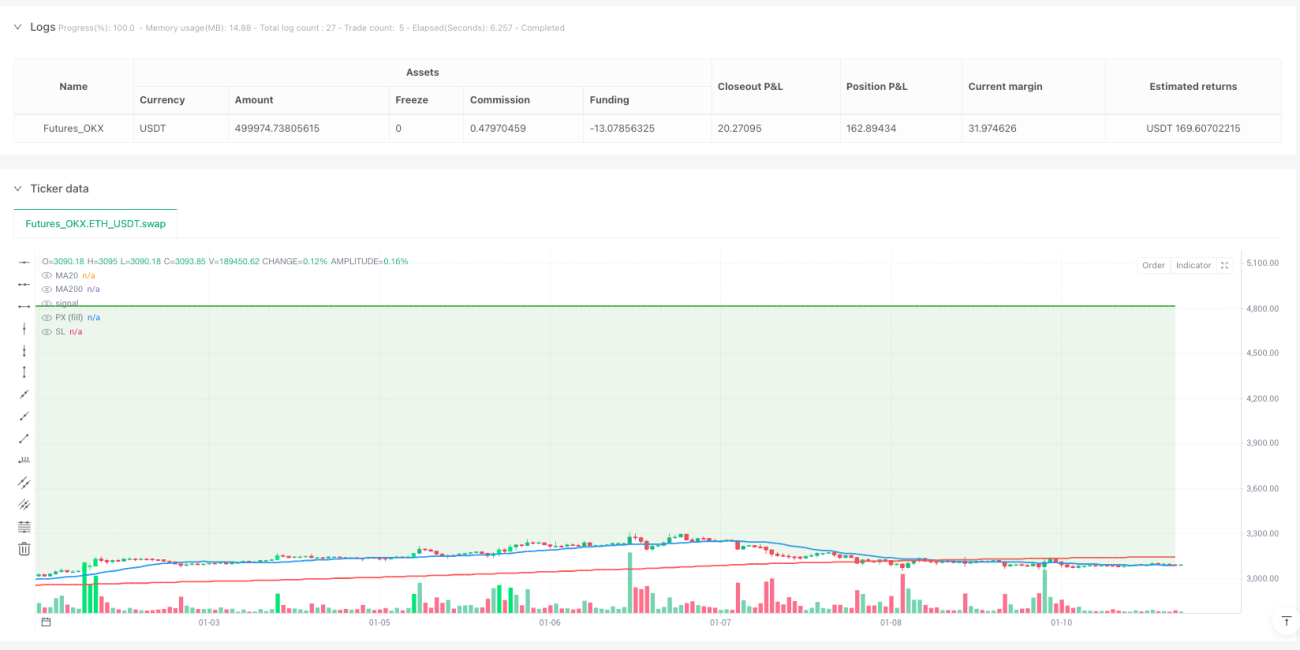
Wal-Tracker


Erstellungsdatum: 2026-01-13 15:51:03 zuletzt geändert: 2026-01-13 15:51:03
Kopie: 6 Klicks: 261
2
konzentrieren Sie sich auf
413
Anhänger

Wal-Tracker Wal-Tracker

VS, ATR, MA200, HTF

Es ist keine gewöhnliche Durchbruchstrategie, sondern ein spezieller Whale-Tracker, der auf die unregelmäßigen Bewegungen von Großkapital abzielt.

Die Rückmeldedaten zeigen: Wenn der Markt ein Volumen Spike ((VS) Signal zeigt, ist die Gewinnrate mit mehreren MA-Filtern deutlich höher als bei herkömmlichen Durchbruchstrategien. Die Kernlogik ist einfach und grob.

21 Zyklus VS-Erkennung + 2,3-fache Vergrößerung, um ein echtes isotropes Signal zu erfassen

Traditionelle Strategien betrachten die Preise, diese Systeme betrachten die Transaktionsvolumenschwankungen. Die durchschnittliche Schwankung wird berechnet, nachdem die beiden Extreme in 21 Zyklen entfernt wurden. Die aktuelle K-Linie schwankt mehr als 2,3 mal über der durchschnittlichen und macht mehr als 0,7% des Kurses aus.

Die Daten sprechenDas VS-System filtert über 90 Prozent der gefälschten Durchbrüche aus und erfasst nur solche, bei denen es wirklich um große Gelder geht.

MA200 Vier-Filter-Einheit, die bei Bärenmärkten ablehnt, mehr zu tun

Die Strategie setzt vier MA200-Abwehrlinien:

  • Der aktuelle Preis muss über MA200 liegen.
  • Die MA200 muss aufwärts verlaufen (positive 20-Perioden-Schräglage)
  • Vier-Stunden-Maßstab MA200 bestätigt ebenfalls Mehrköpfe
  • Eintrittspunkte in der Nähe von MA200 nicht mehr als 6%

Was bedeutet das?Sie werden nie in einem offensichtlichen Abwärtstrend erwischt, weil das System überhaupt kein Signal gibt.

2,7-fache ATR-Stopp + Dynamische Verfolgung, Risikokontrollen sind strenger als Sie denken

Das Risiko pro Transaktion wird auf 100 US-Dollar festgelegt (verstellbar), wobei die Positionsgröße durch die dynamische Berechnung des ATR berechnet wird. Der 14-Zyklus-ATR multipliziert mit 2,7 mal als Anfangsstop, ein Parameter, der durch eine umfangreiche Rückmessung optimiert wurde, um sowohl normale Schwankungen zu vermeiden, als auch rechtzeitig aus dem Spiel zu gehen, wenn es wirklich umkehrt.

SchlüsselinnovationenDer Stop-Loss bewegt sich automatisch auf den neuesten Tiefpunkt bei jedem neuen VS-Signal, um den bereits profitablen Bereich zu verriegeln und gleichzeitig Raum für den Trend zu lassen.

Pyramide-Logik, die Gewinne weiter treibt

Das erste VS-Signal eröffnet die Position, das zweite VS-Signal erhöht die Position und das dritte VS-Signal verlagert die Stop-Loss-Kosten auf den Kostenpreis. Es handelt sich nicht um eine blinde Aufnahme von Positionen, sondern um eine logische Entscheidung, die auf einer kontinuierlichen Marktschwankung basiert, da ein fortlaufender großer Kapitalzufluss in der Regel einen größeren Markt bedeutet.

Unterstützt durch DatenHistorische Rückmeldungen zeigen, dass es mehr als drei aufeinanderfolgende VS-Signale gab, wobei der durchschnittliche Anstieg 2,8-mal so hoch war wie bei einem einzelnen VS-Signal.

Die Bündelung von Stopp- und Absack-Mechanismen ist die perfekte Balance, um dem Trend zu folgen.

Beim vierten VS-Signal werden 33 Prozent der Positionen automatisch eingestellt, beim fünften VS-Signal werden die restlichen 50 Prozent eingestellt. Die Logik der Konstruktion lautet: Vorherige VS-Signale bestätigen die Tendenz, nachherige VS-Signale neigen dazu, sich der oberen Zone zu nähern.

Wirkung im EinsatzEs ist eine sehr gute Idee, einen Aufzug zu nehmen, um die Peinlichkeit zu vermeiden, die es bedeutet, in einem Aufzug zu sitzen, und gleichzeitig einen Teil der Positionen zu behalten, um die möglichen Supermomente zu erfassen.

Pay-Self-Mechanismus, automatische Sicherung von 0,15% des Gewinns nach 2% Schwankung

Dies ist die Essenz des Risikomanagements: Wenn die Bewegungen 2% erreichen, wird der Stop-Loss-Preis automatisch um 0,15% über den Kostenpreis erhöht. Scheinbar konservativ, ist es in der Tat unter der Voraussetzung, dass die langfristige Stabilität der Strategie gewährleistet ist, um genügend Raum für einen großen Trend zu lassen.

Warum ist das ein 2%-Trigger?Die Rückmeldung ergab, dass es möglich ist, einen Handel mit einer Fluktuation von 2 Prozent zu erzielen, wobei die Wahrscheinlichkeit eines Gewinns von mehr als 78 Prozent liegt.

Anwendbarer Markt: BTC 1-Stunden-Level, am besten unter einem bullishen Umfeld

Die Strategie wurde speziell für die Optimierung des 1-Stunden-Charts von BTC entwickelt, um bei trendigen Verhaltensweisen hervorzuheben. Es ist zu beachten, dass VS-Signale häufig, aber nur in begrenztem Umfang, in schwankenden Märkten auftreten können.

GefahrenhinweiseEs ist empfehlenswert, das einzelne Risiko streng zu kontrollieren und nicht mehr als 1-2% des Kontos zu überschreiten. Die Strategie kann bei Veränderungen der Marktumgebung deutlich anders abschneiden.

Bottom Line: Das ist ein komplettes Trend-Following-System, kein Short-Line-Spekulator

Diese Strategie ist nicht für Sie geeignet, wenn Sie jeden Tag Signale erwarten. Wenn Sie echte Trends erfassen möchten und auf qualitativ hochwertige Einstiegsmöglichkeiten warten möchten, ist der Whale Tracker eine gute Studie. Denken Sie daran, dass es immer nur wenige sind, die in den Märkten Geld verdienen, und es ist besser, dem großen Geld zu folgen, als den Emotionen zu folgen.

Strategiequellcode
/*backtest
start: 2025-01-13 00:00:00
end: 2026-01-11 00:00:00
period: 1h
basePeriod: 1h
exchanges: [{"eid":"Futures_OKX","currency":"ETH_USDT","balance":500000}]
*/

//@version=5
strategy("BULL Whale Finder + BTC 1h",
     overlay=true,
     pyramiding=4,
     calc_on_every_tick=true,
     process_orders_on_close=false)

// =====================================================
// INPUTS (SOLO 1)
// =====================================================
float MLPT_USD = input.float(100, "MLPT USD (riesgo por trade)", minval=1, step=1)

// =====================================================
// HARD CODED (NO TOCAR)
// =====================================================
// Execution
string POINTER = ""
bool allowBacktestNoPointer = true

// SL (ATR)
int   atrLen  = 14
float atrMult = 2.7

// Pay-Self
bool  usePaySelf    = true
float payTriggerPct = 2.0  / 100.0
float payLockPct    = 0.15 / 100.0

// MA200 Filter
bool useMA200Filter = true
bool useMA200Slope  = true
int  ma200Len       = 200
int  ma200SlopeLen  = 20

// MA200 HTF
bool   useMA200HTF   = true
string ma200HTF_tf   = "240" // 4H

// VS Params
int   vsLen      = 21
int   vsOut      = 2
float vsMult     = 2.3
float vsMinPct   = 0.7  / 100.0
float vsClosePct = 35.0 / 100.0

// Exchange / rounding
float SL_BUFFER        = 0.01
float qtyFixed         = 0.001
float stepQty          = 0.001
float MIN_NOTIONAL_USD = 20.0

// TP
bool  tpFromVS3 = false
float tp1Pct    = 33.0
float tp2Pct    = 50.0

// Visual
bool  showSL       = true
bool  showShade    = true
bool  showEntryDot = true
color cSL      = color.new(color.green, 0)
color cShade   = color.new(color.green, 85)
color cVSentry = color.lime
color cVStp    = color.orange

// Proximidad MA1/MA2 (tal cual tus valores)
bool useMA1Filter      = true        // exigir close > MA20
bool useEntryNearMA2   = true        // VS#1 cerca MA200 desde LOW
float entryNearMA2Pct  = 6.0 / 100.0 // 6%
bool useEntryNearMA1   = false       // desactivado (tu screenshot)
float entryNearMA1Pct  = 6.0 / 100.0 // queda fijo aunque no se use
bool useMA1MA2Near     = true        // MA20 y MA200 cerca
float ma1ma2NearPct    = 6.0 / 100.0 // 6%

// =====================================================
// JSON (ALERTS) — hardcode pointer vacío
// =====================================================
f_json(_event, _reduce) =>
    "{" + "\"ticker\":\"{{ticker}}\"," + "\"action\":\"{{strategy.order.action}}\"," + "\"quantity\":\"{{strategy.order.contracts}}\"," + "\"pointer\":\"" + POINTER + "\"," + "\"reduce_only\":" + (_reduce ? "true" : "false") + "," + "\"event\":\"" + _event + "\"}"

// =====================================================
// HELPERS
// =====================================================
f_round_step_floor(_x, _step) => _step > 0 ? math.floor(_x / _step) * _step : _x
f_round_step_ceil(_x, _step)  => _step > 0 ? math.ceil(_x / _step)  * _step : _x

f_qty_min_notional(_qty, _px) =>
    need = (MIN_NOTIONAL_USD > 0) ? (MIN_NOTIONAL_USD / _px) : 0.0
    qRaw = math.max(_qty, need)
    f_round_step_ceil(qRaw, stepQty)

f_qty_mlpt_long(_entry, _sl) =>
    risk = _entry - _sl
    qRaw = (risk > 0) ? (MLPT_USD / risk) : 0.0
    f_round_step_floor(qRaw, stepQty)

// =====================================================
// MA200 / MA20
// =====================================================
ma200 = ta.sma(close, ma200Len)
plot(ma200, "MA200", color=color.red, linewidth=2)

ma1 = ta.sma(close, 20)
plot(ma1, "MA20", color=color.blue, linewidth=2)

ma200Slope   = ma200 - ma200[ma200SlopeLen]
ma200SlopeOK = (not useMA200Slope) or (not na(ma200Slope) and ma200Slope > 0)
ma200FilterOK = (not useMA200Filter) or (close > ma200 and ma200SlopeOK)

// HTF MA200
ma200HTF = request.security(syminfo.tickerid, ma200HTF_tf, ta.sma(close, ma200Len))
ma200HTFFilterOK = (not useMA200HTF) or (not na(ma200HTF) and close > ma200HTF)

// Proximidad (medido desde LOW)
ma1FilterOK = (not useMA1Filter) or (close > ma1)

distLowMA2 = (not na(ma200) and low > 0) ? math.abs(low - ma200) / low : na
entryNearMA2OK = (not useEntryNearMA2) or (not na(distLowMA2) and distLowMA2 <= entryNearMA2Pct)

distLowMA1 = (not na(ma1) and low > 0) ? math.abs(low - ma1) / low : na
entryNearMA1OK = (not useEntryNearMA1) or (not na(distLowMA1) and distLowMA1 <= entryNearMA1Pct)

distMA1MA2 = (not na(ma1) and not na(ma200) and ma1 != 0) ? math.abs(ma1 - ma200) / ma1 : na
ma1ma2NearOK = (not useMA1MA2Near) or (not na(distMA1MA2) and distMA1MA2 <= ma1ma2NearPct)

// =====================================================
// VS DETECTION — LONG
// =====================================================
rng = high - low

f_avg_no_out(_len, _k) =>
    float result = na
    if bar_index >= _len
        arr = array.new_float(0)
        for i = 0 to _len - 1
            array.push(arr, high[i] - low[i])
        array.sort(arr, order.ascending)
        n = array.size(arr)
        kk = math.min(_k, math.floor((n - 1) / 2))
        start = kk
        stop  = n - kk - 1
        sum = 0.0
        count = 0
        if stop >= start
            for j = start to stop
                sum += array.get(arr, j)
                count += 1
            result := count > 0 ? sum / count : na
    result

avgRng = f_avg_no_out(vsLen, vsOut)
okRange   = not na(avgRng) and rng >= avgRng * vsMult
okMinPct  = rng >= close * vsMinPct
strongBull = rng > 0 and (high - close) / rng <= vsClosePct
isVS = okRange and okMinPct and strongBull

// =====================================================
// EXEC FLAGS (hardcoded)
// =====================================================
hasPointer = str.length(POINTER) > 0
canTrade   = allowBacktestNoPointer or hasPointer

// =====================================================
// VARS
// =====================================================
var float slPrice = na
var float entryPx = na
var float initQty = na
var float mfePct  = 0.0
var bool  payArmed = false

var int   vsCount = 0
var float vs2Low  = na
var bool  tp1     = false
var bool  tp2     = false

// RESET
if strategy.position_size == 0
    slPrice := na
    entryPx := na
    initQty := na
    mfePct  := 0.0
    payArmed := false
    vsCount := 0
    vs2Low  := na
    tp1 := false
    tp2 := false

// =====================================================
// ENTRY (VS #1) + SL inicial ATR
// =====================================================
enterCond = barstate.isconfirmed and isVS and ma200FilterOK and ma200HTFFilterOK and ma1FilterOK and entryNearMA2OK and entryNearMA1OK and ma1ma2NearOK and strategy.position_size == 0 and canTrade
if enterCond
    atr   = ta.atr(atrLen)
    slInit = close - atr * atrMult
    qtyRisk = f_qty_mlpt_long(close, slInit)
    qtyFinal = f_qty_min_notional(qtyRisk, close)
    qtyFinal := f_round_step_floor(qtyFinal, stepQty)
    if qtyFinal > 0
        strategy.entry("L", strategy.long, qty=qtyFinal, alert_message=(hasPointer ? f_json("ENTRY_INIT", false) : ""))
        entryPx := close
        initQty := qtyFinal
        slPrice := slInit
        vsCount := 1

plotshape(showEntryDot and enterCond, title="Entry Dot", style=shape.circle, size=size.tiny, location=location.belowbar, color=color.new(color.green, 0))

// =====================================================
// PAY-SELF (MFE % -> SL piso a profit fijo, sin cerrar size)
// =====================================================
if usePaySelf and strategy.position_size > 0 and not na(entryPx) and entryPx > 0
    curMfePct = math.max(0.0, (high - entryPx) / entryPx)
    mfePct := math.max(mfePct, curMfePct)
    if not payArmed and mfePct >= payTriggerPct
        payArmed := true
    if payArmed and payLockPct > 0 and not na(initQty) and initQty > 0
        paySL = entryPx * (1.0 + payLockPct)
        slPrice := na(slPrice) ? paySL : math.max(slPrice, paySL)

// =====================================================
// VS SEQUENCE
// =====================================================
if barstate.isconfirmed and strategy.position_size > 0 and isVS
    vsCount += 1

    slTrail = low - SL_BUFFER
    slPrice := na(slPrice) ? slTrail : math.max(slPrice, slTrail)

    if vsCount == 2
        vs2Low := low - SL_BUFFER
        addQty = f_qty_mlpt_long(close, slPrice)
        addQty := f_qty_min_notional(addQty, close)
        addQty := f_round_step_floor(addQty, stepQty)
        if addQty > 0
            strategy.entry("L", strategy.long, qty=addQty, alert_message=(hasPointer ? f_json("ADD_VS2", false) : ""))

    if vsCount == 3
        slPrice := math.max(slPrice, entryPx)
        if not na(vs2Low)
            slPrice := math.max(slPrice, vs2Low)

    int tp1VS = tpFromVS3 ? 3 : 4
    int tp2VS = tpFromVS3 ? 4 : 5

    if vsCount == tp1VS and not tp1
        strategy.close("L", qty_percent=tp1Pct, alert_message=(hasPointer ? f_json("TP1_VS" + str.tostring(tp1VS), true) : ""))
        tp1 := true

    if vsCount == tp2VS and not tp2
        strategy.close("L", qty_percent=tp2Pct, alert_message=(hasPointer ? f_json("TP2_VS" + str.tostring(tp2VS), true) : ""))
        tp2 := true

// =====================================================
// EXIT (SL EVENT)
// =====================================================
if strategy.position_size > 0 and not na(slPrice)
    strategy.exit("XL", from_entry="L", stop=slPrice, alert_message=(hasPointer ? f_json("SL_EVENT", true) : ""))

// =====================================================
// BAR COLORS (VS entrada vs VS de TP)
// =====================================================
int tp1VS_now = tpFromVS3 ? 3 : 4
int tp2VS_now = tpFromVS3 ? 4 : 5
isTPvs = strategy.position_size > 0 and isVS and (vsCount == tp1VS_now or vsCount == tp2VS_now)
barcolor(isTPvs ? cVStp : (isVS ? cVSentry : na))

// =====================================================
// SL PLOT + SHADE
// =====================================================
pSL = plot(showSL ? slPrice : na, "SL", color=cSL, linewidth=2, style=plot.style_linebr)
pPx = plot(showShade and strategy.position_size > 0 ? close : na, "PX (fill)", color=color.new(color.white, 100), display=display.none)
fill(pSL, pPx, color=(showShade and strategy.position_size > 0 ? cShade : na))