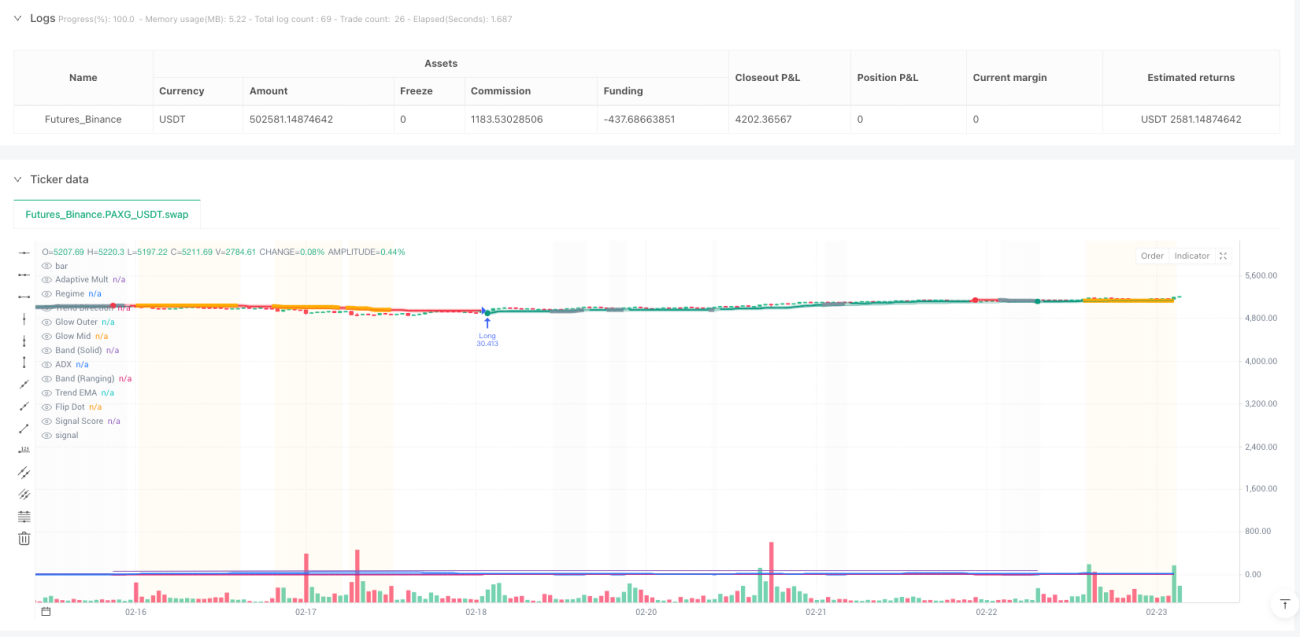
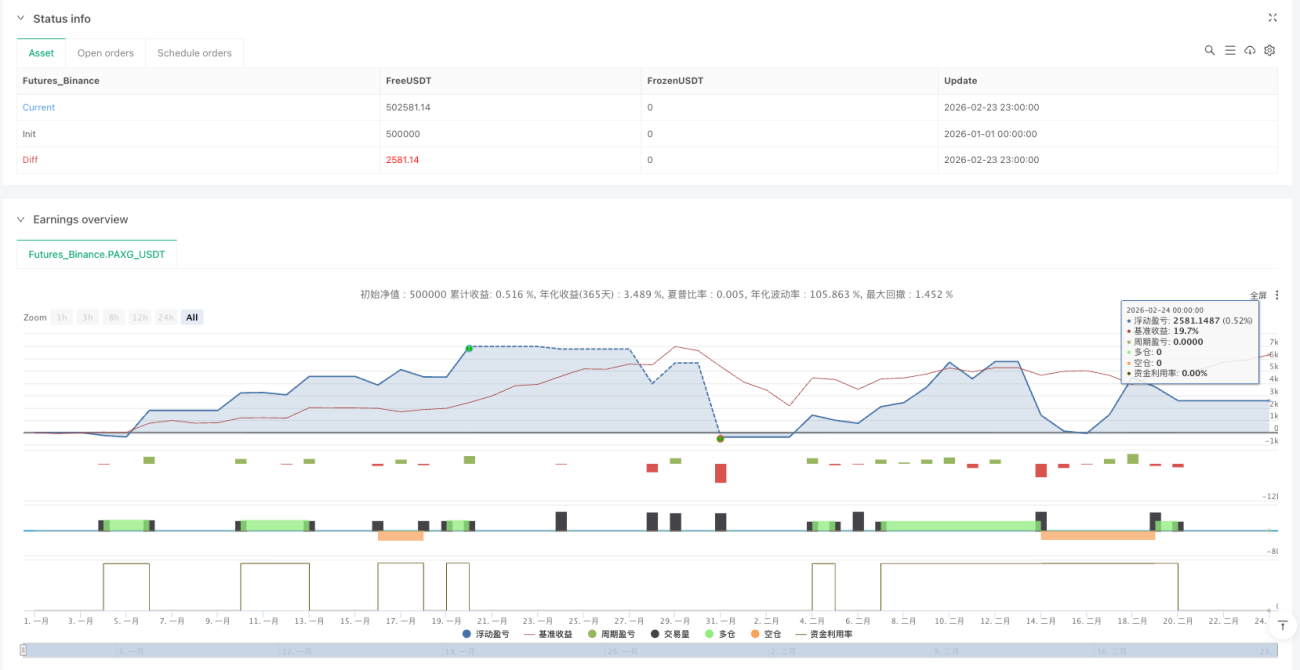
Adaptive Supertrend-KI-Strategie


Erstellungsdatum: 2026-02-25 17:53:23 zuletzt geändert: 2026-02-26 11:33:18
Kopie: 8 Klicks: 148
2
konzentrieren Sie sich auf
413
Anhänger

Adaptive Supertrend-KI-Strategie Adaptive Supertrend-KI-Strategie

SUPERTREND, ATR, ADX, EMA, AI

Das ist nicht die übliche Supertrend-Strategie, die Sie kennen.

Der größte Nachteil der traditionellen SuperTrend-Strategie? Die Fixparameter unterscheiden sich stark in der Performance in verschiedenen Marktumgebungen. Diese AI-erweiterte Version dynamisch die ATR-Multiplikator anpassen, um den Multiplikator zu erhöhen, um das 2-fache des Basiswerts während der hohen Schwankungen, während der niedrigen Schwankungen bis zu 0,85 Mal.

Die Kerninnovation besteht in einem dreistufigen Filtersystem: Marktstatuserkennung, AI-Signalbewertung und Mehrfachbestätigungsmechanismus. Es ist nicht mehr einfach, den Preis zu durchbrechen, um den SuperTrend zu betreten, sondern es ist erforderlich, dass der AI-Score 65 oder mehr Punkte erreicht, um ein Handelssignal auszulösen.

AI-Score-System: Quantifizierung der Zuverlässigkeit jedes Signals

Die Bewertungsmechanismen sind raffiniert konzipiert: Der Umsatzanstieg wird mit 20 Gewichtspunkten gewichtet, die Abweichung der Preise von der SuperTrend-Linie mit 25 Punkten, die EMA-Trendkonsistenz mit 20 Punkten, die Qualität der Marktlage mit 15 Punkten und die Vorlaufpreise und die Trendlinie mit 20 Punkten. Insgesamt 100 Punkte, die Standardschwelle von 65 Punkten bedeutet, dass nur hochwertige Signale durch die Filterung gelangen.

Insbesondere wird ein Vollwert von 20 Punkten erzielt, wenn der Umsatz mehr als das 2,5-fache des 20-Zyklus-Durchschnittswertes übersteigt, und ein Vollwert von 25 Punkten, wenn der Preis über die 1,5-fache ATR von der SuperTrend-Linie abweicht. Diese quantitative Bewertung vermeidet subjektive Beurteilungen, und jedes Signal wird eindeutig durch Daten unterstützt. In der praktischen Anwendung wird empfohlen, die Mindestwertanforderungen an die Eigenschaften der verschiedenen Sorten anzupassen.

Marktlage passt sich an: Abschied von Schnittparametern

Die Strategie identifiziert drei Arten von Marktsituationen anhand des ATR-Verhältnisses und des ADX-Indikators: Trendperiode (Regime = 1), Hochfluktuationsperiode (Regime = 2) und Schwingungsphase (Regime = 0). Eine Hochfluktuationsphase wird beurteilt, wenn der ATR-Verhältnis über 1,4 liegt. Eine Schwingungsphase wird beurteilt, wenn der ADX unter 20 liegt und der ATR-Verhältnis unter 0,9 liegt.

Anpassungslogik des Multiplikators: Das Multiplikator erhöht sich bei hohen Schwankungen um 40% × (ATR-Verhältnis -1.0) und das Multiplikator bei Schwankungen sinkt auf 85% des Basiswerts. Dies bedeutet, dass das Basismultiplikator von 3.0 bei extremen Schwankungen auf 4.2 angepasst werden kann und bei Schwankungen auf 2.55 gesenkt wird. Diese dynamische Anpassungsmechanik erhöht die Anpassungsfähigkeit der Strategie unter verschiedenen Marktbedingungen erheblich.

Risikomanagement: Drei Stop-Loss-Methoden für Sie

ATR-Dynamische Stopps sind die bevorzugte Option, wobei die Standard-Stop-Daten sowohl normale Schwankungen als auch zeitnahe Stopps mit einer Distanz von 2,5 mal ATR tolerieren. Die Prozentsatz-Stop-Daten eignen sich für eine relativ stabile Variante der Schwankungen, während der SuperTrend-Modus sofort platziert wird, wenn sich der Trend umkehrt.

Die Stop-Line-Einstellung unterstützt das Risiko-Gewinn-Verhältnis-Modus, wobei das Standardrisiko-Gewinn-Verhältnis von 2.5:1 statistisch vorteilhaft ist. Nach der Aktivierung des Stop-Tracking wird die Stop-Line für eine gewinnbringende Position dynamisch an die 2,5-fache ATR-Distanz angepasst, um den Gewinn in einem Trend zu maximieren.

Mehrfachfilter: Weniger ungültige Geschäfte

Der EMA-Trendfilter sorgt dafür, dass nur bei einer 50-Zyklus-EMA-Richtung eingeschaltet wird, um Rückschläge zu vermeiden. Die Schwingungsphase-Filterung überspringt direkt das Signal mit Regime = 0, wodurch die Falschsignalrate deutlich reduziert wird, obwohl möglicherweise einige Chancen verpasst werden.

Die Transaktionsvolumen-Filterung erfordert, dass die Transaktionsmenge bei der Eintrittszeit über dem 20-Zyklus-Durchschnittswert liegt, um sicherzustellen, dass genügend Marktbeteiligung zur Unterstützung des Preisbruchs besteht. Die 10-Zyklus-Abkühlzeit verhindert häufige Transaktionen und reduziert die Transaktionskosten.

Empfehlungen für den Einsatz: Parameter-Abstimmung und Risikokontrolle

Für Kryptowährungen wird empfohlen, die Mindest-AI-Bewertung auf 70 Punkte zu erhöhen, für herkömmliche Aktien auf 60 Punkte. Hochfrequente Händler können die Abkühlzeit auf 5 Zyklen verkürzen, langfristige Investoren empfehlen eine Verlängerung auf 15 Zyklen.

Der ATR-Längenparameter 10 ist ein optimierter Gleichgewichtspunkt, zu kurz wird überempfindlich und zu lang wird verzögert. Das Basisfaktor 3.0 ist für die meisten Sorten geeignet, bei hochschwingenden Sorten kann es auf 3,5 eingestellt werden, bei niedrigschwingenden Sorten auf 2,5.

Wichtige GefahrenhinweiseEs wird empfohlen, die Einzelsituation nicht mehr als 30% des Gesamtkapitals zu kontrollieren. Es gibt deutliche Unterschiede in der Performance der Strategie in verschiedenen Marktumgebungen, die kontinuierlich überwacht und angepasst werden müssen.

Strategiequellcode
/*backtest
start: 2026-01-01 00:00:00
end: 2026-02-24 00:00:00
period: 1h
basePeriod: 1h
exchanges: [{"eid":"Futures_Binance","currency":"PAXG_USDT","balance":500000}]
*/

// This source code is subject to the terms of the Mozilla Public License 2.0 at https://mozilla.org/MPL/2.0/
// © DefinedEdge

//@version=6
strategy("SuperTrend AI Strategy [Adaptive]", "ST AI Strategy ◈",
     overlay         = true,
     initial_capital  = 10000,
     default_qty_type = strategy.percent_of_equity,
     default_qty_value= 30,
     commission_type  = strategy.commission.percent,
     commission_value = 0.06,
     slippage         = 2,
     pyramiding       = 0,
     calc_on_every_tick = false,
     max_labels_count = 500)

// ============================================================================
// INPUTS
// ============================================================================

// --- SuperTrend Core ---
GRP_ST  = "◈ SuperTrend"
i_atLen = input.int(10,    "ATR Length",        minval=1, maxval=50, group=GRP_ST)
i_bMult = input.float(3.0, "Base Multiplier",   minval=0.5, maxval=10.0, step=0.1, group=GRP_ST)
i_src   = input.source(hl2, "Source",           group=GRP_ST)

// --- Regime Detection ---
GRP_REG  = "◈ Regime Detection"
i_regLen = input.int(40,    "Regime Lookback",   minval=10, maxval=100, group=GRP_REG)
i_adxLen = input.int(14,    "ADX Length",        minval=5,  maxval=50,  group=GRP_REG)
i_adxThr = input.float(20,  "ADX Trend Threshold", minval=10, maxval=40, step=1, group=GRP_REG)
i_adapt  = input.bool(true, "Adaptive Multiplier", group=GRP_REG)

// --- AI Scoring ---
GRP_AI     = "◈ AI Engine"
i_trendLen = input.int(50,  "Trend EMA Length",  minval=10, maxval=200, group=GRP_AI)
i_volLen   = input.int(20,  "Volume MA Length",   minval=5,  maxval=50, group=GRP_AI)
i_minSc    = input.int(65,  "Min Signal Score",   minval=0,  maxval=90, group=GRP_AI, tooltip="Only enter trades when the AI score meets this threshold.")

// --- Risk Management ---
GRP_RISK = "◈ Risk Management"
i_slMode = input.string("ATR", "Stop Loss Mode", options=["ATR", "Percent", "SuperTrend"], group=GRP_RISK, tooltip="ATR: dynamic SL based on volatility. Percent: fixed %. SuperTrend: exit on trend flip.")
i_slAtr  = input.float(2.5,  "SL ATR Multiplier", minval=0.5, maxval=8.0, step=0.1, group=GRP_RISK)
i_slPct  = input.float(3.0,  "SL Percent",        minval=0.5, maxval=10.0, step=0.1, group=GRP_RISK)
i_tpMode = input.string("RR", "Take Profit Mode", options=["RR", "Percent", "None"], group=GRP_RISK, tooltip="RR: risk/reward ratio based on SL distance. Percent: fixed %. None: hold until SL or flip.")
i_tpRR   = input.float(2.5,  "TP Risk:Reward",    minval=0.5, maxval=10.0, step=0.1, group=GRP_RISK)
i_tpPct  = input.float(6.0,  "TP Percent",        minval=0.5, maxval=20.0, step=0.1, group=GRP_RISK)
i_trail  = input.bool(true,  "Trailing Stop",     group=GRP_RISK, tooltip="When enabled, SL trails in the direction of the trade after entry.")
i_trailAtr = input.float(2.5, "Trail ATR Mult",   minval=0.5, maxval=8.0, step=0.1, group=GRP_RISK)

// --- Filters ---
GRP_FLT  = "◈ Trade Filters"
i_trendF = input.bool(true,  "EMA Trend Filter",  group=GRP_FLT, tooltip="Only take longs above EMA, shorts below EMA.")
i_regF   = input.bool(true,  "Skip Ranging",      group=GRP_FLT, tooltip="Skip entries during ranging regime. Reduces whipsaws.")
i_volF   = input.bool(true,  "Volume Filter",      group=GRP_FLT, tooltip="Only enter if volume is above average.")
i_sigCD  = input.int(10,     "Cooldown (bars)",    minval=0, maxval=50, group=GRP_FLT)

// --- Backtest Window ---
GRP_BT   = "◈ Backtest"
bool inWindow = true 

// --- Visuals ---
GRP_VIS  = "◈ Visuals"
i_sGlow  = input.bool(true,  "Band Glow Effect",    group=GRP_VIS)
i_sRegBg = input.bool(true,  "Regime Background",   group=GRP_VIS)


// --- Colors ---
GRP_COL  = "◈ Colors"
i_cBull  = input.color(color.new(#089981, 0), "Bull",  inline="c1", group=GRP_COL)
i_cBear  = input.color(color.new(#f23645, 0), "Bear",  inline="c1", group=GRP_COL)

// ============================================================================
// CORE CALCULATIONS
// ============================================================================

int n = bar_index
float atr = ta.atr(i_atLen)
float safeAtr = nz(atr, 0.001)

// ── Regime Detection ──
float atrMa    = ta.sma(atr, i_regLen)
float atrRatio = atrMa > 0 ? atr / atrMa : 1.0

// ADX
float upMove   = high - high[1]
float dnMove   = low[1] - low
float plusDM    = upMove > dnMove and upMove > 0 ? upMove : 0
float minusDM  = dnMove > upMove and dnMove > 0 ? dnMove : 0
float trueR    = ta.tr
float smoothTR = ta.rma(trueR, i_adxLen)
float smoothPD = ta.rma(plusDM, i_adxLen)
float smoothND = ta.rma(minusDM, i_adxLen)
float plusDI    = smoothTR > 0 ? 100 * smoothPD / smoothTR : 0
float minusDI  = smoothTR > 0 ? 100 * smoothND / smoothTR : 0
float diSum    = plusDI + minusDI
float dx       = diSum > 0 ? 100 * math.abs(plusDI - minusDI) / diSum : 0
float adx      = ta.rma(dx, i_adxLen)

var int regime = 1
if atrRatio > 1.4
    regime := 2
else if adx < i_adxThr and atrRatio < 0.9
    regime := 0
else
    regime := 1

// ── Adaptive Multiplier ──
float adaptMult = i_bMult
if i_adapt
    if regime == 2
        adaptMult := i_bMult * (1.0 + (atrRatio - 1.0) * 0.4)
    else if regime == 0
        adaptMult := i_bMult * 0.85
adaptMult := math.max(math.min(adaptMult, i_bMult * 2.0), i_bMult * 0.5)

// ── SuperTrend ──
var float stBand  = na
var int   stDir   = 1

float upperBase = i_src + adaptMult * atr
float lowerBase = i_src - adaptMult * atr
float prevBand  = nz(stBand[1], stDir == 1 ? lowerBase : upperBase)

if stDir == 1
    stBand := math.max(lowerBase, prevBand)
    if close < stBand
        stDir  := -1
        stBand := upperBase
else
    stBand := math.min(upperBase, prevBand)
    if close > stBand
        stDir  := 1
        stBand := lowerBase

bool trendFlip = stDir != stDir[1]

// ── Trend EMA ──
float trendMa = ta.ema(close, i_trendLen)
bool  trendUp = close > trendMa
bool  trendDn = close < trendMa

// ── Volume ──
float volMa = ta.sma(volume, i_volLen)

// ============================================================================
// AI SIGNAL SCORING
// ============================================================================

scoreSignal(bool isBull) =>
    float score = 0

    // Factor 1: Volume surge (0-20)
    float vRat = volMa > 0 ? volume / volMa : 1.0
    score += vRat >= 2.5 ? 20 : vRat >= 1.5 ? 14 : vRat >= 1.0 ? 8 : 3

    // Factor 2: Displacement beyond band (0-25)
    float disp = isBull ? (close - stBand) : (stBand - close)
    float dispAtr = safeAtr > 0 ? disp / safeAtr : 0
    score += dispAtr >= 1.5 ? 25 : dispAtr >= 0.8 ? 18 : dispAtr >= 0.3 ? 12 : dispAtr > 0 ? 5 : 0

    // Factor 3: EMA trend alignment (0-20)
    bool aligned = (isBull and trendUp) or (not isBull and trendDn)
    float emaDist = math.abs(close - trendMa) / safeAtr
    score += aligned and emaDist > 0.5 ? 20 : aligned ? 14 : emaDist < 0.3 ? 8 : 2

    // Factor 4: Regime quality (0-15)
    score += regime == 1 ? 15 : regime == 2 ? 8 : 3

    // Factor 5: Band distance before flip (0-20)
    float prevDist = not na(stBand[1]) ? math.abs(close[1] - stBand[1]) / safeAtr : 0
    score += prevDist >= 2.0 ? 20 : prevDist >= 1.0 ? 14 : prevDist >= 0.5 ? 8 : 3

    int(math.min(math.round(score), 100))

// ============================================================================
// TRADE LOGIC
// ============================================================================

var int   lastEntryBar  = 0
var float entryPrice    = 0.0
var float slPrice       = 0.0
var float tpPrice       = 0.0
var int   lastSigScore  = 0
var int   lastSigDir    = 0
var bool  lastSigBright = false

bool longEntry  = false
bool shortEntry = false
int  sigScore   = 0

// Cooldown check
bool cdOk = (n - lastEntryBar) > i_sigCD

if trendFlip and inWindow and cdOk and barstate.isconfirmed
    if stDir == 1
        sigScore := scoreSignal(true)
        // Apply filters
        bool passScore = sigScore >= i_minSc
        bool passTrend = not i_trendF or trendUp
        bool passReg   = not i_regF or regime != 0
        bool passVol   = not i_volF or (volume > volMa)

        if passScore and passTrend and passReg and passVol
            longEntry := true

    else
        sigScore := scoreSignal(false)
        bool passScore = sigScore >= i_minSc
        bool passTrend = not i_trendF or trendDn
        bool passReg   = not i_regF or regime != 0
        bool passVol   = not i_volF or (volume > volMa)

        if passScore and passTrend and passReg and passVol
            shortEntry := true

// ── Calculate SL/TP Levels ──
float slDist = 0.0
if i_slMode == "ATR"
    slDist := atr * i_slAtr
else if i_slMode == "Percent"
    slDist := close * i_slPct / 100
else // SuperTrend mode
    slDist := math.abs(close - stBand)

float tpDist = 0.0
if i_tpMode == "RR"
    tpDist := slDist * i_tpRR
else if i_tpMode == "Percent"
    tpDist := close * i_tpPct / 100

// ── Execute Entries ──
if longEntry
    // Close any existing short
    if strategy.position_size < 0
        strategy.close("Short")

    entryPrice := close
    slPrice    := close - slDist
    tpPrice    := i_tpMode != "None" ? close + tpDist : na

    strategy.entry("Long", strategy.long)

    if not na(slPrice) and i_tpMode != "None" and not na(tpPrice)
        strategy.exit("Long Exit", "Long", stop=slPrice, limit=tpPrice,
             trail_points = i_trail ? slDist / syminfo.mintick : na,
             trail_offset = i_trail ? (atr * i_trailAtr) / syminfo.mintick : na)
    else if not na(slPrice)
        strategy.exit("Long SL", "Long", stop=slPrice,
             trail_points = i_trail ? slDist / syminfo.mintick : na,
             trail_offset = i_trail ? (atr * i_trailAtr) / syminfo.mintick : na)

    lastEntryBar  := n
    lastSigScore  := sigScore
    lastSigDir    := 1
    lastSigBright := sigScore >= 70

if shortEntry
    // Close any existing long
    if strategy.position_size > 0
        strategy.close("Long")

    entryPrice := close
    slPrice    := close + slDist
    tpPrice    := i_tpMode != "None" ? close - tpDist : na

    strategy.entry("Short", strategy.short)

    if not na(slPrice) and i_tpMode != "None" and not na(tpPrice)
        strategy.exit("Short Exit", "Short", stop=slPrice, limit=tpPrice,
             trail_points = i_trail ? slDist / syminfo.mintick : na,
             trail_offset = i_trail ? (atr * i_trailAtr) / syminfo.mintick : na)
    else if not na(slPrice)
        strategy.exit("Short SL", "Short", stop=slPrice,
             trail_points = i_trail ? slDist / syminfo.mintick : na,
             trail_offset = i_trail ? (atr * i_trailAtr) / syminfo.mintick : na)

    lastEntryBar  := n
    lastSigScore  := sigScore
    lastSigDir    := -1
    lastSigBright := sigScore >= 70

// ── SuperTrend Flip Exit (if SL mode is SuperTrend) ──
if i_slMode == "SuperTrend" and trendFlip
    if strategy.position_size > 0 and stDir == -1
        strategy.close("Long", comment="ST Flip")
    if strategy.position_size < 0 and stDir == 1
        strategy.close("Short", comment="ST Flip")

// ============================================================================
// VISUALS
// ============================================================================

// ── Band Color ──
color bandCore  = stDir == 1 ? i_cBull : i_cBear
color bandColor = regime == 2 ? color.new(#ffab00, 0) : regime == 0 ? color.new(#78909c, 20) : bandCore

// ── Glow ──
plot(i_sGlow ? stBand : na, "Glow Outer", color=color.new(bandColor, 85), linewidth=6, style=plot.style_linebr)
plot(i_sGlow ? stBand : na, "Glow Mid",   color=color.new(bandColor, 70), linewidth=4, style=plot.style_linebr)

// ── Band ──
plot(regime != 0 ? stBand : na, "Band (Solid)",   color=bandColor, linewidth=2, style=plot.style_linebr)
plot(regime == 0 ? stBand : na, "Band (Ranging)",  color=bandColor, linewidth=2, style=plot.style_linebr)

// ── Flip Dot ──
plot(trendFlip ? stBand : na, "Flip Dot", color=bandCore, style=plot.style_circles, linewidth=5, join=false)

// ── Regime Background ──
bgcolor(i_sRegBg and regime == 2 ? color.new(#ffab00, 95) : na, title="Volatile BG")
bgcolor(i_sRegBg and regime == 0 ? color.new(#78909c, 96) : na, title="Ranging BG")

// ── Trend EMA ──
plot(trendMa, "Trend EMA", color=color.new(trendUp ? i_cBull : i_cBear, 65), linewidth=1)

// ============================================================================
// HIDDEN PLOTS
// ============================================================================

plot(sigScore > 0 ? sigScore : na, "Signal Score", display=display.none)
plot(adaptMult,     "Adaptive Mult",  display=display.none)
plot(adx,           "ADX",            display=display.none)
plot(float(regime), "Regime",         display=display.none)
plot(float(stDir),  "Trend Direction", display=display.none)