Multi-factor Strategy

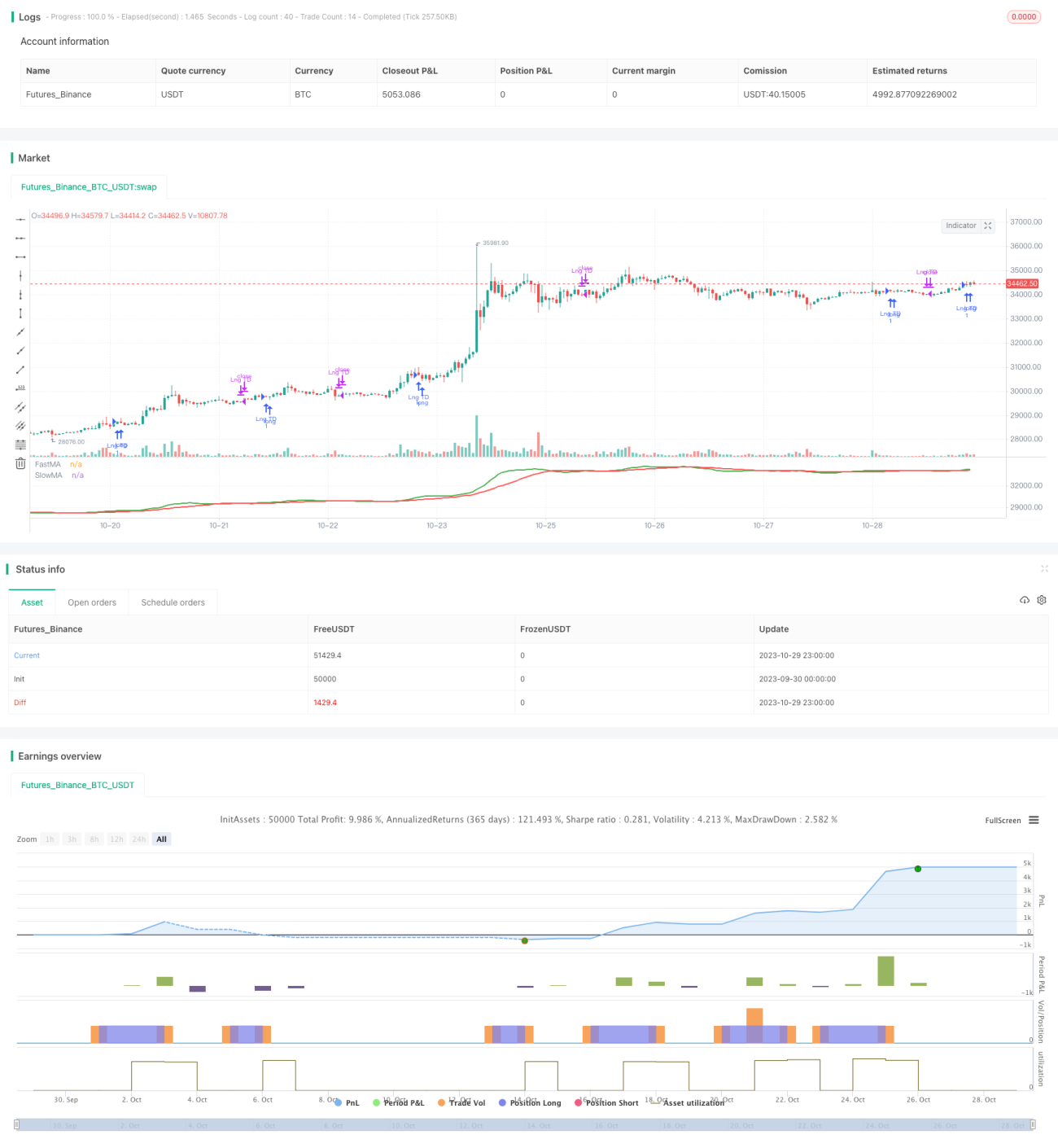
Overview
The multi-factor strategy integrates oscillating, trend-following, and breakout strategies into one by combining their strengths. This allows obtaining better performance across different market conditions.
Strategy Logic
The multi-factor strategy is mainly modeled based on the following aspects:
-
The oscillating part uses the Stochastic oscillator to identify buy and sell signals. Specifically, a buy signal is generated when the %K line crosses over the %D line from the oversold zone. A sell signal is generated when the %K line crosses below the %D line from the overbought zone.
-
The trend-following part uses the golden cross of SMAs to determine the trend direction. A buy signal is generated when the fast SMA crosses above the slow SMA. A sell signal is generated when the fast SMA crosses below the slow SMA.
-
The breakout part monitors if the price breaks out above the highest price or breaks down below the lowest price in a specified period. It will trigger a buy when the price breaks out above the highest price, and a sell when the price breaks down below the lowest price.
-
The ADX indicator is used to measure the trend strength. Trend trading signals are only generated when the trend is strong enough.
-
Stop loss and take profit lines are implemented to optimize profitability.
In summary, the multi-factor strategy follows the logic below:
-
When ADX is above a threshold, the trend is considered strong. The trend-following strategy takes effect. When ADX is below the threshold, the market is ranging. Only the oscillating strategy takes effect.
-
In a trending market, the SMA golden cross triggers a long entry and the death cross triggers exiting positions.
-
In a ranging market, trading signals from the Stochastic oscillator are followed.
-
The breakout strategy applies in both market conditions to follow strong momentum.
-
Stop loss and take profit lines are set to lock in profits and limit losses.
Advantage Analysis
The biggest advantage of the multi-factor strategy is that it combines the strengths of different strategies and achieves good performance in both trending and ranging markets. The main advantages are:
-
It rides trends well and achieves high winning rates in trending markets.
-
It can profit from range-bound markets and avoids being stuck in positions.
-
It has high profit factors with properly set stop loss and take profit.
-
It considers trend strength to reduce losses from false signals.
-
The combination of multiple indicators leads to strong trading signals.
-
The parameters can be optimized for better performance.
Risk Analysis
There are also risks associated with the multi-factor strategy:
-
Improper combination of factors may lead to conflicting trading signals. Extensive testing is required to find the optimal combination.
-
Multiple parameters increase the difficulty of optimization and require sufficient historical data.
-
It may fail to exit positions in time when the trend reverses, leading to large losses.
-
The ADX indicator has lagging effects and may miss trend turning points.
-
Breakout trading is prone to getting trapped in losing positions. Reasonable stop loss is required.
The risks can be mitigated through:
-
Backtesting factor stability and picking stable ones.
-
Using heuristic optimization algorithms to find the optimal parameters.
-
Setting proper stop loss to control maximum drawdown.
-
Incorporating additional indicators to detect trend reversal.
-
Optimizing the stop loss rules for breakout trading.
Improvement Directions
There is still room for improving the multi-factor strategy:
-
Testing more factor types like volatility, volume etc. to find better combinations.
-
Using machine learning techniques to optimize factor weights dynamically.
-
Leveraging heuristic algorithms for fast parameter optimization.
-
Testing profitability under different holding periods.
-
Exploring dynamic stop loss rules. For example, widening stop loss after making some profits.
-
Adding more filters like volume spikes to improve signal quality.
-
Optimizing ADX parameters or using more advanced trend detection indicators.
Conclusion
The multi-factor strategy combines multiple trading logics like trend, mean-reversion, and breakout. It achieves good performance in both trending and ranging markets. Compared to single-factor strategies, it provides more stable returns and has great potential for upgrades. However, the parameter optimization could be difficult and requires sufficient historical data. Overall, the multi-factor strategy is a very effective algorithmic trading technique worth further research and optimization.
/*backtest
start: 2023-09-30 00:00:00
end: 2023-10-30 00:00:00
period: 1h
basePeriod: 15m
exchanges: [{"eid":"Futures_Binance","currency":"BTC_USDT"}]
*/

//@version=4

// strategy("Strategy_1", shorttitle="Strategy1",overlay=true ,pyramiding = 12, initial_capital=25000, currency='EUR', commission_type = strategy.commission.cash_per_order, commission_value = 3, default_qty_type = strategy.percent_of_equity, default_qty_value = 20)
- 1