Trend Following Moving Average Crossover Trading Strategy

Overview
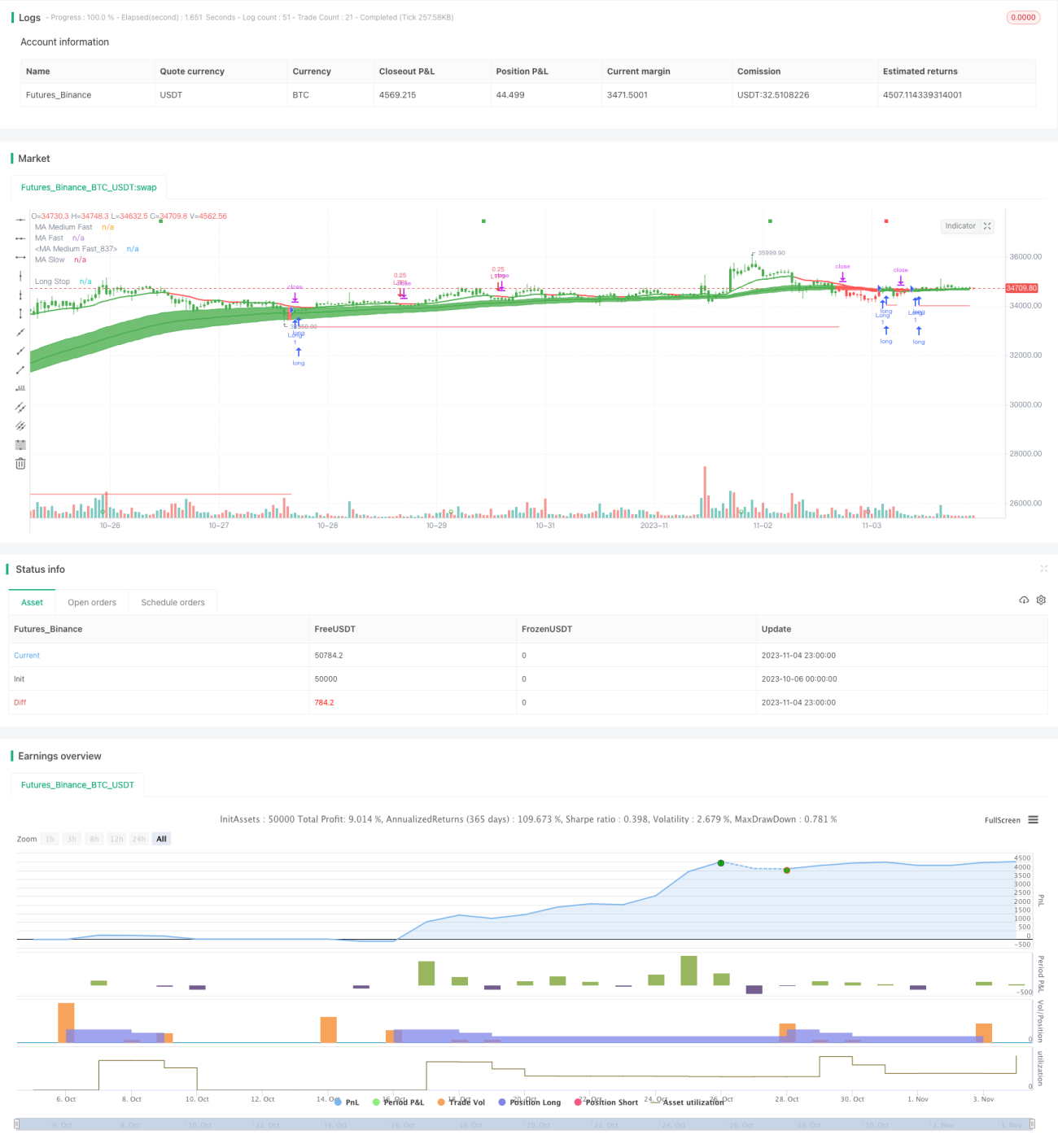
This is a trend following trading strategy based on moving averages. It uses three Hull moving averages with different parameter settings to determine the price trend direction and incorporates a fast ATR filter to detect potential trend reversals in advance. When the fast, medium and slow moving averages cross upwards or downwards, buy or sell signals are generated. The strategy also has trailing stop loss and take profit functions to effectively control risks.
Strategy Logic
The strategy uses three Hull moving averages to judge the price trend, including a faster Hull MA, a medium Hull MA and a slower Hull MA. The trend direction is determined based on their crossover situations:
-
When the fast line crosses above the medium line, it indicates the price is entering an uptrend and a buy signal is generated.
-
When the fast line crosses below the medium line, it indicates the price is entering a downtrend and a sell signal is generated.
To increase the sensitivity in identifying trend reversals, the strategy introduces a fast ATR filter based on RSI. This filter can measure the volatility of price levels. When the price trend changes, its value will change significantly. Therefore, we can judge the reversal of the price trend in advance based on the breakouts of the ATR filter.
Specifically, the filtr function implements the calculation logic of this fast ATR filter. It calculates the ATR size based on the RSI values. When the ATR value breaks above or below the RSI curve, it may indicate a change in the price trend.
In addition, the strategy sets trailing stop loss and take profit conditions to realize automatic risk management according to the set stop loss percentage and take profit percentage.
Advantage Analysis
-
Using three Hull MA lines to determine the trend direction can effectively filter market noise and identify medium-to-long term trends
-
Application of the fast ATR filter can improve the ability to early judge trend reversals
-
Automatically seize opportunities of trend reversal and timely adjust positions without missing buys or sells
-
The moving stop loss and take profit setup strikes a dynamic balance between risk and reward
-
Customizable parameters make it suitable for different markets and trading instruments
Risk Analysis
-
MA crossover strategies tend to produce false buy and sell signals, requiring ATR filter for verification
-
In volatile markets, MAs may cross frequently, closely monitor ATR curve moves
-
A stop loss point too small is prone to be stopped out, too large fails to control losses. Need to adjust parameters based on specific situations
-
This strategy suits trending markets more, not suitable for range-bound markets
-
Can optimize parameters to select the best MA and ATR period combination, reducing false signals
Optimization Directions
-
Try changing MA type to DEMA, TEMA etc, see if more noise can be filtered
-
ATR filter can be changed to Keltner's MIDDLE line to improve trend reversal judgment
-
Can test different MA parameter combinations to find the optimal pair
-
Can test ATR period parameter to find the best smoothing effect
-
Can add volume indicators to aid judgment of true/false breakouts
-
Can test adding other indicators like MACD to improve signal reliability
Summary
This strategy integrates moving averages for trend direction, ATR filter for early reversal detection and automatic stop loss/take profit for risk management. It can automatically track trends and timely seize reversal opportunities. Through parameter optimization it can be applied to different instruments and timeframes and is a very practical trend following trading strategy. Its advantages are the simple and clear strategy logic and efficient risk control means. But the issues of false signals and stop loss point settings also need attention. Further optimizations may lead to better strategy performance.
- 1