Bidirectional Reversal and Momentum Moving Average Strategy

Overview
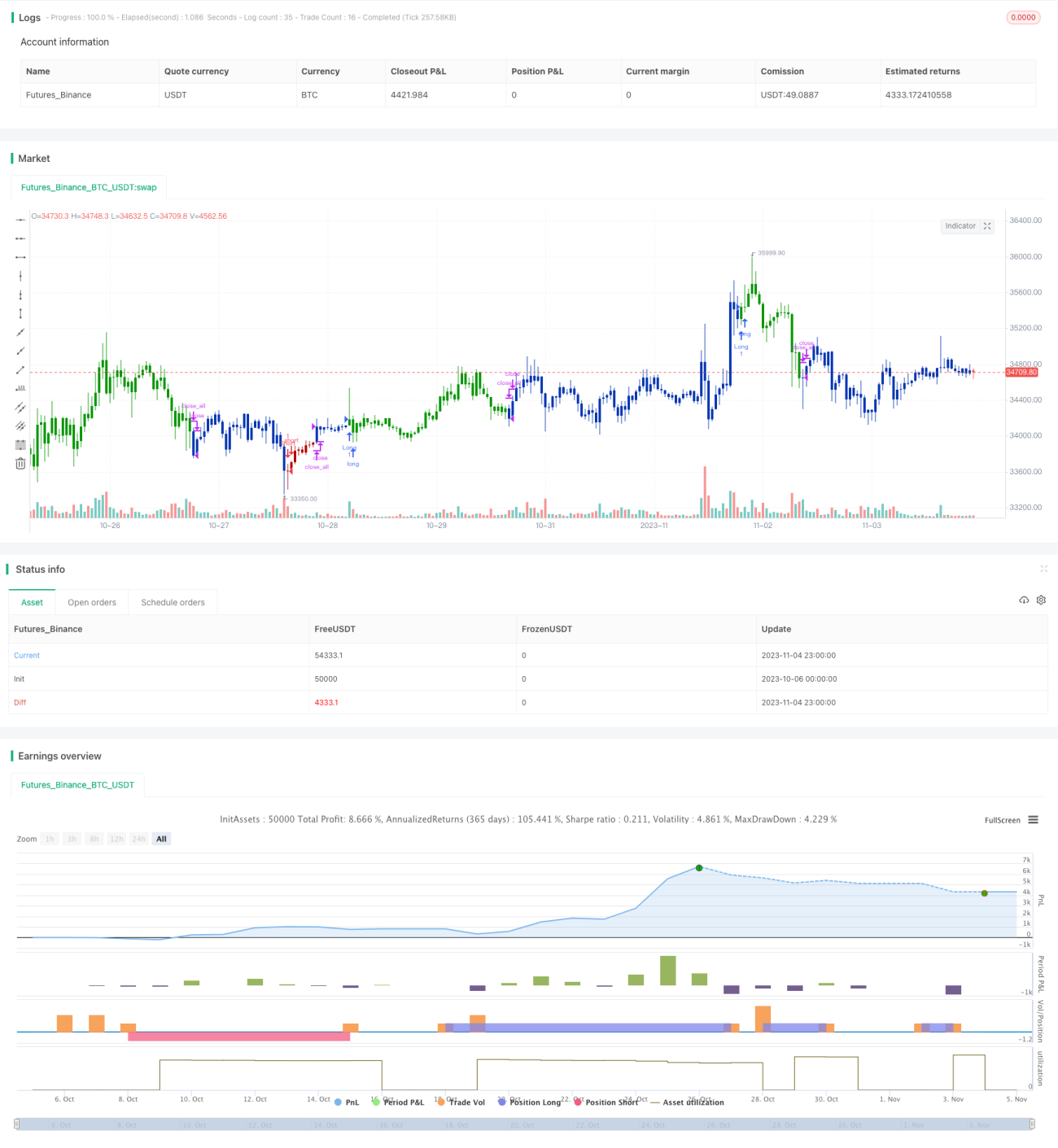
This strategy combines reversal trading rules with momentum indicators. It integrates bidirectional reversal and Chande Momentum Oscillator to identify reversal opportunities while verifying momentum signals to generate more reliable trading signals.
Strategy Logic
The strategy consists of two parts:
The first part is bidirectional reversal trading rules. It identifies reversal opportunities by detecting close price changes in previous two days. Specifically, if close prices decreased in previous two days, and current close price is higher than previous close, and Stochastic Oscillator is below a threshold, it triggers a buy signal. On the contrary, if close prices increased in previous two days, and current close price is lower than previous close, and Stochastic Oscillator is above a threshold, it triggers a sell signal.
The second part is Chande Momentum Oscillator. It compares the magnitude of price change with the average magnitude in a certain period to determine momentum. If the momentum indicator is above a upper limit, it generates a buy signal. If below a lower limit, it generates a sell signal.
The strategy combines bidirectional reversal trading rules to locate potential reversal points, and momentum indicator to verify the validity of the reversal signals. Only when both signals agree, actual buy or sell signals will be generated.
Advantages of the Strategy
-
Dual verification mechanism improves signal reliability by avoiding false signals. Reversal trading rules identify potential reversal points, and momentum indicators verify effectiveness of the reversal signals.
-
Combining reversal strategy with trend strategy provides flexibility to capture opportunities in both reversing and trending markets.
-
Introducing momentum prevents falling into reversal traps by only trading when momentum confirms.
-
Multiple adjustable parameters can be optimized for different market conditions.
Risks of the Strategy
-
Reversal signals may face large pullbacks, requiring reasonable stop loss.
-
Precise timing of reversals is difficult, may cause misjudgments.
-
Lagging of momentum indicators may cause missing best reversal entry points.
-
Parameter tuning needs careful optimization based on specific markets, improper settings may increase risks.
Risks can be reduced by using proper stop loss, robust parameter optimization, keeping some room in reversal signal triggering conditions, etc.
Directions for Optimization
-
Test different reversal parameter combinations to find parameters sensitive to market reversals.
-
Try different momentum indicators, like RSI, volume rate of change, etc.
-
Add filters like breakouts to avoid trading non-key reversal points.
-
Evaluate stop loss strategies to find maximum drawdown-controlled methods.
-
Assess position sizing strategies to adjust position sizes based on market conditions.
Conclusion
The strategy combines the advantages of reversal and momentum strategies, with reliable signals and flexibility to capture opportunities. Parameters can be optimized, risks can be managed through stop loss and position sizing to improve stability and profitability. Overall, it explores effective integration of reversal and trend strategies, and is worth further research and application.
/*backtest
start: 2023-10-06 00:00:00
end: 2023-11-05 00:00:00
period: 1h
basePeriod: 15m
exchanges: [{"eid":"Futures_Binance","currency":"BTC_USDT"}]
*/

//@version=4
////////////////////////////////////////////////////////////
//  Copyright by HPotter v1.0 18/08/2019
// This is combo strategies for get a cumulative signal. - 1