Volume Price Trend Reversal Forex Trading Strategy Based on Stairstep EMA

Overview
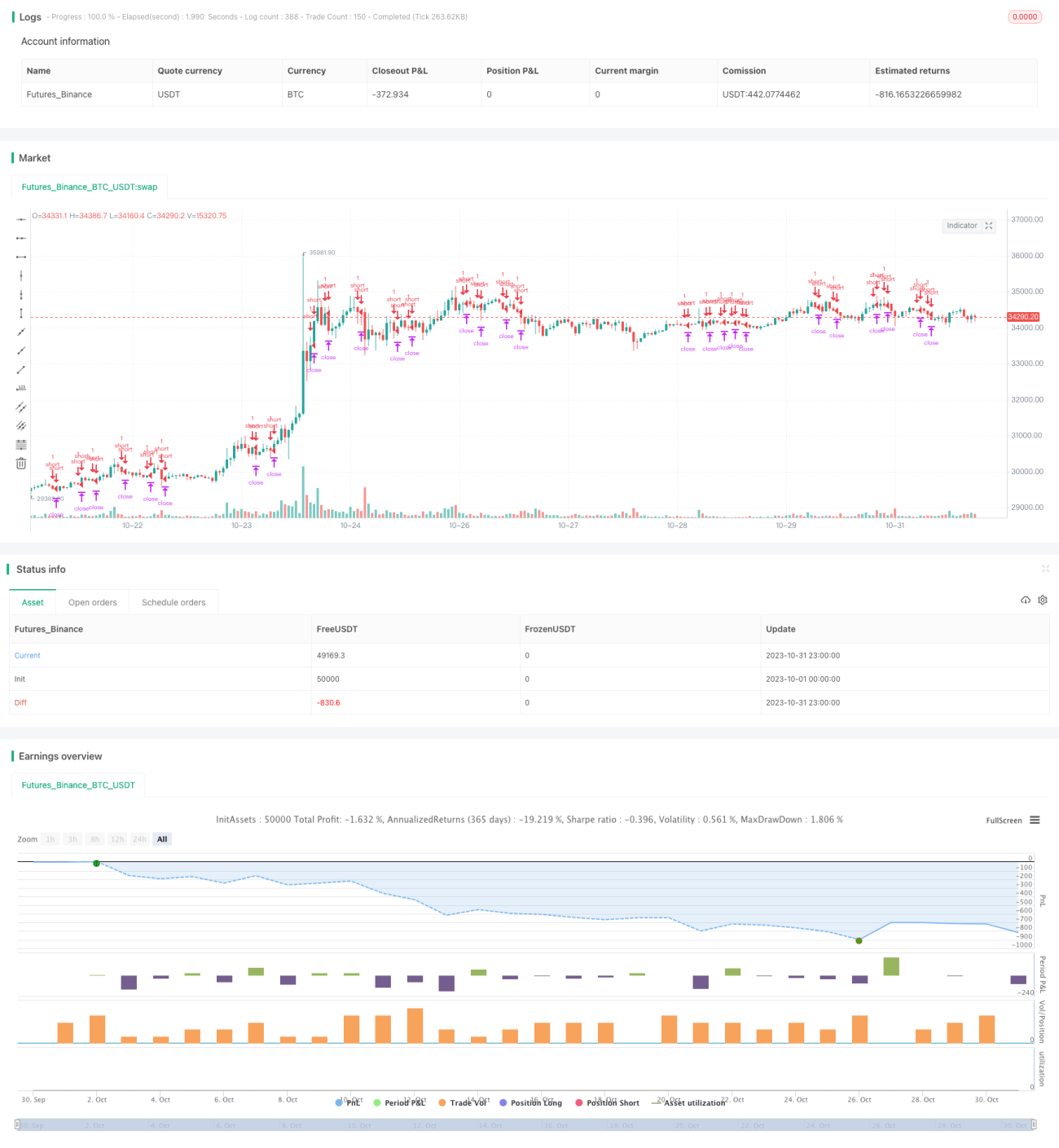
This is a short-term (1-5 minutes) forex trading strategy that mainly utilizes the volume price relationship in tidal theory and multiple Stairstep EMAs to predict trend reversal points for short-term trend tracking trading. The strategy is suitable for high-frequency trading.
Principle
The trading signals of this strategy come from two parts:
-
Volume price relationship judgment based on volume average price. Specifically, the strategy calculates the EMA of volume average price of different periods (configurable) to judge the change in bullish and bearish trends. If the short period EMA crosses above the longer period EMA, it is considered a bullish signal. If the short period EMA crosses below the longer period EMA, it is considered a bearish signal.
-
Trend reversal signals judged by Stairstep EMA. Stairstep EMA refers to setting multiple EMAs with different parameters, such as 10-day, 20-day, 50-day, etc. Judging trend reversal according to their order. If the short period EMA turns ahead of the long period EMA, it means the trend is reversing.
The strategy will combine these two signals to determine entry. Specifically, if the volume price relationship is judged as bullish, and the Stairstep EMA shows that multiple EMAs have turned bullish, long positions will be taken. Conversely, if the volume price relationship is judged as bearish, and the Stairstep EMA shows multiple EMAs have turned bearish, short positions will be taken.
Advantages
This strategy combines the advantages of volume average price and multiple EMAs, which can improve the accuracy and stability of signals:
-
Judging the volume price relationship based on volume average price can be more accurate than simply price EMA judgment, avoiding being misled by enhanced price fluctuations.
-
Stairstep EMA can increase the dimension of judgment by the order of different parameter EMAs, avoiding the noise of a single EMA.
-
The combination of the two signals enables mutual verification and reduces false signals.
-
It is suitable for high-frequency short-term trading and can quickly capture small reversal opportunities within the range.
-
The strategy parameters can be flexibly configured to optimize for different varieties and frequencies.
Risks
This strategy also has some risks:
-
Overly dependent on technical indicators, there is a possibility of being misled by erratic market conditions.
-
Short-term operations are relatively sensitive to trading costs, slippage and commissions need to be well controlled.
-
Short-term EMA parameters need frequent optimization, otherwise they may become invalid.
-
Volume price divergence does not necessarily generate reversal, there is a risk of misjudgment.
-
The order of multiple EMAs is not completely reliable and may also cause misjudgments.
Countermeasures:
-
Combine more fundamental factors for judgment.
-
Adjust positions to ensure losses on single trades are not too large.
-
Regularly retest and optimize parameters.
-
Trade near key support/resistance levels to increase success rate.
-
Use with other indicators for multi-dimensional verification.
Optimization Directions
This strategy can also be optimized in the following aspects:
-
Test different methods of calculating volume price relationship to find more stable parameters.
-
Increase more levels of Stairstep EMA indicators.
-
Combine other indicator signals for filtering, such as RSI, MACD, etc.
-
Optimize stop loss mechanisms like moving stop loss, pending orders, etc.
-
Optimize parameters based on characteristics of different trading instruments to develop suitable parameter sets.
-
Introduce machine learning algorithms to train judgment models using big data.
-
Explore different exit strategies such as fixed exits, trend tracking exits, etc.
-
Introduce adaptive parameter mechanisms to automatically adjust parameters based on market changes.
Summary
This strategy combines the advantages of volume average price and Stairstep EMA for short-term trend tracking trading. The strategy has high stability and accuracy, but risk control and parameter optimization need to be noted. With continuous optimization and testing, combined with other technical indicators, it can become an efficient short-term trading strategy.
- 1