Multiple Moving Average Dynamic Trend Strategy

Overview
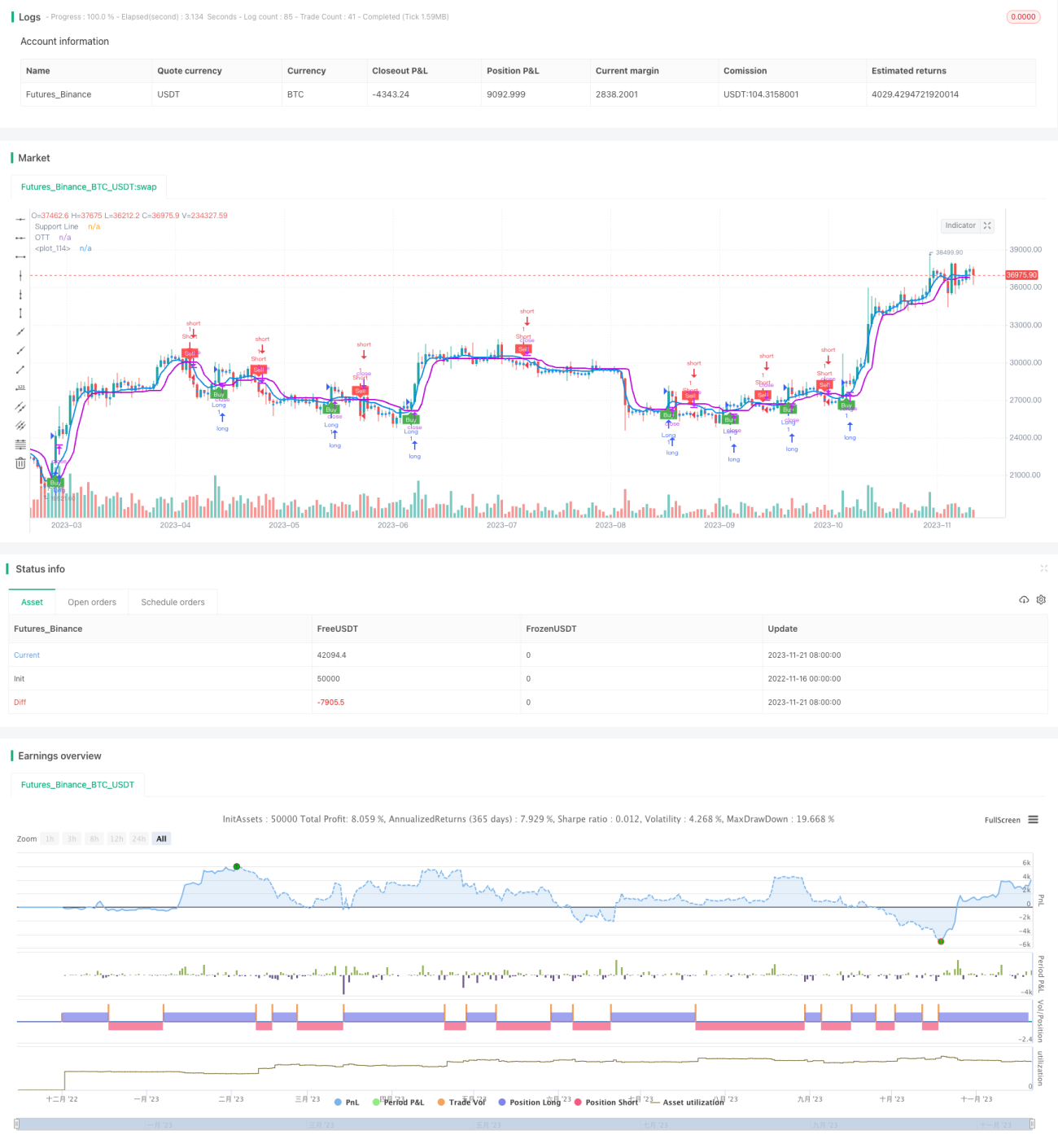
The Multiple Moving Average Dynamic Trend Strategy is a quantitative trading strategy that utilizes multiple types of moving average indicators to determine the market trend and dynamically adjusts the stop loss line position. By combining different moving averages, this strategy can more comprehensively and accurately judge market trends and achieve high-win-rate trading.
Strategy Principle
This strategy mainly implements 8 different types of moving averages through custom functions, including Simple Moving Average (SMA), Exponential Moving Average (EMA), Weighted Moving Average (WMA), Triangular Moving Average (TMA), Variable Index Dynamic Average (VIDYA), Wilder's Moving Average (WWMA), Zero-Lag Exponential Moving Average (ZLEMA) and True Strength Index (TSI). The strategy allows users to choose one of the 8 moving averages as the primary indicator.
The strategy first calculates the selected type of moving average, and then dynamically calculates the position of the upper and lower rails based on the set percentage parameter. A buy signal is triggered when the price breaks through the upper rail, and a sell signal is triggered when the price breaks through the lower rail. In addition, the strategy also tracks the crossovers between the moving average and the price as auxiliary judgment signals.
During the calculation, the strategy also judges the direction of the market trend, thereby dynamically adjusting the position of the upper and lower rails. Specifically, when an uptrend is determined, the lower rail will move up following the rising price so that the stop loss line can optimally track the rising price. When a downtrend is determined, the upper rail will move down following the falling price to reduce the stop loss point and minimize losses.
Strategy Advantages
- Utilizing 8 combined moving average indicators to judge market trends more accurately.
- Dynamically adjusting stop loss line positions to maximize profit locking and avoid reverse stop loss.
- Filtering out wrong trades caused by false breakouts using moving average and price crossovers as auxiliary signals.
- Customizable and optimizable parameters catered to different market environments.
Risks and Solutions
- Increased strategy complexity and debugging difficulty due to multiple combined indicators.
- Certain types of moving averages may underperform in specific market environments.
- Risks associated with false breakout induced erroneous trades still exist.
Solutions:
- Improve code readability through comments to facilitate inspection and debugging.
- Select moving average types or incorporate auto-selection modules based on market conditions.
- Optimize parameter settings and incorporate more auxiliary indicators to filter signals.
Optimization Directions
There is still much room to optimize this strategy:
- Incorporate auto parameter optimization modules based on changing market environments.
- Incorporate machine learning models to aid in trend determination.
- Incorporate more auxiliary judgment indicators like sentiment indices to improve strategy stability.
- Optimize stop loss mechanisms for more dynamic and precise stops.
- Expand to multi-asset pairs spread strategies to capitalize on price differentials.
Conclusion
The multiple moving average dynamic trend strategy determines market trends by combining multiple moving average indicators, and initiates trades based on price breakout signals while dynamically adjusting stop loss line positions for efficient profitability. This strategy successfully integrates the three major quantitative strategy concepts of trend following, price breakout trading, and dynamic stops, exhibiting strong stability and profitability. With further improvements in parameters optimization and pattern recognition, this strategy shows great potential for continued performance enhancement, making it a highly valuable advanced quantitative strategy worthy of focused research and application.
- 1