Moving Average Rebound Strategy

##Overview
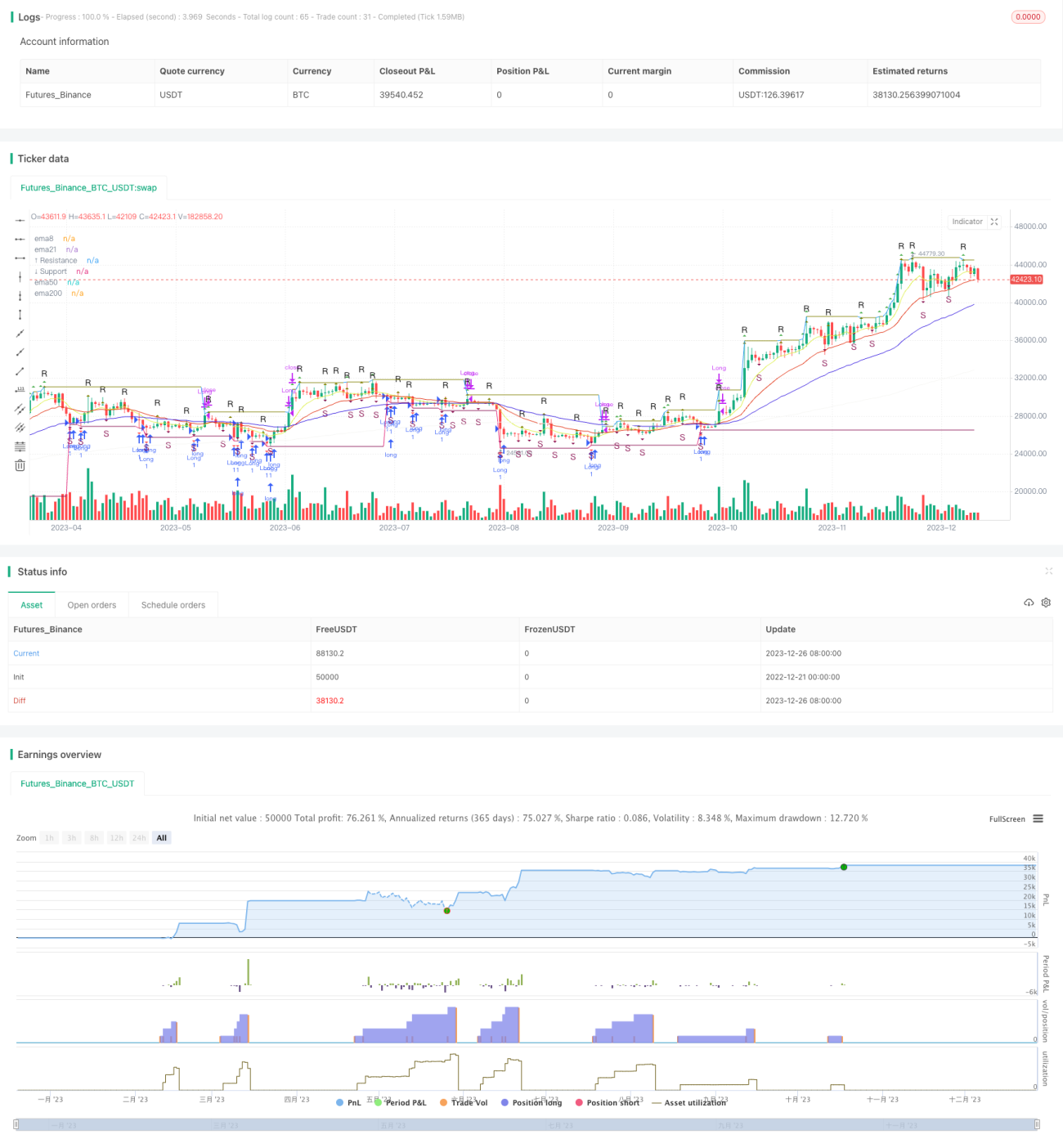
The Moving Average Rebound Strategy is a strategy that combines technical indicators and price patterns to trade long and short around support and resistance levels. The strategy uses moving averages to identify market trend direction, pattern indicators to assist in determining turning points, and previous swing highs/lows to spot key support and resistance levels for counter-trend trading.
Strategy Principles
The key steps for determining trade entries are:
-
Use the Alligator triple moving average indicator to judge trend direction. Crossing the Lip Lines signals strong momentum.
-
Identify potential reversal zones with Peak-Trough pattern indicator when in overbought/oversold areas. Breaking specific highs/lows indicates possible reversal.
-
Combine with support/resistance to pinpoint counter-trend trade entry points around key levels.
-
Use EMAS to assist in determining overall long term trend. Use mean reversion in range-bound and trend following in trending markets.
-
Employ trailing stop loss to control single trade loss amount.
Advantages
Advantages of the strategy:
-
Combining signals from multiple indicators improves accuracy.
-
Trading counter-trend from key support/resistance areas has high probability.
-
Trailing stop loss containing losses on single trades.
Risks
Risks involved:
-
More indicators can lead to higher trade frequency & needs transaction cost control.
-
Failed support/resistance levels are biggest risk. Price may not reverse as expected leading to large losses.
-
Stop loss can be taken out during huge volatile moves.
Enhancement Areas
Areas for improvement:
-
Optimize weights between indicators to find best performance combination.
-
Employ machine learning for improving key support/resistance level accuracy.
-
Add volume indicators to avoid trades when volatile but low volume environments.
-
Refine adaptive stop loss models to balance effectiveness and unnecessary stops.
Summary
In summary, the Moving Average Rebound Strategy utilizes a confluence of indicators including moving averages, price patterns and support/resistance for entries. A typical technical strategy with higher accuracy from multiple signals. Monitor risks around failure of key levels and stop loss slippage. Further optimization on indicator weights, machine learning and volume can enhance performance.
- 1