Quantitative Trading Strategy Based on EMA Crossover

Overview
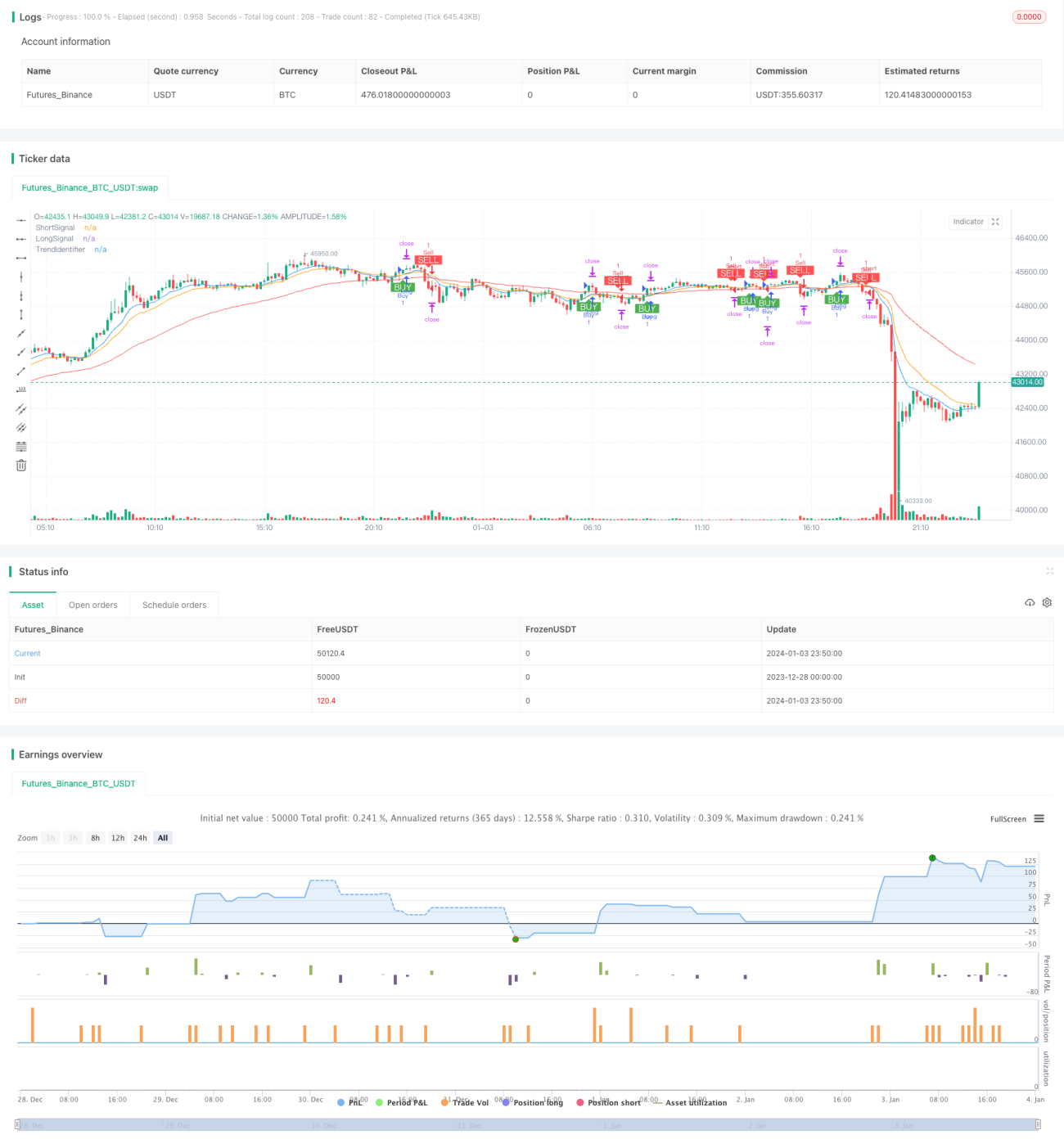
This strategy is named "Quantitative Trading Strategy Based on EMA Crossover". It utilizes the crossover principles of 9-day, 15-day and 50-day EMA lines to trade within short timeframes between 1-minute and 5-minute, in order to capture short-term price trends for quick entry and exit.
Strategy Principles
The strategy employs 9-day EMA, 15-day EMA and 50-day EMA. The crossover between 9-day EMA and 15-day EMA generates buy and sell signals. When 9-day EMA crosses above 15-day EMA, a buy signal is generated. When 9-day EMA crosses below 15-day EMA, a sell signal is generated. The 50-day EMA line judges the overall trend direction - buy signals are only generated when price is above 50-day EMA, and sell signals below it.
By utilizing fast EMA crossover and long-term EMA support, the strategy aims to capture short-term price actions while avoiding counter trend operations. The crossover of two fast EMAs ensures timely catching of recent price changes; the long period EMA effectively filters out market noise to prevent loss-making contrarian trades.
Advantages of the Strategy
-
Captures short-term trends: The crossover of two fast EMAs quickly seizes short-term price movements for swift entry and exit.
-
Filters out noise: Long EMA line judges overall direction to avoid ineffective contrarian trades and unnecessary stop loss.
-
Customizable parameters: Users can tweak EMA periods to adapt to different market conditions per their needs.
-
Easy to adopt: Relatively straightforward EMA crossover logic for facile utilization.
Risks of the Strategy
-
Too sensitive: Two fast EMAs may generate excessive false signals.
-
Ignores long-term trends: Long EMA cannot fully filter noise - some contrarian risks remain.
-
Parameter dependency: Optimized parameter reliance on historical data cannot guarantee future viability.
-
Suboptimal stop loss: Fixed stop loss difficult to calibrate - likely too loose or too tight.
Optimization Directions
-
Add Stochastics indicator to filter signals and employ KDJ overbought-oversold levels to augment EMA crossover signals.
-
Build in adaptive stop loss mechanism based on market volatility levels for intelligent adjustment of stop loss points.
-
Establish parameter optimization module via genetic algorithms for continual iteration towards optimum parameter combinations.
-
Integrate machine learning models to judge trend and signal accuracy, improving strategy resilience.
Conclusion
The strategy generates trade signals through crossover of two fast EMAs, and a long EMA line to determine overall direction, aiming to seize short-term price movements. Such short-term strategies are easy to use but have flaws e.g. excessive false signals, ignoring long-term trends. Solutions include adding auxiliary indicators, adaptive mechanisms and parameter optimization to improve real-life stability.
- 1