Price Channel Trend Following Strategy

Overview
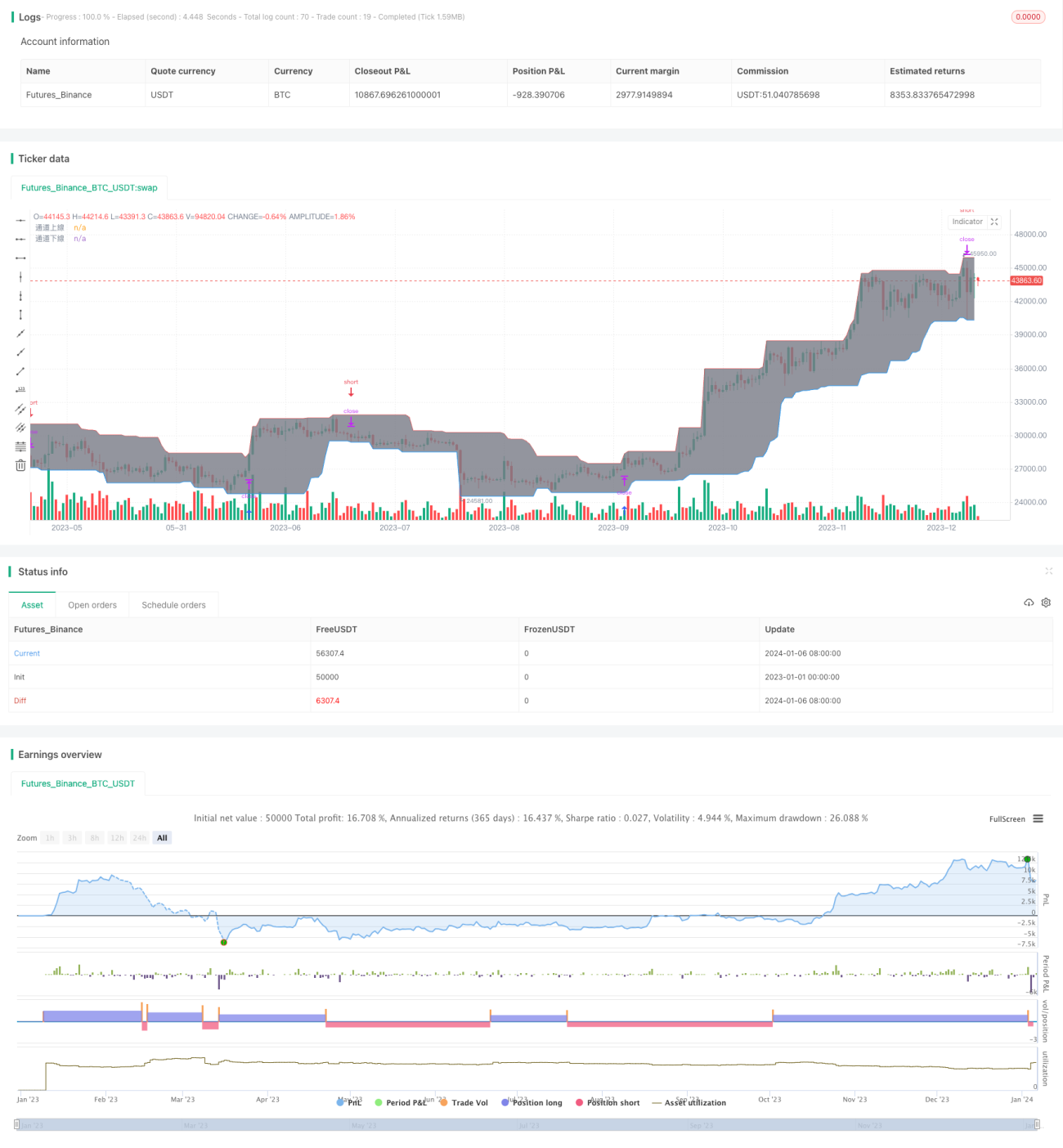
This strategy is a trend following strategy based on the price channel principle. It calculates the highest and lowest prices over a certain historical period to form a price channel, and uses the channel boundaries as buy and sell signals to track price trends.
Strategy Logic
The core idea of the price channel strategy is: when the stock price is in an upward trend, it will break through the historical high; when it is in a downward trend, it will break through the historical low. Therefore, a price channel can be constructed based on the highest and lowest prices over a certain historical period (such as 21 days). The upper and lower rails of the channel serve as buy and sell signals respectively.
Specifically, this strategy uses the highest() and lowest() functions to calculate the highest and lowest prices over the most recent 21 days to form a price channel. If the closing price of the day is higher than the 21-day high (i.e. breaking through the upper rail of the channel), a buy signal is generated. If the closing price is lower than the 21-day low (i.e. breaking through the lower rail), a sell signal is generated.
In addition, the strategy also checks for gaps to judge potential trend reversals. If there is a down gap, the price channel will be set to red to hedge risks. If there is an up gap, it will be set to green.
Advantage Analysis
The main advantages of the price channel strategy are:
- The strategy logic is simple, easy to understand and implement
- Can effectively identify price trends of stocks and track trends in a timely manner
- Reduces transaction costs by generating signals through breakouts
- The price channel can play the role of stop loss
- Checking for gaps indicates possible trend changes
Risk Analysis
There are also some risks with this strategy:
- It only relies on price data, ignoring other fundamentals, technical indicators, etc.
- Improper settings of the channel parameters could lead to over-aggressiveness or over-conservativeness
- Breakout buys can face pullback risks causing a stop loss
- It does not consider the impact of price volatility and liquidity
- Differences across industries and individual stocks are not taken into account
To overcome these risks, the following optimizations could be considered:
- Incorporate key technical indicators to avoid wrong signals
- Add adaptive channel parameter algorithms
- Use moving averages to judge trend persistence
- Set channel width factors to correct different volatility levels
- Distinguish parameters by industry and concepts
Optimization Directions
The main directions to optimize this strategy include:
- Optimize price channel parameter calculations, e.g. adaptive channels, volatility channels, etc.
- Incorporate other technical indicators to improve signal accuracy
- Add stop loss and take profit strategies to control risks and lock in profits
- Set dynamic parameters across industries and individual stocks
- Enhance strategy by incorporating fundamentals and event drives
- Apply machine learning algorithms for adaptive optimization and condition judgment
Summary
The price channel strategy builds a simple channel using historical peaks and troughs and uses the channel boundaries as trading signals. It is a typical trend following strategy that is easy to understand and implement and can effectively track price trends, with the price channel serving as a stop loss mechanism. However there are also risks with this strategy. The main optimization dimensions include parameter tuning, combining other indicators, implementing stop loss/profit taking, dynamic parameterization, etc. Overall, the price channel strategy provides a simple and practical trend following framework for quantitative trading, but needs further enhancements and optimizations to achieve better performance in live trading.
- 1