Eleven Moving Averages Crossover Strategy

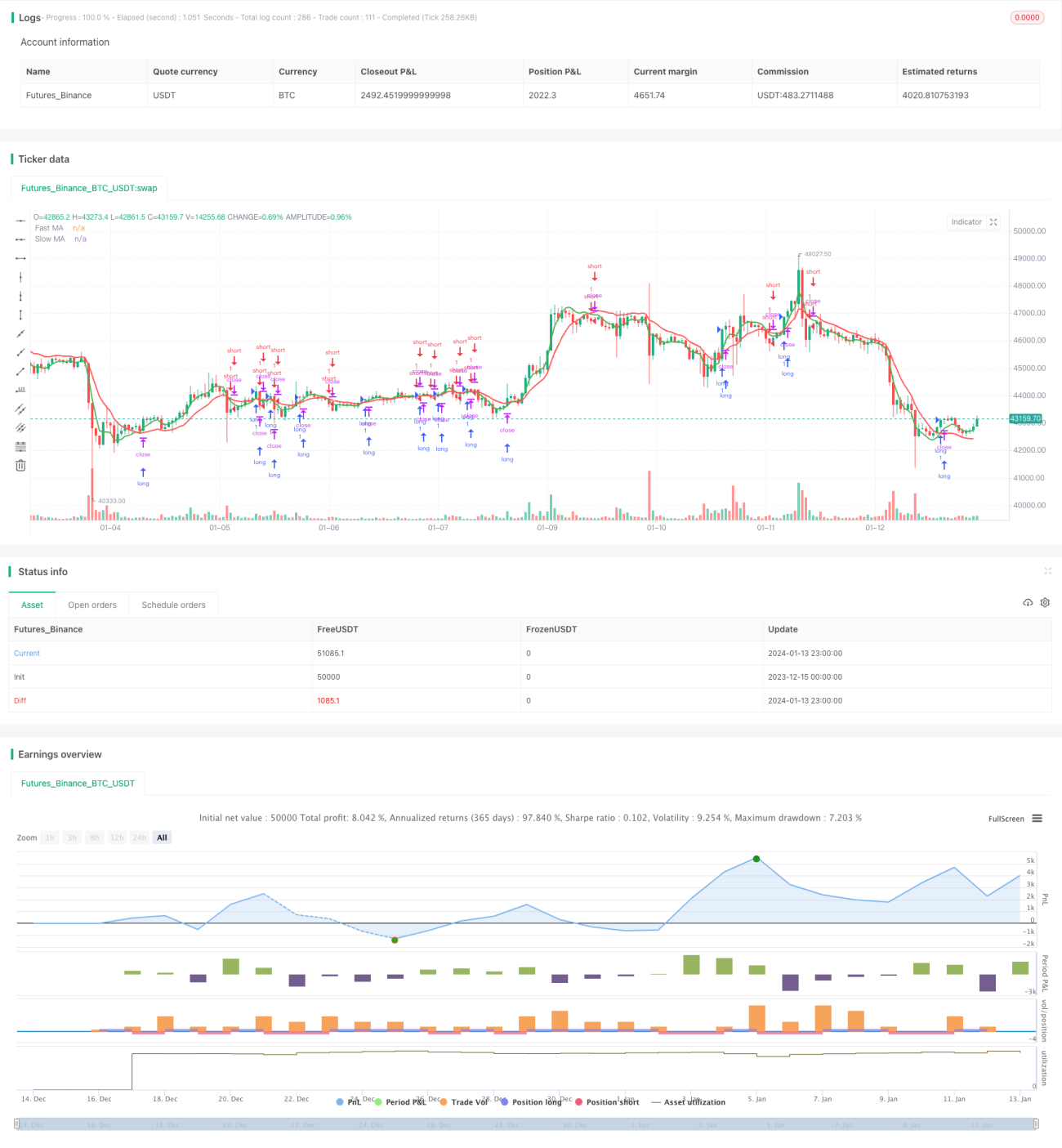
Overview
This strategy combines crossovers of 11 different types of moving averages for long and short entries. The 11 moving averages used are: Simple (SMA), Exponential (EMA), Weighted (WMA), Volume-weighted (VWMA), Smoothed (SMMA), Double Exponential (DEMA), Triple Exponential (TEMA), Hull (HMA), Zero Lag Exponential (ZEMA), Triangular (TMA), and SuperSmoother (SSMA) filter.
The strategy allows configuring two moving averages - a faster one and a slower one, both selected from the 11 options. Long signals are generated when the faster MA crosses above the slower MA. Short signals occur when the faster MA crosses below the slower MA.
Additional features include pyramiding settings, take profit and stop loss levels.
Strategy Logic
The core strategy logic relies on crossovers between two moving averages to determine entries and exits.
The entry conditions are:
Long entry: Fast MA > Slow MA
Short entry: Fast MA < Slow MA
Exits are determined by one of three criteria:
- Take profit level reached
- Stop loss level reached
- Opposite signal generated (MA crossover in opposite direction)
The strategy allows configuring key parameters like the MA type and length, pyramiding settings, take profit and stop loss percentages. This provides flexibility to optimize the strategy for different market conditions and risk preferences.
Advantages
- Combines 11 different MA types for robust signals
- Flexible configuration of key parameters
- Take profit and stop loss features protect profits and limit losses
- Pyramiding allows increased position size for strong trends
Risks
- As with any technical indicator, MA crossovers can generate false signals
- Overoptimization for current market conditions may degrade future performance
- Hard stop loss exits can lead to exiting good trades early in volatile markets
Risk management can be enhanced by using price action confirmation for entry signals, using trailing stops instead of hard stops, and avoiding overoptimization.
Enhancement Opportunities
There are several ways in which this strategy can be improved:
- Incorporate additional filters before entry, such as volume and price action checks
- Test performance of different MA types systematically and select optimal 1 or 2
- Optimize MA lengths specifically for trading instrument and time frame
- Employ trailing stops instead of hard stops
- Add profit taking at incremental levels as trend extends
Conclusion
The eleven moving averages crossover strategy provides a systematic approach to trading crossovers. By combining signals across multiple MA indicators and allowing configuration of key parameters, it provides a robust yet flexible trading framework. Fine-tuning and risk management will play key roles in optimizing performance. The strategy has strong potential for momentum-based trading but should be adapted for different market environments.
- 1