WaveTrend and DER Based Swing Trading Strategy

Overview
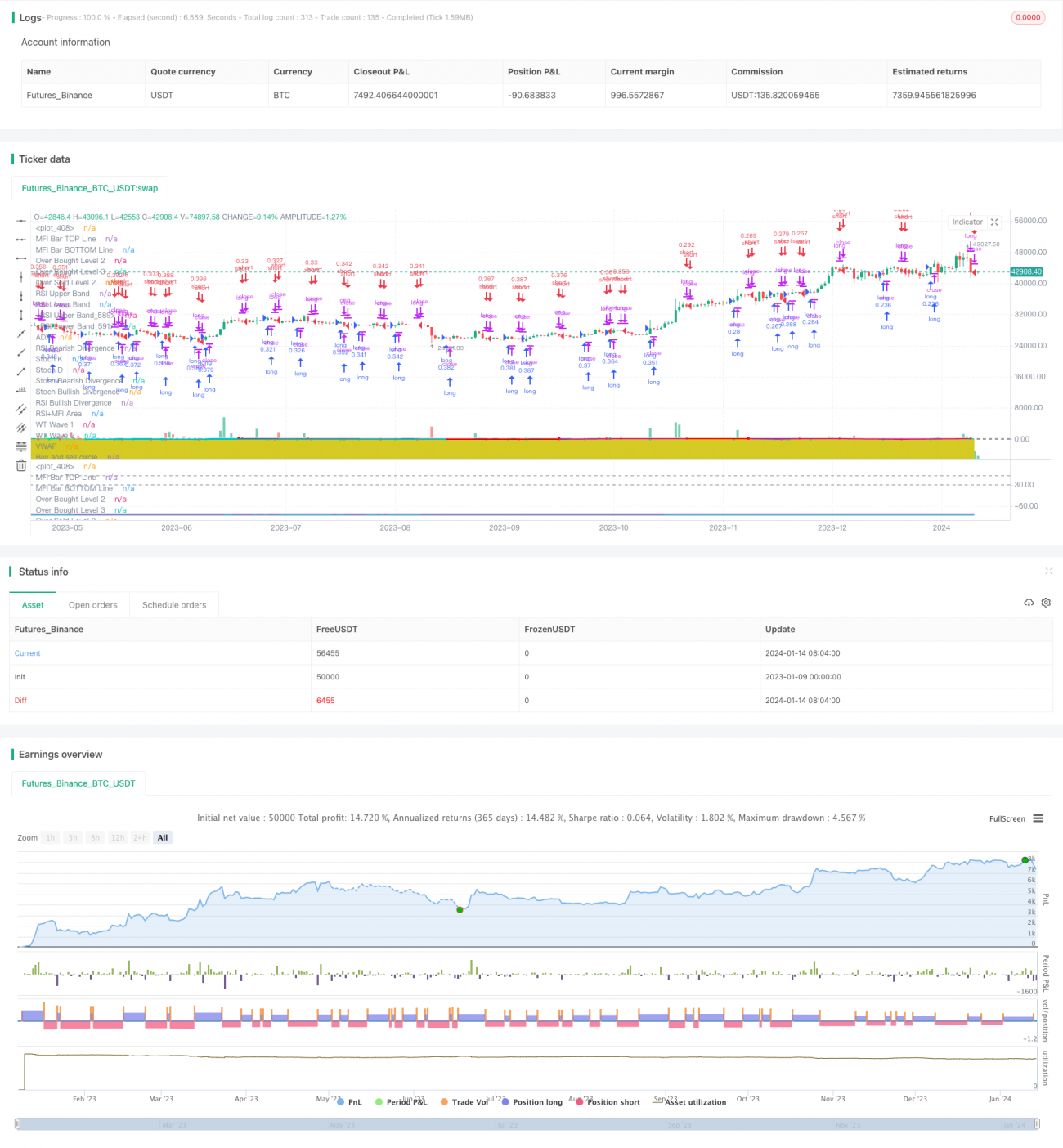
This strategy combines indicators like Relative Strength Index (RSI), Directional Movement System and Directional Energy Ratio (DER) to precisely track market swings and capture short-term trend opportunities.
Strategy Logic
The core logic utilizes WaveTrend indicator to determine price fluctuation and direction, cooperating with the RSI indicator to judge overbought and oversold conditions, as well as the custom DER indicator to estimate the momentum of price movements, in order to decide long/short directions.
Specifically, when the second WaveTrend average wt2 crosses above the first average wt1, it is a long signal. At this moment, if DER > 0 indicating an upward trend, a long position will be opened. When wt2 crosses below wt1, it is a short signal. At this moment, if DER < 0 showing a downward trend, a short position will be opened.
In addition, RSI indicator is used to detect extreme overbought/oversold status. If RSI goes above 70 showing overbought condition, existing long positions may be closed. If RSI goes below 30 showing oversold condition, existing short positions may be closed.
Advantages
-
WaveTrend indicator determines price fluctuation and direction shift more precisely compared to single moving average lines.
-
The custom DER indicator judges the momentum and direction of price movements, avoiding whipsaws in sideways markets.
-
RSI indicator helps set proper stops when overbought/oversold.
-
The strategy has fast response and strong manipulation capability for short-term trends.
Risk Analysis
-
Multiple parameters are used in this strategy and need optimization, which may affect performance if set inappropriately.
-
The strategy mainly targets short-term swings and may underperform in lasting trending markets.
-
It is sensitive to trading fees and commissions. Exchanges with lower commissions should be chosen.
-
Major news events are not considered which may cause drawdowns.
Enhancement Directions
-
Introduce machine learning algorithms to auto-optimize parameters.
-
Employ more position sizing and risk management techniques.
-
Incorporate analysis of longer-term trends using moving averages to determine overall entries and exits.
-
Consider capabilities in risk detection related to impactful news events.
Conclusion
This strategy leverages multiple technical indicators to track short-term oscillations and achieve low-risk market manipulation, fitting for capturing medium and short-term opportunities. Further improvements on parameter tuning, position sizing, integrating more factors can lead to better drawdown controls and overall performance.
- 1