Daily DCA Strategy with Touching EMAs

Overview
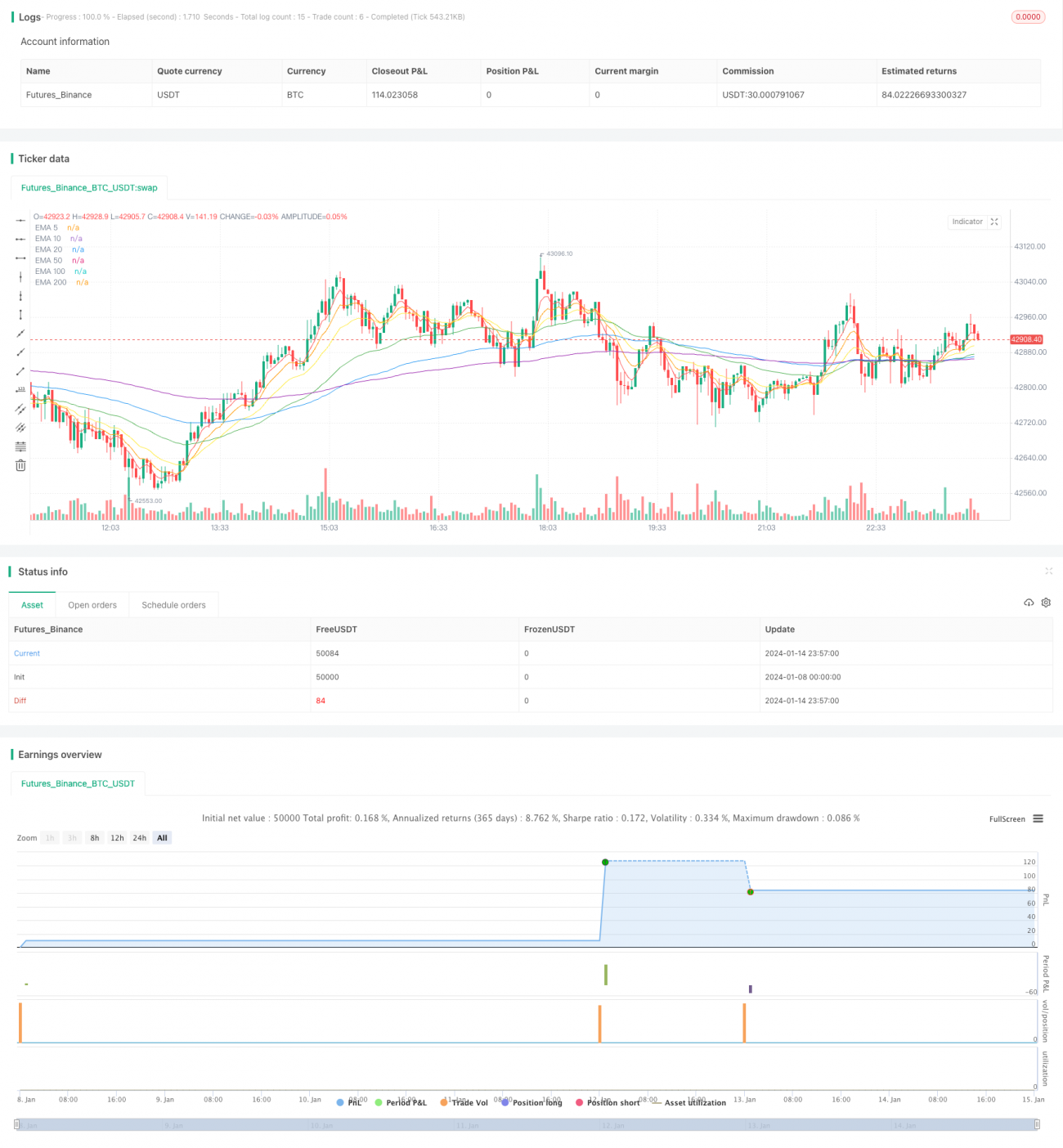
This Pine script strategy implements a daily dollar-cost averaging approach on the TradingView platform, incorporating EMA touch signals to determine entry points. It follows the dollar-cost averaging methodology to make fixed-amount investments every day, spreading purchases over time to mitigate risk. The EMA crossovers then serve as the specific trigger for entries.
Strategy Logic
The strategy has the following key features:
-
Daily Dollar-Cost Averaging
- Fixed daily investment regardless of market ups and downs
- Long-term batch investments to reduce single-trade risk
-
EMAs for Entry Signals
- Buy signal triggered when closing price crosses above EMA 5, 10, 20 etc.
- EMA lines serve as support to avoid short-term pullbacks
-
Dynamic Stop Loss
- Sell all positions if closing price falls below 20-day SMA
- Avoid further losses
-
Trade Count Limit
- Caps max trades at 300 to control position sizing
- Prevents over-investment beyond asset capacity
Specifically, every day the strategy invests a fixed amount and calculates the shares to buy based on the closing price. If the closing price crosses above any of the 5-, 10-, 20-day EMA etc., a buy signal is triggered. Once the accumulated trade count hits the 300 limit, no further buys will occur. Additionally, if the price closes below the 20-day SMA or reaches the preset exit date, all positions are cleared. The script also plots the EMAs on the price chart for visual analysis.
Advantage Analysis
The advantages of this strategy include:
-
Risk Diversification
- Small fixed-amount daily investments regardless of market trends
- Avoids chasing highs
-
EMA Combination Avoids Pullbacks
- EMA crossovers prevent buying into pullback periods
- Continued buying during pullbacks diversifies risk
-
Dynamic Stop Loss Controls Losses
- Stop loss allows timely exits
- Prevents heavy losses
-
Trade Limit Controls Risks
- Max position size is preset to prevent over-investment
- Keeps investment within asset capacity
-
Intuitive EMA Visualization
- EMAs plotted on price chart
- Allows easy monitoring by operator
-
Highly Customizable
- Custom inputs for investment amount, EMA periods, stops etc.
- Adjusts based on personal risk preferences
Risk Analysis
The strategy also carries some risks to note:
-
Systemic Risks Still Exist
- Black swan events can lead to heavy losses
- Diversification only reduces but don't eliminate risks
-
Fixed Investment Amount
- Fixed daily investments could miss out on upside if prices surge
- Dynamic amount adjustment could help
-
EMAs Cannot React to Extreme Moves
- EMAs have slower reaction to sudden events and fails to stop loss in time
- Combining with KD, BOLL may help identify extremes
-
Trade Limit Caps Profit Potential
- Upper limit on trades caps possible gains
- Need to balance risks and rewards
-
Stop Loss Placement Requires Care
- Stops too close tend to get taken out prematurely while stops too loose fails to protect in time
- Extensive testing needed to find the right balance
Future Enhancements
Further optimizations:
-
Dynamic Daily Investment Amount
- Base daily investments on indicators
- Increase when bullish, decrease when bearish
-
Additional Entry Signals
- Complement EMA with other indicators like KD, BOLL
- Improve identification of extreme moves
-
Exponential Moving Averages
- EMAs react slowly to sudden events, DEMA, TEMA may help
- Faster capture of new trends
-
Dynamic Position Limit
- Increase limit based on strategy profitability
- Allows higher exposure at fair valuations
-
Trailing Stop Loss
- Current strategy market sells all, trailing stops could help avoid gaps down
- Reduce risk of stops being "run"
Conclusion
In summary, this EMA-combined daily DCA strategy realizes the concept of long-term periodic investments, spreading risks across multiple small entries compared to large one-time purchases. The EMAs help avoid short-term pullback risks to a certain extent, while the stop loss controls max loss. Still, black swan risks and the limitations of fixed investment size need to be kept in mind. These aspects provide future enhancement directions through parameter tuning and indicator combinations for building efficient yet stable quant strategies.
- 1