Dynmaic Risk Adjusted Momentum Trading Strategy

Overview
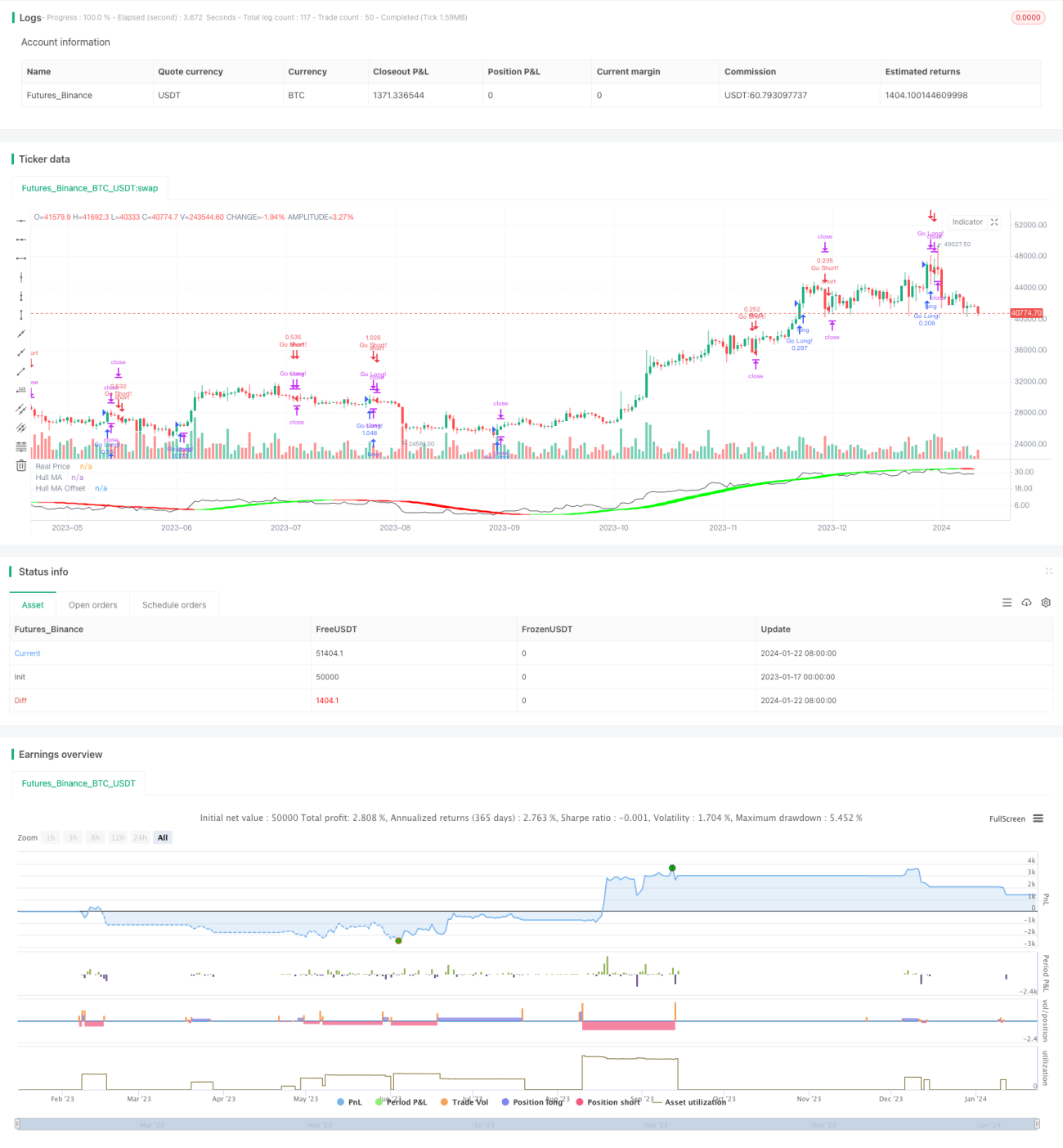
This unique systematic rulebased trading strategy is in the trend following category. It uses normalised prices series transformed from raw ticker price to gernerate trading signals. Advanced position sizing and risk management techniques, commonly reserved for institutional portfolio management, are utilised in this strategy - proven positioning and risk control technologies used by financial advisers like Commodity Trading Advisors and Managed Futures funds.
Strategy mechanics
The "normalised price" is a volatility-adjusted accumulated daily returns series. Daily volatility adjustment lookback is user defined. Hull moving average of the normalised price is used as the main trend indicator. Lookback period of the HMA is user defined too, with default period of 100 days for a responsive signal without inducing over-trading.
The core trades are simple, long when normalised price crossover HMA, short when crossunder HMA. New signals close any existing opposing position.
Position size is dynamically adjusted based on recent price volatility and the user defined annual risk target. Positions are risk-weighted, larger size with lower volatility and smaller with higher volatility. Recent volatility is the standard deviation of returns over the last 14 periods, then extrapolated into annual volatility as expeted returns. Annual risk target is used as reference for volatility adjusted position sizing. Default target is 10% of total capital. Initial capital should be set as maximum loss per trade. Max leverage allows achieving risk target if underlying natural volatility is insuffient, and alleviates excessively low volatility.
Hard stops are based on recent price average true range multiplier, user configurable.
Advantages
- Normalised prices reduces false signals
- Dynamic position sizing controls risk effectively
- Hard stops prevent runaway losses
- Simple trend following logic for transparency
Risks
- Lagging issues with Hull moving average
- Capping profits while lowering risk through volatility adjusted position sizing
- Stops too tight vulnerable to spikes
Risk controls measures include alternate moving average selections, adjusting risk targets.
Enhancements
- Test effectiveness of other moving average types
- Optimize parameters of moving averages
- Try long-only or short-only variants
- Fine tune stop loss ranges
- Experiment with other stop loss mechanisms
Conclusion
The strategy integrates various techniques like normalisation, dynamic position adjustment, hard stops to control risks. Trading is based on simple trend following rules. Parameters can be adjusted for personal preferences and market regimes. Worth further testing and verification for viable real world application.
- 1