Candle Patterns Trading Strategy

Overview
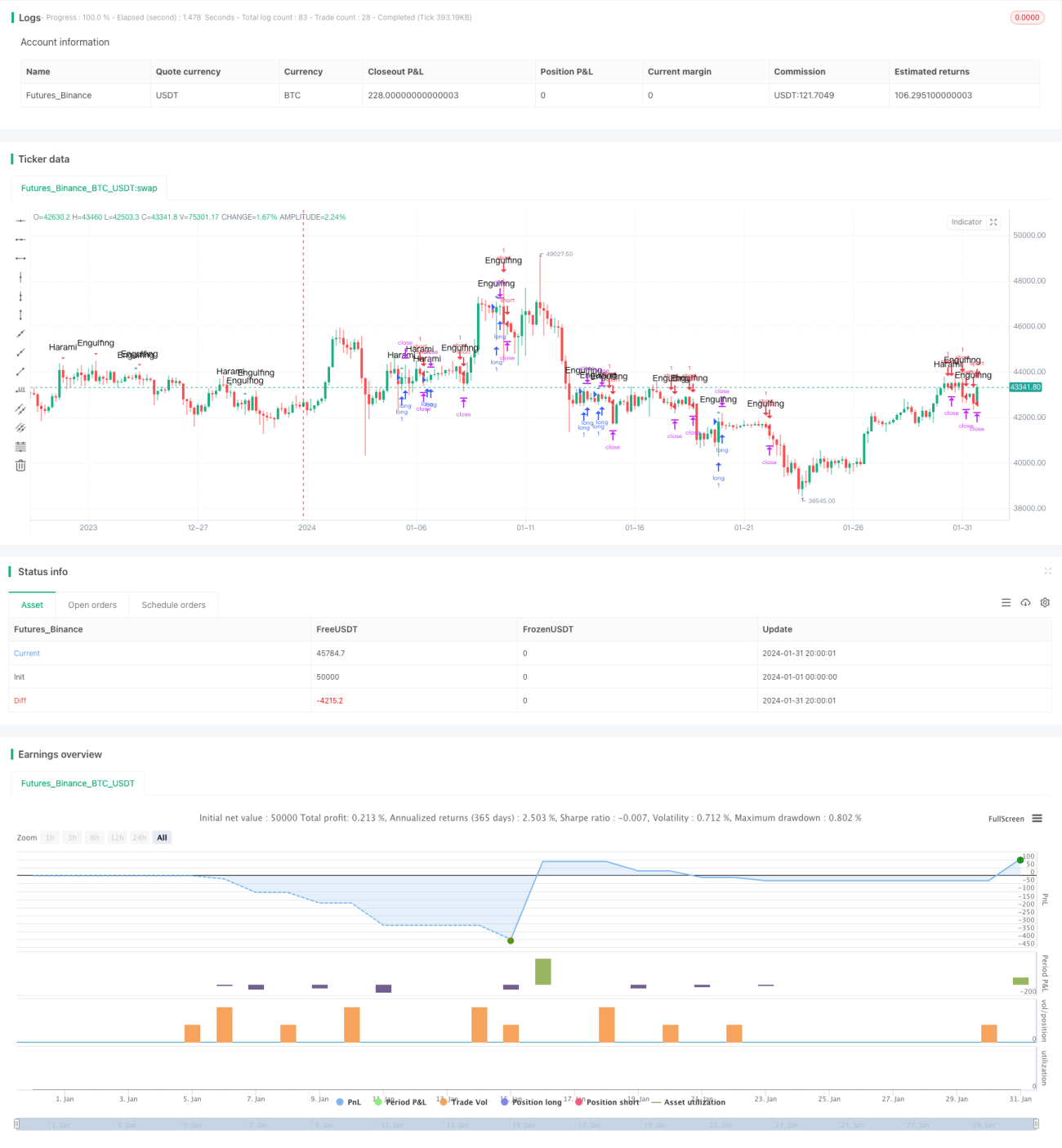
This is an automatic trading strategy based on candlestick patterns. The strategy identifies various candlestick pattern signals and enters positions when pattern conditions are met, with stop loss, take profit and trailing stop configured to control risks.
Strategy Logic
The strategy mainly identifies the following candlestick patterns as entry signals: engulfing pattern, harami pattern, piercing line/dark cloud cover, morning star/evening star, belt hold pattern, three white soldiers/three black crows pattern, three stars in the south pattern, etc. It goes long when bullish signals are detected, and goes short when bearish signals are detected.
In addition, stop loss, take profit and trailing stop are configured for risk control. Specifically, stop loss is set at certain percentage below the entry price, take profit targets certain pips above entry price, and trailing stop trails at certain dynamic level above entry. This effectively prevents losses beyond acceptable amount.
It's worth noting that all positions are closed outside the trading session defined in the strategy, eliminating overnight risks.
Advantage Analysis
The biggest edge of this strategy lies in using candlestick patterns, an effective technical indicator, to determine entries. Vast historical data has shown that certain distinctive candle formations often signify shifts in demand/supply dynamics and market psychology, thus providing good timing for entries.
Another advantage is the comprehensive risk control mechanisms in place. The stop loss, take profit and trailing stop could minimize losses beyond acceptable range substantially.
Finally, the strategy is flexible to run by tweaking pattern parameters and risk control parameters to suit different instruments and trading preferences.
Risk Analysis
The biggest risk of this strategy comes from the inherent instability of candlestick patterns themselves as technical indicators. Although candle patterns can clearly reflect market trend changes, they are also susceptible to market random fluctuations, leading to potentially false signals.
Moreover, there are no causal relationships between candle formations and subsequent price actions. Prices can go against expected pattern outcomes even when typical patterns are detected.
To mitigate above risks, strictly adhering to stop loss, take profit and trailing stop rules is essential. Combining candle patterns with other more stable indicators may also help avoid potential hazards resulting from sole reliance on technical patterns.
Optimization Directions
Given limitations of candle patterns, combining them with more robust indicators like Bollinger Bands, moving averages for trend, or oscillators like RSI and MACD could be worthwhile improving entry timing and signal quality.
Another prospective optimization direction is utilizing machine learning models trained on big historical data to uncover statistical relations between patterns and actual price movements, enhancing pattern signal accuracy.
Finally, this strategy could serve as a framework to be upgraded with more sophisticated algorithms for high-frequency trading, e.g. more delicate stop loss methods, complex modeling with more data interfaces through advanced languages.
Conclusion
In conclusion, this is a strategy worth live testing, using efficient candlestick patterns for signal entries, with comprehensive stop loss/take profit/trailing stop logic controlling risks. Coding Angle encourages optimizing based on this framework to generate better live results.
/*backtest
start: 2024-01-01 00:00:00
end: 2024-01-31 23:59:59
period: 4h
basePeriod: 15m
exchanges: [{"eid":"Futures_Binance","currency":"BTC_USDT"}]
*/

//@version=4

//DanyChe
//The script allows you to test popular candlestick patterns on various instruments and timeframes. In addition, you can configure risk management (if the value is zero, it means the function is disabled), and you can also specify the time of the trading session (for example, so that the positions are not transferred to the next day). - 1