Triple Dynamic Moving Average Trend Tracking Strategy

Overview
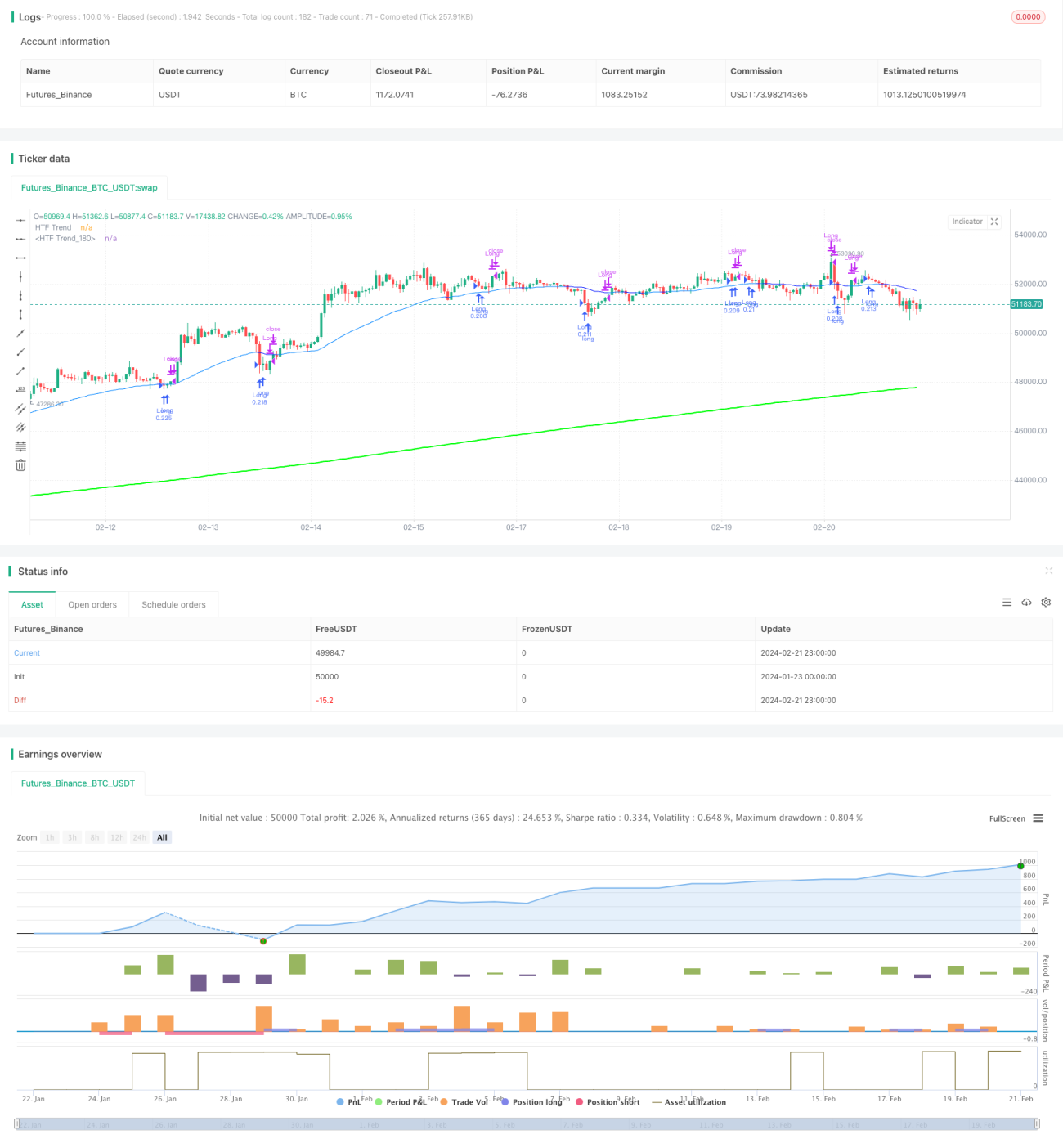
The Triple Dynamic Moving Average Trend Tracking strategy uses multiple time frame dynamic smoothed moving averages to identify market trends and achieve trend consistency filtering across different time frames, thereby improving the reliability of trading signals.
Strategy Logic
The strategy employs 3 dynamic smoothed moving averages with different parameter settings. The first moving average calculates the trend direction of current period prices, the second moving average calculates the trend direction of higher time frame prices, and the third moving average calculates the trend direction of even higher time frame prices. A buy signal is generated when the first moving average crosses above the second moving average, and the third moving average is also in an upward trend, which verifies the reliability of the buy signal. The entire strategy achieves trend consistency across multiple time frames through inter-timeframe trend filtering, ensuring the reliability of trading signals.
The dynamic smoothing feature is used to automatically calculate and apply appropriate smoothing factors between different time frames, so that the higher time frame moving averages present smooth trendlines instead of jagged zigzag lines on the lower time frame charts. This dynamic smoothing allows the strategy to determine the overall trend direction on higher time frames while executing trades on lower time frames for efficient trend tracking.
Advantages
The biggest advantage of this strategy lies in its inter-timeframe trend filtering mechanism. By calculating the average trend directions of prices across different time periods and requiring consistency among them, it can effectively filter out short-term price fluctuations that interfere with trading signals, ensuring that each trade is placed along the major trend, thereby significantly improving profitability.
Another advantage is the application of dynamic smoothing. This allows the strategy to identify both the overall trend on higher time frames and specific trading points on lower time frames simultaneously. The strategy can determine the major trend direction on higher time frames while executing specific trades on lower time frames. Such application of multiple time frames helps to capitalize on market opportunities while controlling trading risks.
Risks and Optimization
The main risk of this strategy is the relatively few trading signals. The strict trend filtering conditions reduce the number of trading opportunities, which may not suit some investors pursuing high-frequency trading. The strictness of filtering conditions can be reduced to obtain more trading opportunities.
In addition, careful testing and optimization is needed for parameter settings, especially the moving average periods, which require different optimum values across different markets. The optimal parameter combinations can be found through backtesting.
Future optimization directions may also consider incorporating more technical indicators for signal filtering or increasing machine learning algorithms for automatic parameter optimization. These are all effective methods to improve strategy performance.
Conclusion
In conclusion, this is a very practical trend tracking strategy. The inter-timeframe trend filtering provides good directional guidance to support each trading decision, effectively reducing trading risks. The addition of dynamic smoothing also enables efficient implementation of this multi-timeframe approach. The entire strategy framework is reasonable and efficient, worthy of learning and application.
- 1