The Order Block Momentum Breakout Strategy

Overview
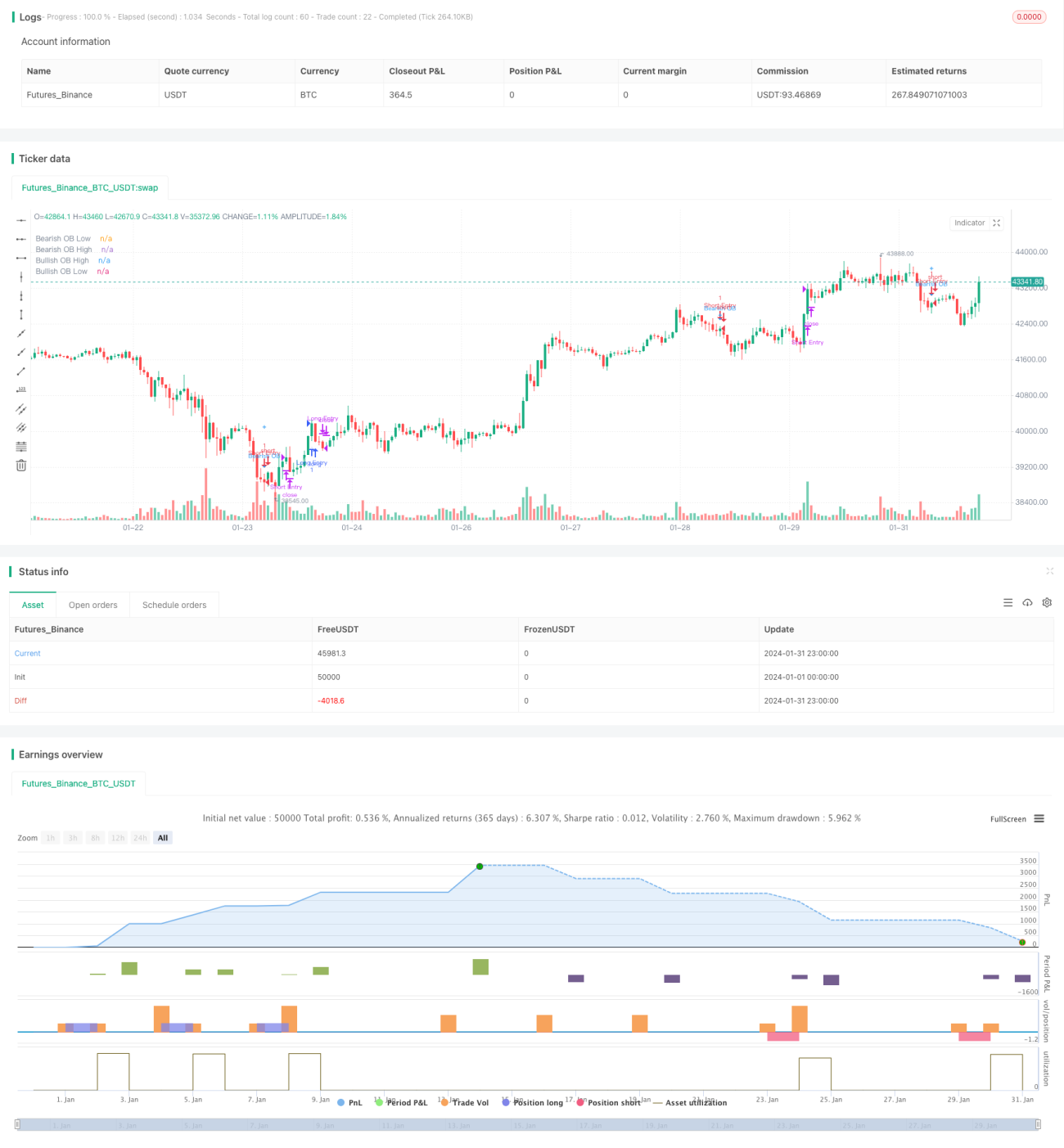
This strategy identifies order blocks in price action to locate momentum bursts and enters the market when buy/sell signals emerge. Order blocks represent institutional participation and significant market forces. Thus order block signals have a higher probability of leading to trending price action.
Strategy Logic
Identifying Order Blocks
There are two types of order blocks - bullish and bearish. A bullish order block is defined as the last red candle followed by consecutive green candles. A bearish order block is the last green candle followed by consecutive red candles.
To identify an order block, the following criteria must be met simultaneously:
-
Candle color change - The candle color changes from the previous candle to the current one (e.g. from red to green, or green to red). This suggests institutions may be ending the previous trend and initiating a new potential trend.
-
Consistent direction afterwards - The subsequent candles maintain the same color direction for the number of periods specified in the parameters (e.g. all green candles after a potential bullish block). This confirms the new trend.
-
Breakout exceeds threshold - The percentage price change from the open of the order block candle to the close of the final confirmation candle exceeds the threshold parameter (default 0). This ensures strong enough momentum.
When all three criteria are true, an order block signal is identified.
Generating Trading Signals
A buy signal is generated when detecting a bullish order block. A sell signal emerges when a bearish order block is identified.
Considering the uncertainty of order flow signals, the strategy does not immediately enter the market. It alerts the trader and allows price limit orders to be placed near the order block levels instead. This provides controlled entries and risk management.
Advantages
Captures hidden momentum
Order blocks represent institutional money flow and substantial volume. They indicate shifts in market forces and provide early clues into potential breakout direction. This facilitates trend following with good timing.
Customizable parameters
The parameters controlling candle count, breakout percentage etc. can be adjusted to optimize for changing market conditions and trading style. This enhances adaptability.
Controlled risk
By not auto-entering on signals and using limit orders instead, traders can define entry levels and control risk. Failed signals simply lead to unfilled limit orders. Risks are contained.
Risks
High retest probability
As order blocks signify zones, prices revisiting the level is common. Signals should not be viewed as direct entries. Further timing judgement is needed.
Parameter misfit causes bad signals
If parameters are not set properly, fake signals can emerge in range-bound markets. Traders need to exercise discretion in applying signals. Blind optimization should be avoided.
Manual review is necessary
With each signal requiring further validation, significant manual effort is involved. Inconsistencies in human discretion on signal quality may lead to performance divergence.
Enhancement Opportunities
Signal filtering with other indicators
Incorporate additional indicators like MACD and RSI when signals appear to gauge market conditions. This filters bad signals from poor parameter settings.
Parameter optimization
The parameters can be tested and tuned to suit different markets and instruments for better fit. Adaptive settings can also be implemented to auto-adjust based on volatility and risk tolerance.
Automated entry/exit
Currently the strategy only serves as signal alerts. Logics can be added to automate limit order entries on signals and implement stops for exits. This increases automation and reduces reliance on human judgement.
Conclusion
By detecting order flow convergence, this strategy reveals hidden momentum moves brewing under the surface. Compared to simple trend following, it has predictive abilities in locating turning points. When combined with optimization and risk control techniques, it can become an effective trend trading system. Nonetheless, traders should be wary of bad signals and assess each signal’s quality. Further efforts should focus on enhancing automation to minimize biases from subjective discretion.
- 1