Adaptive Exponential Moving Average Range Strategy

Overview
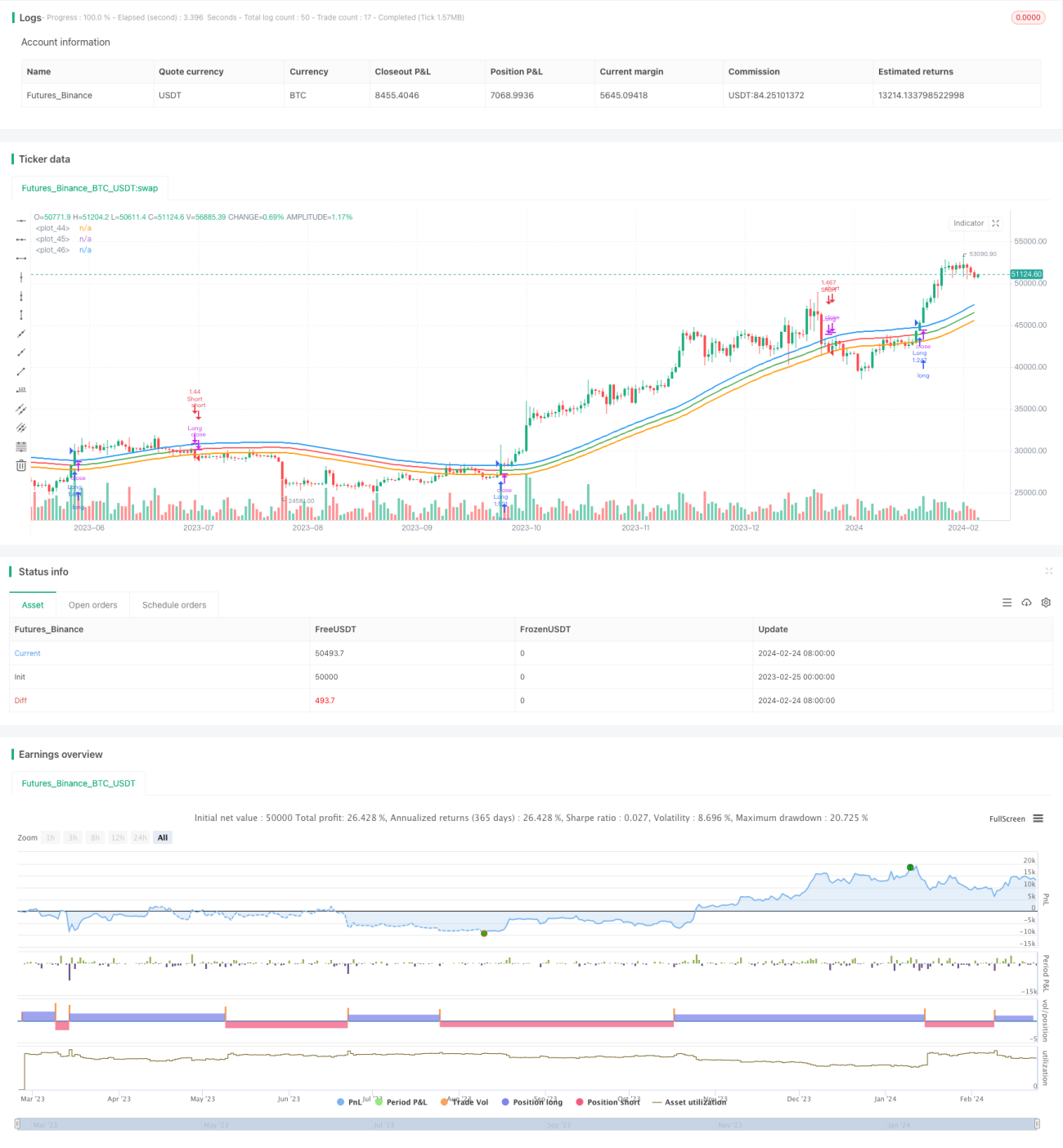
This strategy uses the faster Exponential Hull Moving Average (EHMA) and an adaptive channel to build a trend following strategy. Since EHMA calculates faster, it can effectively identify price trend changes and avoid unnecessary trades caused by false breakouts. At the same time, the adaptive channel can filter out some price fluctuations. Trades are only triggered when the price breaks through the channel, reducing the probability of ineffective trades and increasing profitability.
Strategy Principle
-
Calculate the exponential weighted moving average EHMA based on the Period parameter. EHMA calculates faster and can track price trend changes effectively.
-
Build an adaptive channel above and below the EHMA based on the RangeWidth parameter. Only when the price rises above the upper channel line or falls below the lower channel line, the trend is considered to have changed and trading signals are triggered.
-
Determine the price relationship with the channel. Long when price breaks through the upper line, short when breaks through the lower line. Close long position when price crosses below upper line, close short position when price crosses above lower line.
Advantage Analysis
Compared with ordinary moving average strategies, this strategy has the following advantages:
-
Use the EHMA algorithm to calculate the moving average. EHMA responds more sensitively to price changes and can identify trend changes effectively to avoid unnecessary trades caused by false breakouts.
-
The adaptive channel can filter out price fluctuations effectively. Trading signals are only triggered when the price trend has changed firmly. This could filter out some ineffective trades and improve profitability.
-
The channel width can be adjusted flexibly to adapt to different market conditions. Wider channels can filter more fluctuations and reduce trading frequency. Narrower channels can identify trend changes earlier and increase trading frequency.
Risk Analysis
There are also some risks with this strategy:
-
False breakouts are still not completely avoidable. Prices may gap beyond the channel. Parameters need to adjusted properly to control risks.
-
Some trading opportunities may be missed if the channel is too wide. Narrow down the channel reasonably to increase sensitivity.
-
Too narrow channels can increase ineffective trades. Expand channel width appropriately to enhance stability.
Optimization Directions
This strategy can be optimized in the following aspects:
-
Optimize the Period parameter. Adjust the moving average calculation cycle to adapt to different products and timeframes.
-
Optimize the RangeWidth parameter. Adjust the channel scope based on market volatility and personal risk preference.
-
Add stop loss strategy. Set reasonable stop loss points during holding positions to effectively control maximum loss per trade.
-
Combine with other indicators for entries filtering. For example, add volume to reduce false entries.
-
Diversify strategy applications and optimize parameters. Test and optimize universal parameters across more products and timeframes.
Summary
This strategy combines the EHMA indicator and adaptive channel indicator to form a trend following strategy. It can identify market trends effectively and filter out price fluctuations to avoid unnecessary trades. After a series of parameter optimization and risk control, stable profits can be achieved across various products and timeframes.
- 1