BabyShark VWAP Trading Strategy Based on VWAP and OBV RSI Indicators

Strategy Overview
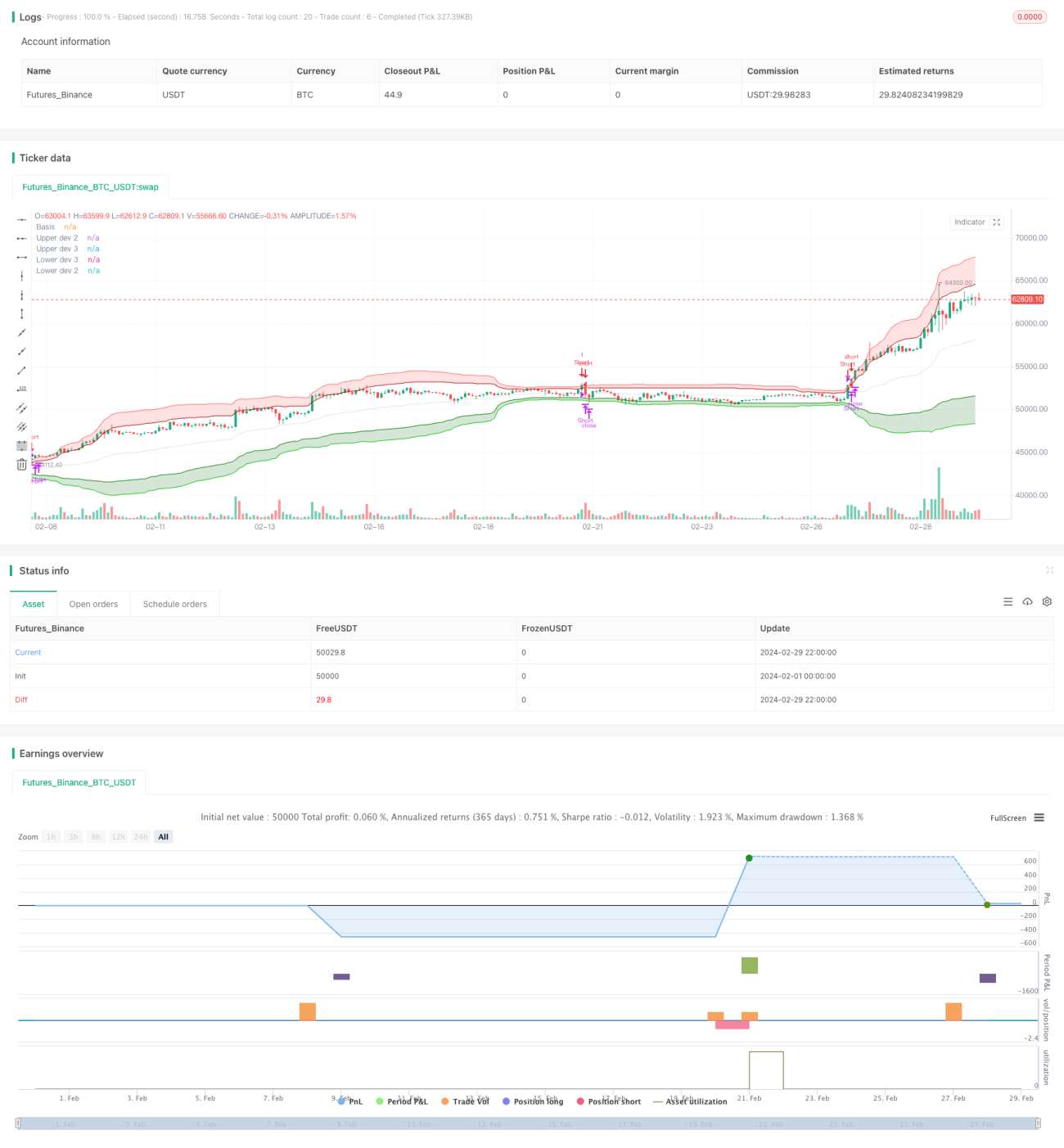
The BabyShark VWAP trading strategy is a quantitative trading strategy based on Volume Weighted Average Price (VWAP) and On Balance Volume Relative Strength Index (OBV RSI). The strategy aims to identify potential buy and sell signals based on deviations from VWAP and OBV RSI crossing certain threshold levels.
Strategy Principle
The core principle of this strategy is to utilize VWAP and OBV RSI indicators to capture market trends and momentum changes. VWAP is a dynamic moving average based on price and volume, which reflects the main trading areas of the market. When the price significantly deviates from VWAP, it usually indicates overbought or oversold conditions in the market. OBV RSI, on the other hand, introduces the volume factor on the basis of the traditional RSI indicator to determine the strength of market trends by measuring the intensity of volume changes.
Specifically, the strategy uses 60 candles as the calculation period for VWAP, with the closing price as the input data. It then constructs overbought and oversold zones based on price deviations of positive and negative 3 standard deviations from VWAP. For OBV RSI, it uses 5 candles as the calculation period and sets thresholds of 70 and 30 as criteria for determining overbought and oversold conditions.
In terms of trading logic, when the price is in the oversold zone below the lower band of VWAP and OBV RSI is less than 30, the strategy generates a long signal. Conversely, when the price is in the overbought zone above the upper band of VWAP and OBV RSI is greater than 70, it generates a short signal. Additionally, the strategy sets a take profit and stop loss ratio of 0.6% and introduces a cooling-off period of 10 candles after consecutive losses to control risks.
Strategy Advantages
- Combines multiple market factors such as price and volume to comprehensively capture market trends and momentum.
- Adopts dynamic VWAP and OBV RSI indicators to adapt to changes in different market cycles.
- Sets reasonable take profit and stop loss ratios and cooling-off periods to effectively control risks while seizing opportunities.
- Clear logic, easy to understand and implement, with a certain level of interpretability.
- Adjustable parameters, suitable for traders with different styles to optimize and improve.
Strategy Risks
- For oscillating or repetitive markets, frequent trading signals may lead to overtrading and increased slippage costs.
- In trending markets, solely relying on VWAP for profit-taking may cause the strategy to exit too early, missing out on subsequent trend profits.
- Fixed parameter settings may not adapt to changes in market conditions, requiring optimization for different instruments and timeframes.
- OBV indicator heavily relies on volume data; when volume data is inaccurate or manipulated, indicator distortions may mislead judgments.
- The strategy lacks consideration of external factors such as macroeconomics and news, and may fail in extreme market conditions.
Optimization Directions
- Introduce more filtering conditions for oscillating markets, such as trend confirmation indicators and volatility indicators, to reduce frequent trading.
- Optimize exit conditions, such as using trailing stops or combining with other trend-following indicators to better capture trending markets.
- Perform adaptive optimization of VWAP and OBV RSI parameters, dynamically adjusting calculation periods and threshold settings.
- Introduce volume authenticity verification mechanisms to improve the reliability of the OBV RSI indicator.
- Consider incorporating macroeconomic data analysis, sentiment indicators, etc., to enhance the adaptability and robustness of the strategy.
Summary
The BabyShark VWAP trading strategy is a quantitative trading strategy that combines volume weighted average price and on balance volume relative strength index to generate trading signals by capturing overbought and oversold conditions and changes in trend momentum. The strategy has clear logic, integrating multiple market factors such as price and volume to comprehensively grasp the market pulse. At the same time, reasonable take profit and stop loss settings and risk control mechanisms allow the strategy to pursue returns while considering risk management. However, the strategy also has potential issues such as inadequate adaptability to oscillating and trending markets and fixed parameters. Future improvements can focus on optimizing entry filters, dynamic profit-taking, adaptive parameters, enhancing external data analysis, and further improving the robustness and profitability of the strategy. Overall, the BabyShark VWAP trading strategy provides a reference framework for quantitative trading practice that is worth further exploration and improvement.
/*backtest
start: 2024-02-01 00:00:00
end: 2024-02-29 23:59:59
period: 2h
basePeriod: 15m
exchanges: [{"eid":"Futures_Binance","currency":"BTC_USDT"}]
*/

// This Pine Script™ code is subject to the terms of the Mozilla Public License 2.0 at https://mozilla.org/MPL/2.0/
// © GreatestUsername

//@version=5- 1