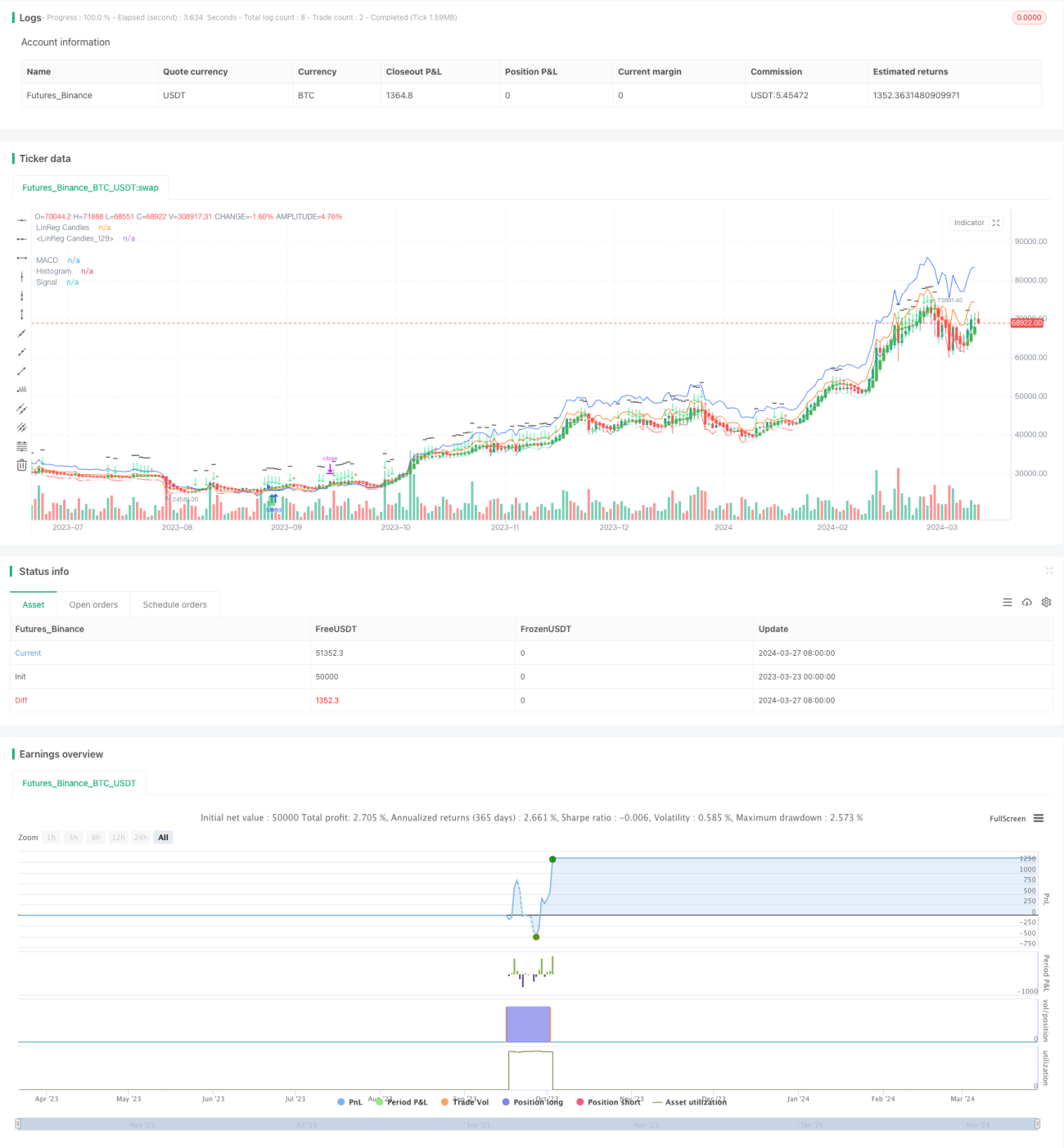
This strategy combines the Triple Exponential Moving Average Convergence Divergence (Triple MACD) and Relative Strength Index (RSI) methods, specifically designed for quantitative trading in the cryptocurrency market on a 1-minute time frame. The main idea behind the strategy is to capture changes in bullish and bearish momentum using MACD indicators with different period parameters, while employing the RSI indicator to confirm trend strength. By averaging the three MACD signals, noise can be effectively smoothed out, improving the reliability of trading signals. Additionally, the strategy utilizes linear regression techniques to identify consolidation phases in the market, avoiding frequent trades during choppy price action. The entire strategy is suitable for grid trading bots, capable of generating steady returns amidst the rapid fluctuations of the cryptocurrency market.
The strategy employs three MACD indicators with different parameters: fast line periods of 5/13/34 and slow line periods of 8/21/144. It calculates the difference between them to obtain the MACD values. These three MACD values are then averaged, and the final MACD histogram is derived by subtracting the Signal value (N-period EMA of MACD) from the averaged MACD. Simultaneously, a 14-period RSI indicator is calculated to assist in determining trend strength. A long signal is generated when the average MACD histogram shifts from negative to positive, RSI is below 55, and there is a bullish alignment. Conversely, a close signal is triggered when the average MACD histogram changes from positive to negative, RSI is above 45, and there is a bearish alignment. Furthermore, the strategy applies an 11-period linear regression to fit the candlesticks, identifying ranging markets by analyzing the ratio between the length of the candlestick bodies and shadows.
This strategy cleverly combines the Triple MACD with the RSI indicator and utilizes linear regression techniques to identify ranging markets, forming a complete set of high-frequency quantitative trading strategies. The strict entry and exit conditions and the application of averaged MACD signals contribute to improved trading accuracy and drawdown control. Although the strategy performs better in unidirectional trend markets, measures such as introducing volatility filters, optimizing ranging market identification methods, setting trailing stop-losses, and establishing independent parameters for different instruments can further enhance the strategy’s adaptability and robustness. Overall, this is a very promising cryptocurrency quantitative trading strategy that merits further optimization and live trading application.
/*backtest
start: 2023-03-23 00:00:00
end: 2024-03-28 00:00:00
period: 1d
basePeriod: 1h
exchanges: [{"eid":"Futures_Binance","currency":"BTC_USDT"}]
*/
//@version=5
strategy(title="TrippleMACD", shorttitle="TrippleMACD + RSI strategy", format=format.price, precision=4, overlay=true)
// RSI
ma(source, length, type) =>
switch type
"SMA" => ta.sma(source, length)
"Bollinger Bands" => ta.sma(source, length)
"EMA" => ta.ema(source, length)
"SMMA (RMA)" => ta.rma(source, length)
"WMA" => ta.wma(source, length)
"VWMA" => ta.vwma(source, length)
rsiLengthInput = input.int(14, minval=1, title="RSI Length", group="RSI Settings")
rsiSourceInput = input.source(close, "Source", group="RSI Settings")
maTypeInput = input.string("SMA", title="MA Type", options=["SMA", "Bollinger Bands", "EMA", "SMMA (RMA)", "WMA", "VWMA"], group="MA Settings")
maLengthInput = input.int(14, title="MA Length", group="MA Settings")
bbMultInput = input.float(2.0, minval=0.001, maxval=50, title="BB StdDev", group="MA Settings")
showDivergence = input.bool(false, title="Show Divergence", group="RSI Settings")
up = ta.rma(math.max(ta.change(rsiSourceInput), 0), rsiLengthInput)
down = ta.rma(-math.min(ta.change(rsiSourceInput), 0), rsiLengthInput)
rsi = down == 0 ? 100 : up == 0 ? 0 : 100 - (100 / (1 + up / down))
rsiMA = ma(rsi, maLengthInput, maTypeInput)
isBB = maTypeInput == "Bollinger Bands"
bbUpperBand = plot(isBB ? rsiMA + ta.stdev(rsi, maLengthInput) * bbMultInput : na, title = "Upper Bollinger Band", color=color.green)
bbLowerBand = plot(isBB ? rsiMA - ta.stdev(rsi, maLengthInput) * bbMultInput : na, title = "Lower Bollinger Band", color=color.green)
// Divergence
lookbackRight = 5
lookbackLeft = 5
rangeUpper = 60
rangeLower = 5
bearColor = color.red
bullColor = color.green
textColor = color.white
noneColor = color.new(color.white, 100)
plFound = na(ta.pivotlow(rsi, lookbackLeft, lookbackRight)) ? false : true
phFound = na(ta.pivothigh(rsi, lookbackLeft, lookbackRight)) ? false : true
_inRange(cond) =>
bars = ta.barssince(cond == true)
rangeLower <= bars and bars <= rangeUpper
//------------------------------------------------------------------------------
// Regular Bullish
// rsi: Higher Low
rsiHL = rsi[lookbackRight] > ta.valuewhen(plFound, rsi[lookbackRight], 1) and _inRange(plFound[1])
// Price: Lower Low
priceLL = low[lookbackRight] < ta.valuewhen(plFound, low[lookbackRight], 1)
bullCondAlert = priceLL and rsiHL and plFound
bullCond = showDivergence and bullCondAlert
// rsi: Lower High
rsiLH = rsi[lookbackRight] < ta.valuewhen(phFound, rsi[lookbackRight], 1) and _inRange(phFound[1])
// Price: Higher High
priceHH = high[lookbackRight] > ta.valuewhen(phFound, high[lookbackRight], 1)
bearCondAlert = priceHH and rsiLH and phFound
bearCond = showDivergence and bearCondAlert
// Getting inputs
stopLuse = input(1.040)
fast_length = input(title = "Fast Length", defval = 5)
slow_length = input(title = "Slow Length", defval = 8)
fast_length2 = input(title = "Fast Length2", defval = 13)
slow_length2 = input(title = "Slow Length2", defval = 21)
fast_length3 = input(title = "Fast Length3", defval = 34)
slow_length3 = input(title = "Slow Length3", defval = 144)
fast_length4 = input(title = "Fast Length3", defval = 68)
slow_length4 = input(title = "Slow Length3", defval = 288)
src = input(title = "Source", defval = close)
signal_length2 = input.int(title="Signal Smoothing", minval = 1, maxval = 200, defval = 11)
signal_length = input.int(title = "Signal Smoothing", minval = 1, maxval = 50, defval = 9)
sma_source = input.string(title = "Oscillator MA Type", defval = "EMA", options = ["SMA", "EMA"])
sma_signal = input.string(title = "Signal Line MA Type", defval = "EMA", options = ["SMA", "EMA"])
// Calculating
fast_ma = sma_source == "SMA" ? ta.sma(src, fast_length) : ta.ema(src, fast_length)
slow_ma = sma_source == "SMA" ? ta.sma(src, slow_length) : ta.ema(src, slow_length)
fast_ma2 = sma_source == "SMA2" ? ta.sma(src, fast_length2) : ta.ema(src, fast_length2)
slow_ma2 = sma_source == "SMA2" ? ta.sma(src, slow_length2) : ta.ema(src, slow_length2)
fast_ma3 = sma_source == "SMA3" ? ta.sma(src, fast_length3) : ta.ema(src, fast_length3)
slow_ma3 = sma_source == "SMA3" ? ta.sma(src, slow_length3) : ta.ema(src, slow_length3)
fast_ma4 = sma_source == "SMA3" ? ta.sma(src, fast_length3) : ta.ema(src, fast_length3)
slow_ma4 = sma_source == "SMA3" ? ta.sma(src, slow_length3) : ta.ema(src, slow_length3)
macd = fast_ma - slow_ma
macd2 = fast_ma2 - slow_ma2
macd3 = fast_ma3 - slow_ma3
macd4 = fast_ma4 - slow_ma4
signal = sma_signal == "SMA" ? ta.sma(macd, signal_length) : ta.ema(macd, signal_length)
signal2 = sma_signal == "SMA" ? ta.sma(macd2, signal_length) : ta.ema(macd2, signal_length)
signal3 = sma_signal == "SMA" ? ta.sma(macd3, signal_length) : ta.ema(macd3, signal_length)
signal4 = sma_signal == "SMA" ? ta.sma(macd4, signal_length) : ta.ema(macd4, signal_length)
//hist = (macd + macd2 + macd3)/1 - (signal + signal2 + signal3)/1
hist = (macd + macd2 + macd3 + macd4)/4 - (signal + signal2 + signal3 + signal4)/4
signal5 = (signal + signal2 + signal3)/3
sma_signal2 = input.bool(title="Simple MA (Signal Line)", defval=true)
lin_reg = input.bool(title="Lin Reg", defval=true)
linreg_length = input.int(title="Linear Regression Length", minval = 1, maxval = 200, defval = 11)
bopen = lin_reg ? ta.linreg(open, linreg_length, 0) : open
bhigh = lin_reg ? ta.linreg(high, linreg_length, 0) : high
blow = lin_reg ? ta.linreg(low, linreg_length, 0) : low
bclose = lin_reg ? ta.linreg(close, linreg_length, 0) : close
shadow = (bhigh - bclose) + (bopen - blow)
body = bclose - bopen
perc = (shadow/body)
cond2 = perc >=2 and bclose+bclose[1]/2 > bopen+bopen[1]/2
r = bopen < bclose
//signal5 = sma_signal2 ? ta.sma(bclose, signal_length) : ta.ema(bclose, signal_length)
plotcandle(r ? bopen : na, r ? bhigh : na, r ? blow: na, r ? bclose : na, title="LinReg Candles", color= color.green, wickcolor=color.green, bordercolor=color.green, editable= true)
plotcandle(r ? na : bopen, r ? na : bhigh, r ? na : blow, r ? na : bclose, title="LinReg Candles", color=color.red, wickcolor=color.red, bordercolor=color.red, editable= true)
//alertcondition(hist[1] >= 0 and hist < 0, title = 'Rising to falling', message = 'The MACD histogram switched from a rising to falling state')
//alertcondition(hist[1] <= 0 and hist > 0, title = 'Falling to rising', message = 'The MACD histogram switched from a falling to rising state')
green = hist >= 0 ? (hist[1] < hist ? "G" : "GL") : (hist[1] < hist ? "RL" : "R")
Buy = green == "G" and green[1] != "G" and green[1] != "GL" and bopen < bclose and rsi < 55.0 //and not cond2
//StopBuy = (green == "R" or green == "RL" or green == "RL") and bopen > bclose and bopen[1] < bclose[1]
StopBuy = bopen > bclose and bopen[1] < bclose[1] and (green == "G" or green == "GL" or green == "R") and bopen[2] < bclose[2] and bopen[3] < bclose[3]
hists = close[3] < close[2] and close[2] < close[1]
//Buy = green == "RL" and hist[0] > -0.07 and hist[0] < 0.00 and rsi < 55.0 and hists
//StopBuy = green == "GL" or green == "R"
alertcondition(Buy, "Long","Покупка в лонг")
alertcondition(StopBuy, "StopLong","Закрытие сделки")
//hline(0, "Zero Line", color = color.new(#787B86, 50))
plot(hist + (close - (close * 0.03)), title = "Histogram", style = plot.style_line, color = (hist >= 0 ? (hist[1] < hist ? #26A69A : #B2DFDB) : (hist[1] < hist ? #FFCDD2 : #FF5252)))
plotshape(Buy ? low : na, 'Buy', shape.labelup, location.belowbar , color=color.new(#0abe40, 50), size=size.small, offset=0)
plotshape(StopBuy ? low : na, 'Buy', shape.cross, location.abovebar , color=color.new(#be0a0a, 50), size=size.small, offset=0)
plot(macd4 + (close - (close * 0.01)), title = "MACD", color = #2962FF)
plot(signal5 + (close - (close * 0.01)), title = "Signal", color = #FF6D00)
plotchar(cond2 , char='↓', color = color.rgb(0, 230, 119), text = "-")
if (Buy)
strategy.entry("long", strategy.long)
// if (startShortTrade)
// strategy.entry("short", strategy.short)
profitTarget = strategy.position_avg_price * stopLuse
strategy.exit("Take Profit", "long", limit=profitTarget)
// strategy.exit("Take Profit", "short", limit=profitTarget)