Donchian Channel and Larry Williams Large Trade Index Strategy

Overview
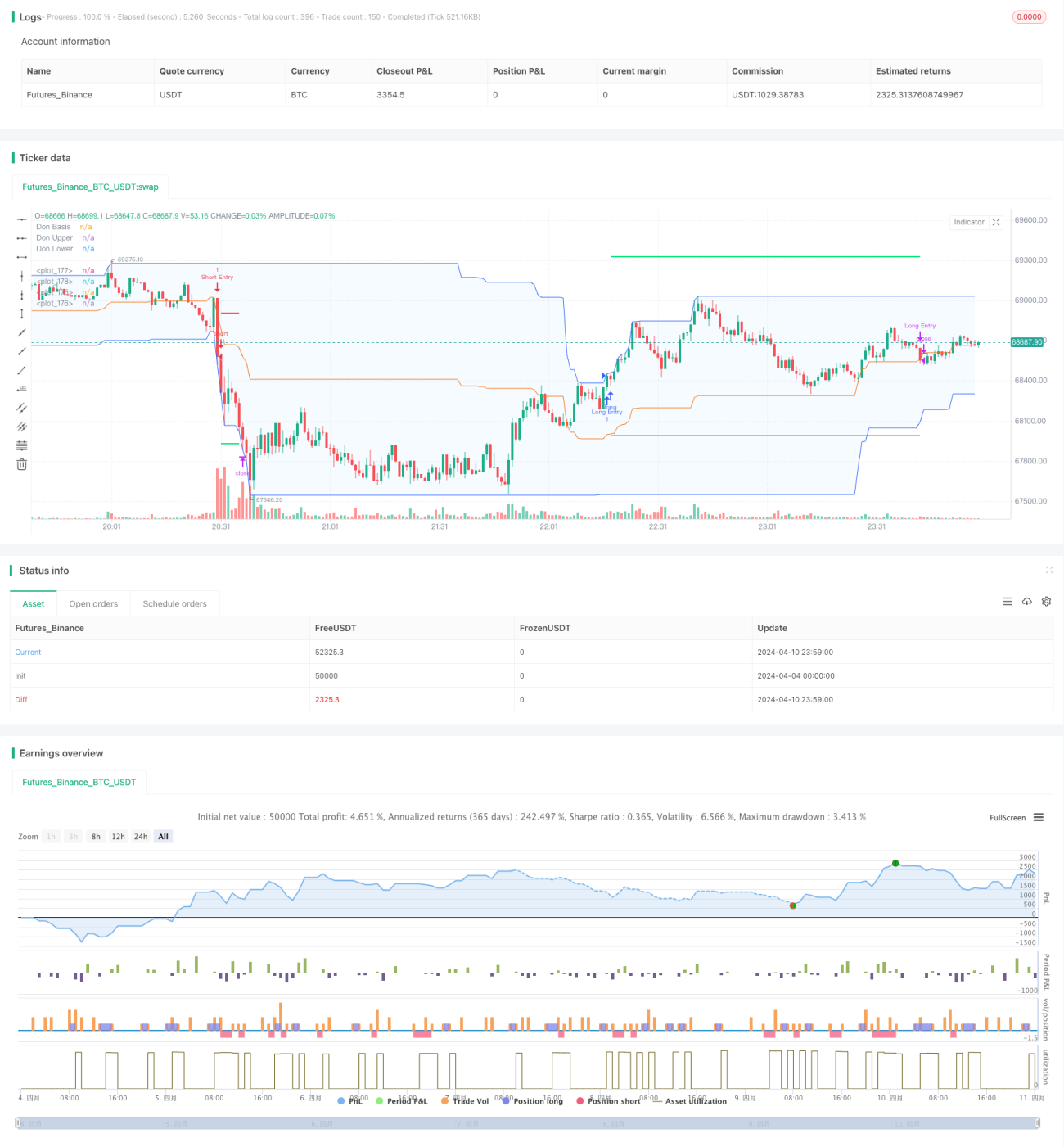
This strategy combines three indicators - Donchian Channel, Larry Williams Large Trade Index (LWTI), and Volume Moving Average to generate trading signals. It enters a long position when the price breaks above the upper band of the Donchian Channel, LWTI is green, and volume is greater than the moving average. It enters a short position when the price breaks below the lower band of the Donchian Channel, LWTI is red, and volume is greater than the moving average. The strategy exits positions when the price reaches the stop loss or take profit levels, or when the price returns to the middle band of the Donchian Channel. To prevent repeated entries in the same trend direction, the strategy employs a trade counter that only allows new entries after the price crosses the middle band of the Donchian Channel.
Strategy Principle
- Donchian Channel: A long signal is generated when the price breaks above the upper band, and a short signal is generated when the price breaks below the lower band.
- Larry Williams Large Trade Index: Long positions are only allowed when the LWTI color is green, and short positions are only allowed when it is red.
- Volume: Entries are only allowed when the current volume is greater than the volume moving average.
- Trade Counter: To prevent repeated entries in the same trend direction, new entries are only allowed after the price crosses the middle band of the Donchian Channel.
- Stop Loss and Take Profit: Upon entry, stop loss and take profit distances are calculated based on ATR, with the take profit distance being the stop loss distance multiplied by the risk-reward ratio.
Strategy Advantages
- The combination of multiple indicators to confirm trading signals can effectively filter out false signals and improve signal quality.
- Dynamic stop loss and take profit - Adjusting stop loss and take profit distances based on volatility allows the strategy to better adapt to market changes.
- The trade counter prevents repeated entries in the same trend, controlling trading frequency.
- Risk-reward ratio based take profit - Setting the take profit level based on a predetermined risk-reward ratio allows profit potential to exceed risk.
Strategy Risks
- Parameter risk - Strategy performance is greatly affected by different parameter settings, requiring optimization based on different market characteristics and timeframes.
- Choppy market risk - In choppy market conditions, frequent fluctuations may cause the strategy to enter and exit positions frequently, resulting in poor performance.
- Trend risk - If the trend lacks persistence, frequent entries and exits may occur, leading to increased losses.
- Black swan risk - In extreme market conditions, indicators may fail, resulting in poor strategy performance.
Strategy Optimization Directions
- Optimize parameters for different instruments and timeframes to find the best parameter combinations.
- Add trend filtering conditions, such as using moving averages or momentum indicators, to only enter positions when the trend is clear, reducing the number of trades in choppy environments.
- Consider using range breakout strategies for choppy market conditions.
- Optimize stop loss and take profit logic by introducing trailing stops or other methods.
- For extreme market conditions, consider introducing fixed money management and maximum drawdown limits.
Summary
The Donchian Channel and Larry Williams Large Trade Index strategy is a classic trend-following trading strategy. It captures trend direction using the Donchian Channel, filters signals using LWTI, volume, and other indicators, and employs dynamic stop loss and take profit with strict risk control. Overall, it is a strategy framework with the potential for steady returns. However, it is important to note that the strategy is sensitive to parameters and performs poorly in choppy market conditions. It is recommended for use in trending markets. In practical application, further optimization of parameters and logic based on trading instruments and market characteristics, along with strict money management, is necessary to achieve good and stable returns.
- 1