Multi-Level Dynamic Trend Following System

Overview
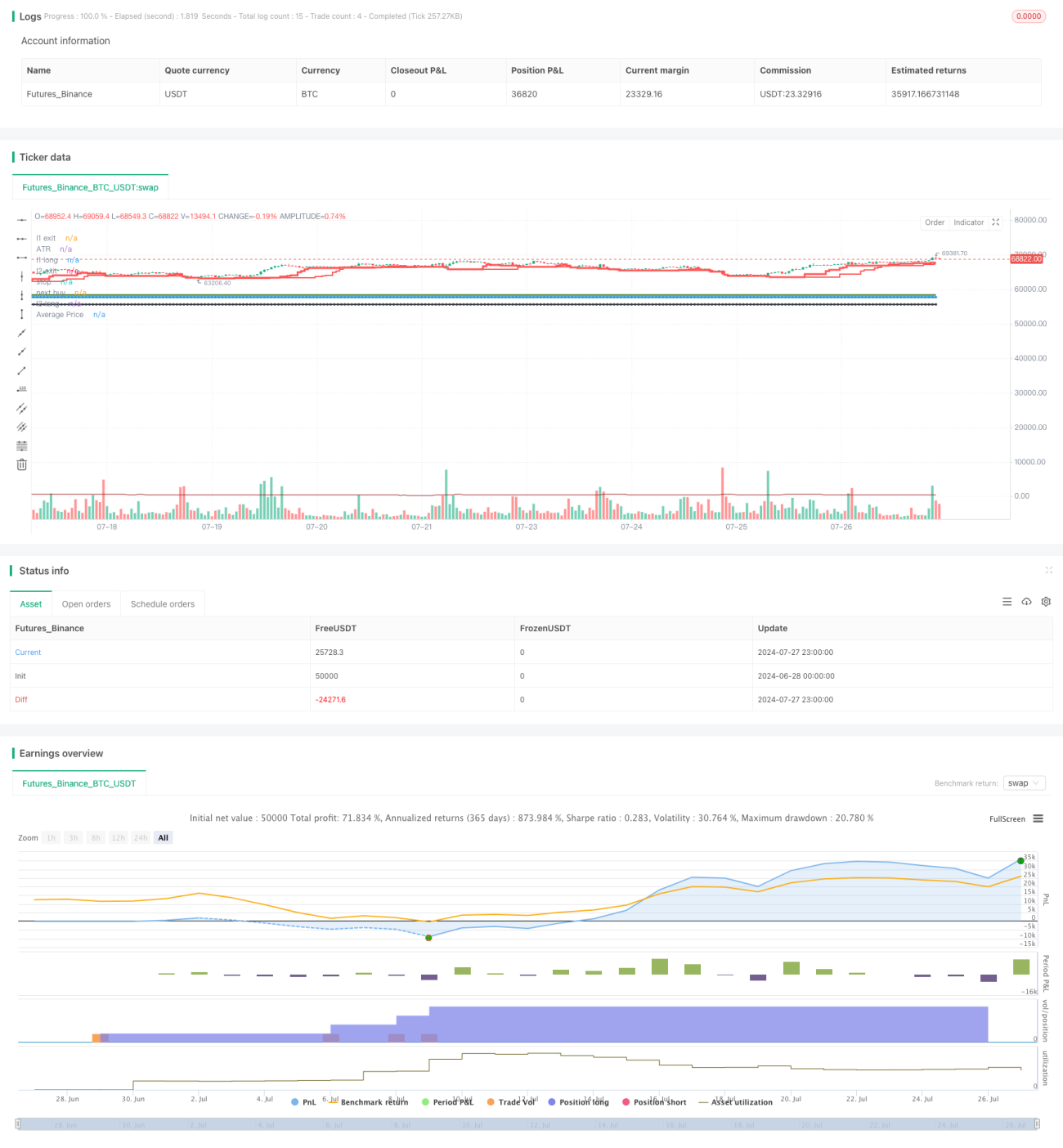
The Multi-Level Dynamic Trend Following System is an improved strategy based on the Turtle Trading Rules. This strategy utilizes trend signals from multiple time periods, combined with dynamic stop-loss and pyramid position building, to capture medium to long-term trends. The system sets up two trend-following periods (L1 and L2) to capture trends at different speeds and uses an adaptive ATR indicator to dynamically adjust entry, position building, and stop-loss points. This multi-level design allows the strategy to maintain stability in different market environments while maximizing profit potential through pyramid position building.
Strategy Principles
-
Trend Identification: Two moving average periods (L1 and L2) are used to identify trends at different speeds. L1 is used to capture faster trends, while L2 captures slower but more reliable trends.
-
Entry Signals: Long signals are generated when the price breaks above the L1 or L2 high. If the previous L1 trade was profitable, the next L1 signal is skipped until an L2 signal appears.
-
Dynamic Stop-Loss: A multiple of the ATR (default 3x) is used as the initial stop-loss distance, which gradually moves up as the position is held.
-
Pyramid Position Building: During trend continuation, additional positions are added every time the price rises by 0.5 ATR, up to a maximum of 5 times.
-
Risk Control: Each trade risks no more than 2% of the account equity, achieved through dynamic position sizing.
-
Exit Mechanism: Positions are closed when the price falls below the 10-day low (L1) or 20-day low (L2), or when the trailing stop-loss is triggered.
Strategy Advantages
-
Multi-Level Trend Capture: The L1 and L2 periods allow for capturing both rapid and long-term trends, improving the strategy's adaptability and stability.
-
Dynamic Risk Management: Using ATR as a volatility indicator enables dynamic adjustment of entry, stop-loss, and position building points, better adapting to market changes.
-
Pyramid Position Building: Gradually increasing positions during trend continuation both controls risk and maximizes profit potential.
-
Flexible Parameter Settings: Multiple adjustable parameters allow the strategy to adapt to different markets and trading styles.
-
Automated Execution: The strategy can run fully automated, reducing human intervention and emotional influence.
Strategy Risks
-
Trend Reversal Risk: Performs well in strong trend markets but may lead to frequent losses in range-bound markets.
-
Slippage and Transaction Costs: Frequent position building and moving stop-losses may result in high transaction costs.
-
Over-Optimization Risk: Numerous parameters may lead to overfitting historical data.
-
Capital Management Risk: Smaller initial capital may not effectively execute multiple position builds.
-
Market Liquidity Risk: In less liquid markets, it may be difficult to execute trades at ideal prices.
Strategy Optimization Directions
-
Incorporate Market Environment Filtering: Add trend strength indicators (e.g., ADX) to assess market conditions and reduce trading frequency in range-bound markets.
-
Optimize Position Building Strategy: Consider dynamically adjusting the interval and number of position builds based on trend strength, rather than fixed 0.5 ATR and 5 times.
-
Introduce Profit-Taking Mechanism: In long-term trends, set partial profit-taking to lock in gains, such as closing half the position when reaching 3x ATR profit.
-
Multi-Instrument Correlation Analysis: When applying to a portfolio, add inter-instrument correlation analysis to optimize overall risk-reward ratio.
-
Add Volatility Filtering: Pause trading or adjust risk parameters during periods of extreme volatility to handle abnormal market conditions.
-
Optimize Exit Mechanism: Consider using more flexible exit indicators such as Parabolic SAR or Chandelier Exit.
Summary
The Multi-Level Dynamic Trend Following System is a comprehensive strategy combining classic Turtle Trading Rules with modern quantitative techniques. Through multi-level trend identification, dynamic risk management, and pyramid position building, this strategy improves trend capture ability and profit potential while maintaining robustness. Although it faces challenges in range-bound markets, with proper parameter optimization and risk control, the strategy has the potential to maintain stable performance across different market environments. Future improvements can focus on introducing market environment assessment, optimizing position building and exit mechanisms to enhance the strategy's robustness and profitability.
- 1