Dual Moving Average Channel Trend Following Strategy

Overview
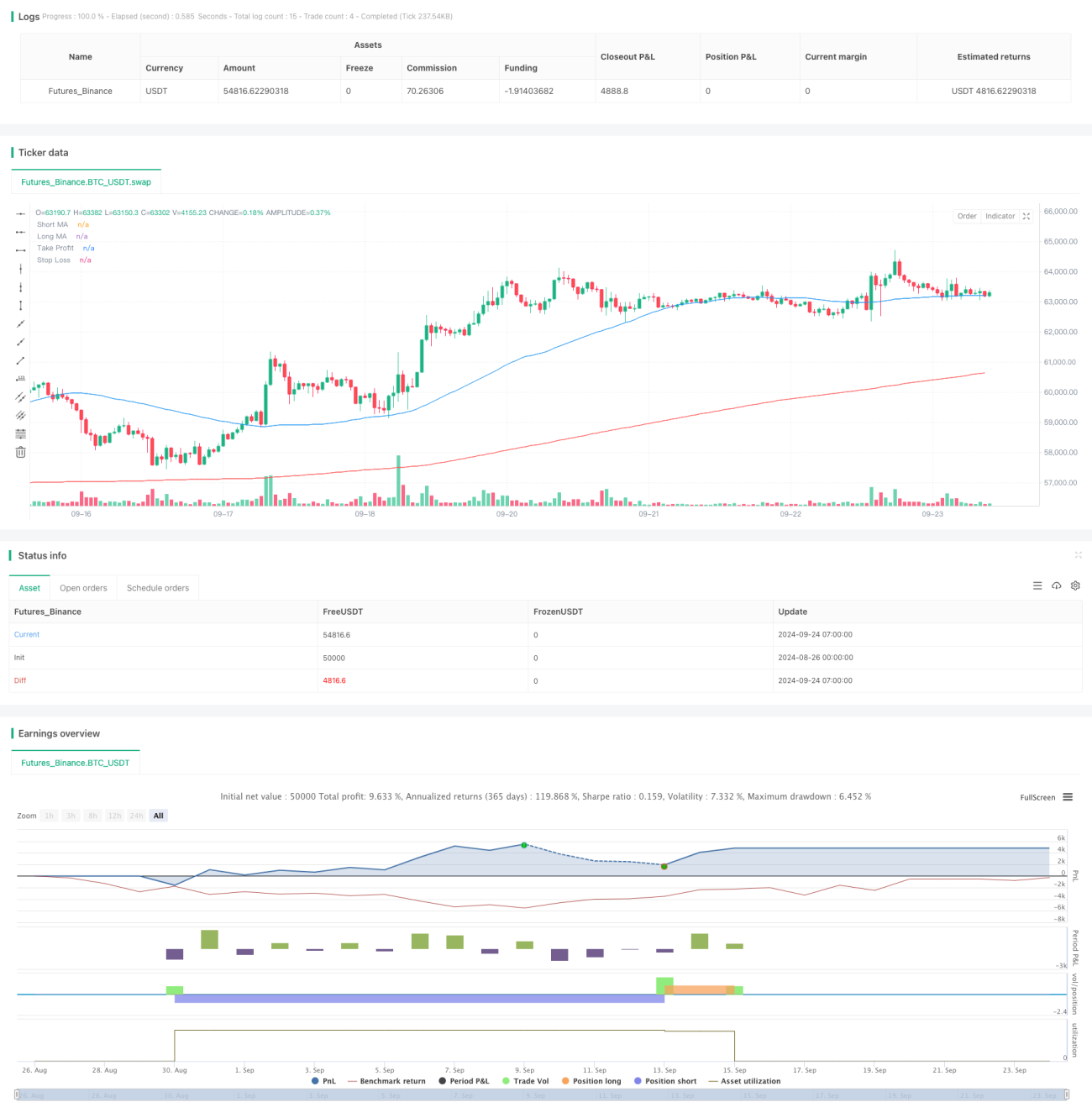
This strategy is a trend-following system based on dual moving averages and channels. It utilizes crossover signals from short-term and long-term moving averages, combined with channels formed by exponential moving averages (EMAs), to capture market trends and execute trades. The strategy is applicable to both long and short positions, employing stop-loss and take-profit mechanisms for risk and profit management.
Strategy Principle
The core logic of the strategy includes the following key components:
- Two Simple Moving Averages (SMAs) as primary trend indicators: 55-period and 300-period SMAs.
- Two Exponential Moving Averages (EMAs) forming a trading channel: 576-period and 676-period EMAs.
- Long entry signals are triggered when the short-term SMA crosses above the long-term SMA or EMA; short entry signals occur when the short-term SMA crosses below the long-term SMA or EMA.
- Fixed-point stop-loss and take-profit strategy, with stop-loss set at 1/70 of the entry price and take-profit at 1/140 of the entry price.
- A trailing stop mechanism is activated when profit reaches 300 points to protect accumulated gains.
- The strategy includes exit conditions, such as automatic position closure when price hits stop-loss or take-profit levels.
Strategy Advantages
- Multi-indicator integration: Combining multiple moving averages and EMA channels enhances trend identification accuracy.
- Bidirectional trading: The strategy can profit in both bullish and bearish markets, improving capital efficiency.
- Risk management: Employs fixed-point stop-loss and take-profit, effectively controlling risk for each trade.
- Profit protection: Utilizes trailing stop mechanism to lock in partial profits during sustained trends.
- Flexibility: Strategy parameters are adjustable to adapt to different market conditions.
Strategy Risks
- Ranging market risk: In sideways markets, frequent false signals may lead to consecutive losses.
- Slippage risk: In highly volatile markets, actual execution prices may significantly deviate from ideal prices.
- Overtrading: Frequent trading signals may result in excessive transaction costs.
- Parameter sensitivity: Strategy performance may be highly sensitive to parameter settings, potentially requiring frequent adjustments for different market environments.
Strategy Optimization Directions
- Incorporate volatility indicators: Consider adding ATR (Average True Range) to dynamically adjust stop-loss and take-profit levels, adapting to varying market volatility.
- Enhance trend strength filtering: Introduce ADX (Average Directional Index) to filter out weak trend signals, reducing losses from false breakouts.
- Optimize entry timing: Consider combining RSI (Relative Strength Index) or MACD (Moving Average Convergence Divergence) to improve entry timing and increase win rate.
- Refine money management: Implement dynamic position sizing, adjusting trade sizes based on account equity and market volatility.
- Extend backtesting period: Conduct longer-term backtests to verify strategy stability across different market environments.
Conclusion
This dual moving average channel trend-following strategy provides a comprehensive trading system by combining multiple technical indicators. It not only captures major trends but also incorporates risk management and profit protection mechanisms. While some potential risks exist, through continuous optimization and parameter adjustment, the strategy has the potential to perform well under various market conditions. Future optimization should focus on improving signal quality, enhancing risk management, and increasing strategy adaptability.
- 1