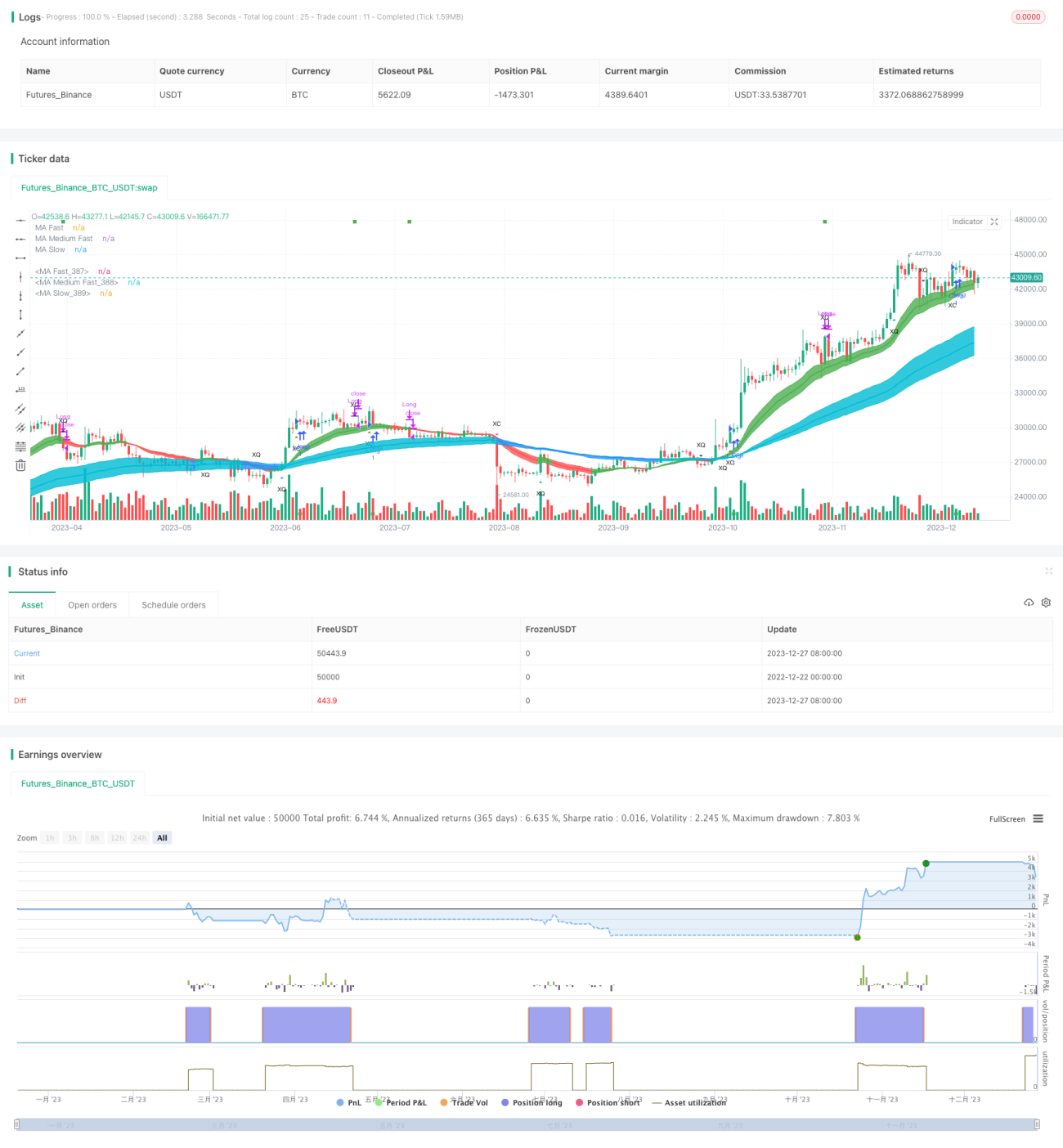
Estrategia de seguimiento de tendencias basada en QQE y MA


Fecha de creación: 2023-12-29 16:36:47 Última modificación: 2023-12-29 16:36:47
Copiar: 1 Número de Visitas: 1320
1
Seguir
1621
Seguidores

Estrategia de seguimiento de tendencias basada en QQE y MA

Descripción general

La estrategia es una estrategia de seguimiento de tendencias basado en el indicador QQE y las medias móviles. La estrategia determina la dirección de la tendencia a través de la intersección del indicador QQE rápido y la filtración de la dirección de las medias móviles, generando señales de compra y venta.

La estrategia puede elegir entre tres cruces de indicadores QQE para juzgar la señal: 1) cruce del indicador RSI plano con el eje 0; 2) cruce del indicador RSI plano con la línea QQE rápida; 3) cruce del indicador RSI plano para salir del canal de desvalorización del RSI. Por defecto, se usa el tercer cruce para abrir posiciones y el segundo cruce para cerrar posiciones.

Las señales de compra y venta pueden elegir si se filtran adicionalmente a través de las medias móviles: la señal se produce cuando el precio de cierre es superior a (y inferior a) la media móvil rápida y la media móvil rápida es superior a (y inferior a) la media móvil lenta.

La estrategia se adapta al uso de un modelo de señal a señal para la negociación de programas automatizados.

El principio

El indicador central de la estrategia es el QQE, cuya fórmula de cálculo es la siguiente:

Wilders_Period = RSILen * 2 - 1  

Rsi = rsi(close,RSILen)  
RSIndex = ema(Rsi, SF)  
AtrRsi = abs(RSIndex - RSIndex[1])  
MaAtrRsi = ema(AtrRsi, Wilders_Period)
DeltaFastAtrRsi = ema(MaAtrRsi,Wilders_Period) * QQEfactor

newshortband = RSIndex + DeltaFastAtrRsi 
newlongband = RSIndex - DeltaFastAtrRsi

Donde RSILen es la duración del ciclo del RSI y SF es el factor de suavización del RSI. QQE es esencialmente un RSI suavizado. Calcula el canal de arriba a abajo a través de un rápido ATR, que se considera una oportunidad de compra o venta cuando el precio supera el canal.

La estrategia utiliza tres cruces de QQE para identificar las señales de negociación:

  1. El indicador RSI plano cruzado con el eje 0 (XZ)
QQEzlong = RSIndex >= 50 ? QQEzlong + 1 : 0
QQEzshort = RSIndex < 50 ? QQEzshort + 1 : 0  
  1. El indicador RSI suave cruza con el indicador QQE rápido (XQ), similar a una señal de oscilación anticipada
QQExlong = FastAtrRsiTL < RSIndex ? QQExlong + 1 : 0
QQExshort = FastAtrRsiTL > RSIndex ? QQExshort + 1 : 0
  1. El indicador RSI se desliza hacia fuera del canal de la brecha (XC), similar a una señal de oscilación confirmada
threshhold = 10 
QQEclong = RSIndex > (50 + threshhold) ? QQEclong + 1 : 0
QQEcshort = RSIndex < (50 - threshhold) ? QQEcshort + 1 : 0

Se puede elegir una o más de las tres cruces anteriores para identificar las señales de compra/venta y las señales de posición baja.

Las señales de compra y venta pueden elegir si se filtran adicionalmente a través de las medias móviles:

// 过滤条件  
QQEflong = close > ma_medium 和  
            ma_medium > ma_slow 和  
            ma_fast > ma_medium
             
QQEfshort = close < ma_medium 和  
            ma_medium < ma_slow 和 
            ma_fast < ma_medium  

Esto evita que se produzcan señales erróneas en caso de temblores.

La estrategia se adapta a la automatización de las operaciones para abrir posiciones de paz a través de diferentes cruces de QQE:

开仓信号 = XC 或 XQ 或 XZ
平仓信号 = XQ 或 XZ

Las ventajas

La estrategia tiene las siguientes ventajas:

  1. El uso de indicadores QQE para determinar tendencias y señales cruzadas, QQE en sí tiene la característica de suavizar el ruido, lo que reduce la señal errónea.

  2. La combinación de filtros con las medias móviles puede evitar aún más las señales erróneas de los mercados convulsivos y mejorar la calidad de la señal.

  3. Se pueden elegir diferentes cruces de QQE para abrir una posición y una posición para realizar transacciones automatizadas.

  4. El indicador RSI plano no se replantea debido a la retraso, por lo que las señales de compra y venta no ocurren.

  5. Se puede optimizar en diferentes períodos de tiempo para encontrar la combinación óptima de parámetros.

El riesgo

La estrategia también tiene ciertos riesgos:

  1. Cuando la tendencia se invierte, se producen señales erróneas y se debe establecer un stop loss para controlar el riesgo.

  2. La configuración incorrecta de los parámetros también puede afectar el rendimiento de la estrategia, lo que requiere varias pruebas de optimización para encontrar los mejores parámetros.

  3. Los diferentes parámetros de variedades y períodos de tiempo necesitan ser probados y optimizados por separado.

  4. Las transacciones automatizadas presentan el riesgo de retiro y pérdidas continuas y requieren administración de fondos.

La solución es la siguiente:

  1. Establezca un stop loss, que se detiene cuando se alcanza un determinado límite de pérdidas.

  2. Prueba detalladamente diferentes combinaciones de parámetros para encontrar el mejor.

  3. Ajuste los parámetros según la variedad y el ciclo.

  4. La administración de fondos, la construcción de almacenes por lotes y el control de las posiciones individuales.

Dirección de optimización

La estrategia puede ser optimizada en las siguientes direcciones:

  1. Optimice los parámetros de QQE, incluyendo la longitud RSI, la longitud RSI suave, la longitud ATR rápida, etc., para encontrar la combinación óptima de parámetros.

  2. Optimización de los parámetros de promedio móvil, ciclo de ajuste, tipo, etc., para obtener la mejor correspondencia con el indicador QQE.

  3. Prueba diferentes cruces de QQE para abrir una posición y una posición, en busca de la combinación más estable.

  4. Se pueden refinar los parámetros según la variedad y el ciclo de transacción. Las transacciones diarias pueden acortar el ciclo y mejorar el getParameter.

  5. Agrega un mecanismo de suspensión de pérdidas. Se detiene cuando las pérdidas alcanzan una cierta proporción.

  6. Reducir adecuadamente el tamaño de las posiciones y probar diferentes formas de gestión de las mismas.

Resumir

La estrategia integra el indicador QQE para determinar tendencias y señales cruzadas, y las medias móviles se filtran para generar señales de negociación. En el mercado real, se puede optimizar la calidad de la señal mediante el ajuste de los parámetros; y se combina con una estricta administración de fondos para controlar el riesgo. La estrategia es adecuada para usar como modelo de señal de señal para automatizar el comercio, y también puede ayudar a juzgar en el comercio discrecional.

Código Fuente de la Estrategia
/*backtest
start: 2022-12-22 00:00:00
end: 2023-12-28 00:00:00
period: 1d
basePeriod: 1h
exchanges: [{"eid":"Futures_Binance","currency":"BTC_USDT"}]
*/

//@version=3
//

//*** START of COMMENT OUT [Alerts]
strategy(title="[Backtest]QQE Cross v6.0 by JustUncleL", shorttitle="[BT]QQEX v6.0", overlay=true)
//*** END of COMMENT OUT [Alerts]
//<<<<<<<<<<<<<<<<<<<<<<<<<<<<<<<<<<<<<<<<<<<<<<<<<<<<<<<<<<<<<<<<<<<<<<<<<<<<<//

//>>>>>>>>>>>>>>>>>>>>>>>>>>>>>>>>>>>>>>>>>>>>>>>>>>>>>>>>>>>>>>>>>>>>>>>>>>>>>//
//*** START of COMMENT OUT [BackTest]
//study(title="[Alerts]QQE Cross v6.0 by JustUncleL", shorttitle="[AL]QQEX v6.0", overlay=true,max_bars_back=2000)
//*** END of COMMENT OUT [BackTest]

//
// Author:  JustUncleL
// Date:    10-July-2016
// Version: v6, Major Release Nov-2018
//
// Description:
//  A following indicator is Trend following that uses fast QQE crosses with Moving Averages
//  for trend direction filtering. QQE or Qualitative Quantitative Estimation is based 
//  on the relative strength index (RSI), but uses a smoothing technique as an additional 
//  transformation. Three crosses can be selected (all selected by default): 
//    - Smooth RSI signal crossing ZERO (XZ)
//    - Smooth RSI signal crossing Fast QQE line (XQ), this is like an early warning swing signal.
//    - Smooth RSI signal exiting the RSI Threshhold Channel (XC), this is like a confirmed swing signal.
//      An optimumal Smooth RSI threshold level is between 5% and 10% (default=10), it helps reduce
//      the false swings.
//  These signals can be selected to Open Short/Long and/or Close a trade, default is XC open
//  trade and XQ (or opposite open) to Close trade.
//
//  The (LONG/SHORT) alerts can be optionally filtered by the Moving Average Ribbons:
//    - For LONG alert the Close must be above the fast MA Ribbon and 
//        fast MA Ribbon must be above the slow MA Ribbon.
//    - For SHORT alert the Close must be below the fast MA Ribbon and
//        fast MA Ribbon must be below the slow MA Ribbon.
//  and/or directional filter:
//    - For LONG alert the Close must be above the medium MA and the
//      directional of both MA ribbons must be Bullish.
//    - For SELL alert the Close must be below the medium MA and the
//      directional of both MA ribbons must be Bearish.
//
//  This indicator is designed to be used as a Signal to Signal trading BOT 
//  in automatic or semi-automatic way (start and stop when conditions are suitable).
//  - For LONG and SHORT alerts I recommend you use "Once per Bar" alarm option
//  - For CLOSE alerts I recommend you use "Once per Bar Close" alarm option
//  (* The script has been designed so that long/short signals come at start of candles *)
//  (* and close signals  come at the end of candles                                    *)
//
// Mofidifications:
//  6.0 - Major Release Version
//      - Added second MA ribbon to help filter signals to the trend direction.
//      - Modified Alert filtering to include second MA Ribbon
//      - Change default settings to reflect Signal to Signal BOT parameters.
//      - Removed older redunant alerts.
//
//  5.0 - Development series
//
//  4.1 - Fix bug with painting Buy/Sell arrows when non-repaint shunt mode selected.
//      - Added option to alert just the first Buy/Sell alert after a trend swing
//      - Added Long and Short Alarms. When combined with the "first Buy/Sell" in trend option,
//        It is now possible to use this indicator to interface with AutoView 
//        or ProfitView. I suggest using the "QQEX XZ Alert" alarm to exit Long or Short
//        trade. Use only "Once per bar Close" option for Alarms. This is not a full
//        fledged trading BOT though with TP/SL settings.
//
//      - Changed QQE defaults to be a bit smoother (8, 5, 3) instead of (6, 3, 2.618).
//
//  4.0 - Added implied GPL copyright notice.
//      - Changed defaults to use HullMAs instead of EMAs.
//  3.0 - No repaint on BUY/SELL alert, however, now trades should be taken when the BUY/SELL
//        Alert is displayed. The alarm is still generated on the previous candle so you can
//        still get a pre-warning, this enables you time to analyse the pending alert.
//      - Added option to test success of alerted trades, highlight successful and failed trade bars
//        and show simple stats: success rate and number of trades (out of 5000), this will help
//        tune the settings for timeframe and currency PAIR.
//  2.0 - Added code to use the medium moving average (EMA20) rising/falling for additional
//        trend direction filter.
//      - Remove Moving Average cross over signals and other options not used in this indicator.
//      - Added code to distinguish between the crosses, now only show Thresh Hold crosses as BUY/SELL
//        alerts.
//      - Modidied default settings to more well known MA's and slightly different QQE settings, these
//        work well at lower timeframes.
//      - Added circle plots at bottom of chart to show when actual BUY/SELL alerts occur.
//  1.0 - original
//
// References:
//  Some Code borrowed from:
//  - "Scalp Jockey - MTF MA Cross Visual Strategizer by JayRogers"
//  - "QQE MT4 by glaz"
//  Inspiration from:
//  - http://www.forexstrategiesresources.com/binary-options-strategies-ii/189-aurora-binary-trading/
//  - http://www.forexstrategiesresources.com/metatrader-4-trading-systems-v/652-qqe-smoothed-trading/
//  - http://dewinforex.com/forex-indicators/qqe-indicator-not-quite-grail-but-accurately-defines-trend-and-flat.html
//  - "Binary option trading by two previous bars" by radixvinni
//
//
// -----------------------------------------------------------------------------
// Copyright 2015 Glaz,JayRogers
//
// Copyright 2016,2017,2018 JustUncleL
//
// This program is free software: you can redistribute it and/or modify
// it under the terms of the GNU General Public License as published by
// the Free Software Foundation, either version 3 of the License, or
// any later version.
//
// This program is distributed in the hope that it will be useful,
// but WITHOUT ANY WARRANTY; without even the implied warranty of
// MERCHANTABILITY or FITNESS FOR A PARTICULAR PURPOSE.  See the
// GNU General Public License for more details.
// 
// The GNU General Public License can be found here
// <http://www.gnu.org/licenses/>.
//
// -----------------------------------------------------------------------------
//

// Use Alternate Anchor TF for MAs 
anchor     = input(4,minval=0,maxval=100,title="Relative TimeFrame Multiplier for Second MA Ribbon (0=none, max=100)")
//

// - INPUTS START
// Fast MA - type, source, length
showAvgs     = input(true,title="Show Moving Average Lines")
type1   = input(defval="EMA", title="Fast MA Type: ", options=["SMA", "EMA", "WMA", "VWMA", "SMMA", "DEMA", "TEMA", "HullMA", "ZEMA", "TMA", "SSMA"])
len1    = input(defval=16, title="Fast - Length", minval=1)
gamma1  = 0.33
// Medium Fast MA - type, source, length
type2   = input(defval="EMA", title="Medium MA Type: ", options=["SMA", "EMA", "WMA", "VWMA", "SMMA", "DEMA", "TEMA", "HullMA", "ZEMA", "TMA", "SSMA"])
len2    = input(defval=21, title="Medium - Length", minval=1)
gamma2  = 0.55
// Slow MA - type, source, length
type3   = input(defval="EMA", title="Slow MA Type: ", options=["SMA", "EMA", "WMA", "VWMA", "SMMA", "DEMA", "TEMA", "HullMA", "ZEMA", "TMA", "SSMA"])
len3    = input(defval=26, title="Slow Length", minval=1)
gamma3  = 0.77
//
// QQE rsi Length, Smoothing, fast ATR factor, source
RSILen  = input(14,title='RSI Length')
SF      = input(8,title='RSI Smoothing Factor')
QQEfactor  = input(5.0,type=float,title='Fast QQE Factor')
threshhold = input(10, title="RSI Threshhold")
//
sQQEx   = input(true,title="Show QQE Signal crosses")
sQQEz   = input(false,title="Show QQE Zero crosses")
sQQEc   = input(true,title="Show QQE Thresh Hold Channel Exits")
//
tradeSignal = input("XC", title="Select which QQE signal to Buy/Sell", options=["XC","XQ","XZ"])
closeSignal = input("XQ", title="Select which QQE signal to Close Order", options=["XC","XQ","XZ"])
//
xfilter = input(true, title="Filter XQ Buy/Sell Orders by Threshold" )
filter  = input(false,title="Use Moving Average Filter")
dfilter = input(true, title="Use Trend Directional Filter" )
ufirst  = input(false, title="Only Alert First Buy/Sell in a new Trend")
RSIsrc  = input(close,title="Source")

src     = RSIsrc // MA source
srcclose= RSIsrc

///////////////////////////////////////////////
//* Backtesting Period Selector | Component *//
///////////////////////////////////////////////

//* https://www.tradingview.com/script/eCC1cvxQ-Backtesting-Period-Selector-Component *//
//* https://www.tradingview.com/u/pbergden/ *//
//* Modifications made by JustUncleL*//


//>>>>>>>>>>>>>>>>>>>>>>>>>>>>>>>>>>>>>>>>>>>>>>>>>>>>>>>>>>>>>>>>>>>>>>>>>>>>>//
//*** START of COMMENT OUT [Alerts]

testStartYear = input(2018, "Backtest Start Year",minval=1980)
testStartMonth = input(6, "Backtest Start Month",minval=1,maxval=12)
testStartDay = input(12, "Backtest Start Day",minval=1,maxval=31)
testPeriodStart = timestamp(testStartYear,testStartMonth,testStartDay,0,0)

testStopYear = 9999 //input(9999, "Backtest Stop Year",minval=1980)
testStopMonth = 12 // input(12, "Backtest Stop Month",minval=1,maxval=12)
testStopDay = 31 //input(31, "Backtest Stop Day",minval=1,maxval=31)
testPeriodStop = timestamp(testStopYear,testStopMonth,testStopDay,0,0)

testPeriod = time >= testPeriodStart and time <= testPeriodStop ? true : false

//*** END of COMMENT OUT [Alerts]
//<<<<<<<<<<<<<<<<<<<<<<<<<<<<<<<<<<<<<<<<<<<<<<<<<<<<<<<<<<<<<<<<<<<<<<<<<<<<<//

// - INPUTS END


gold = #FFD700
AQUA = #00FFFFFF
BLUE = #0000FFFF
RED  = #FF0000FF
LIME = #00FF00FF
GRAY = #808080FF

// - FUNCTIONS

// - variant(type, src, len, gamma)
// Returns MA input selection variant, default to SMA if blank or typo.

// SuperSmoother filter
// © 2013  John F. Ehlers
variant_supersmoother(src,len) =>
    a1 = exp(-1.414*3.14159 / len)
    b1 = 2*a1*cos(1.414*3.14159 / len)
    c2 = b1
    c3 = (-a1)*a1
    c1 = 1 - c2 - c3
    v9 = 0.0
    v9 := c1*(src + nz(src[1])) / 2 + c2*nz(v9[1]) + c3*nz(v9[2])
    v9
    
variant_smoothed(src,len) =>
    v5 = 0.0
    v5 := na(v5[1]) ? sma(src, len) : (v5[1] * (len - 1) + src) / len
    v5

variant_zerolagema(src,len) =>
    ema1 = ema(src, len)
    ema2 = ema(ema1, len)
    v10 = ema1+(ema1-ema2)
    v10
    
variant_doubleema(src,len) =>
    v2 = ema(src, len)
    v6 = 2 * v2 - ema(v2, len)
    v6

variant_tripleema(src,len) =>
    v2 = ema(src, len)
    v7 = 3 * (v2 - ema(v2, len)) + ema(ema(v2, len), len)               // Triple Exponential
    v7
    
//calc Laguerre
variant_lag(p,g) =>
    L0 = 0.0
    L1 = 0.0
    L2 = 0.0
    L3 = 0.0
    L0 := (1 - g)*p+g*nz(L0[1])
    L1 := -g*L0+nz(L0[1])+g*nz(L1[1])
    L2 := -g*L1+nz(L1[1])+g*nz(L2[1])
    L3 := -g*L2+nz(L2[1])+g*nz(L3[1])
    f = (L0 + 2*L1 + 2*L2 + L3)/6
    f

// return variant, defaults to SMA 
variant(type, src, len, g) =>
    type=="EMA"     ? ema(src,len) : 
      type=="WMA"   ? wma(src,len): 
      type=="VWMA"  ? vwma(src,len) : 
      type=="SMMA"  ? variant_smoothed(src,len) : 
      type=="DEMA"  ? variant_doubleema(src,len): 
      type=="TEMA"  ? variant_tripleema(src,len): 
      type=="LAGMA" ? variant_lag(src,g) :
      type=="HullMA"? wma(2 * wma(src, len / 2) - wma(src, len), round(sqrt(len))) :
      type=="SSMA"  ? variant_supersmoother(src,len) : 
      type=="ZEMA"  ? variant_zerolagema(src,len) : 
      type=="TMA"   ? sma(sma(src,len),len) : 
                      sma(src,len)

// - /variant 

// If have anchor specified, calculate the base multiplier, base on time in mins
//mult  = isintraday ? anchor==0 or interval<=0 or interval>=anchor or anchor>1440? 1 : round(anchor/interval) : 1
//mult := not isintraday?  1 : mult  // Only available Daily or less

// Anchor is a relative multiplier based on current TF.
mult = anchor>0 ? anchor : 1 

// - FUNCTIONS END

 
// - Fast ATR QQE
//
Wilders_Period = RSILen * 2 - 1
//
Rsi = rsi(RSIsrc,RSILen)
RSIndex = ema(Rsi, SF)
AtrRsi = abs(RSIndex[1] - RSIndex)
MaAtrRsi = ema(AtrRsi, Wilders_Period)
DeltaFastAtrRsi = ema(MaAtrRsi,Wilders_Period) * QQEfactor
//
newshortband=  RSIndex + DeltaFastAtrRsi
newlongband= RSIndex - DeltaFastAtrRsi
longband = 0.0
shortband=0.0
trend = 0
longband:=RSIndex[1] > longband[1] and RSIndex > longband[1] ? max(longband[1],newlongband) : newlongband
shortband:=RSIndex[1] < shortband[1] and  RSIndex < shortband[1] ? min(shortband[1],newshortband) : newshortband
trend:=cross(RSIndex, shortband[1])? 1 : cross(longband[1], RSIndex) ? -1 : nz(trend[1],1)
FastAtrRsiTL = trend==1 ? longband : shortband


// - SERIES VARIABLES
// MA's
ma_fast    = variant(type1, srcclose, len1, gamma1)
ma_medium  = variant(type2, srcclose, len2, gamma2)
ma_slow    = variant(type3, srcclose, len3, gamma3)
// MA's
ma_fast_alt    = variant(type1, srcclose, len1*mult, gamma1)
ma_medium_alt  = variant(type2, srcclose, len2*mult, gamma2)
ma_slow_alt    = variant(type3, srcclose, len3*mult, gamma3)

// Get Direction From Medium Moving Average
direction = rising(ma_medium,3) ? 1 : falling(ma_medium,3) ? -1 : 0
altDirection = rising(ma_medium_alt,3) ? 1 : falling(ma_medium_alt,3) ? -1 : 0
//
// Find all the QQE Crosses
QQExlong  = 0, QQExlong := nz(QQExlong[1])
QQExshort = 0, QQExshort := nz(QQExshort[1])
QQExlong  := FastAtrRsiTL< RSIndex ? QQExlong+1 : 0
QQExshort := FastAtrRsiTL> RSIndex ? QQExshort+1 : 0
// Zero cross
QQEzlong  = 0, QQEzlong := nz(QQEzlong[1])
QQEzshort = 0, QQEzshort := nz(QQEzshort[1])
QQEzlong  := RSIndex>=50 ? QQEzlong+1 : 0
QQEzshort := RSIndex<50 ? QQEzshort+1 : 0
//  
// Thresh Hold channel Crosses give the BUY/SELL alerts.
QQEclong  = 0, QQEclong := nz(QQEclong[1])
QQEcshort = 0, QQEcshort := nz(QQEcshort[1])
QQEclong  := RSIndex>(50+threshhold) ? QQEclong+1 : 0
QQEcshort := RSIndex<(50-threshhold) ? QQEcshort+1 : 0

//
// Check Filtering.
QQEflong = mult == 1 ? (not filter or (srcclose>ma_medium and ma_medium>ma_slow and ma_fast>ma_medium)) and (not dfilter or (direction>0 )) :
                       (not filter or (ma_medium>ma_medium_alt and srcclose>ma_fast and ma_fast>ma_medium)) and (not dfilter or (direction>0 and altDirection>0 and srcclose>ma_medium))
QQEfshort = mult == 1 ? (not filter or (srcclose<ma_medium and ma_medium<ma_slow and ma_fast<ma_medium)) and (not dfilter or (direction<0 )) :
                       (not filter or (ma_medium<ma_medium_alt and srcclose<ma_fast and ma_fast<ma_medium)) and (not dfilter or (direction<0 and altDirection<0 and srcclose<ma_medium))
  
QQExfilter = (not xfilter or  RSIndex>(50+threshhold) or RSIndex<(50-threshhold))
//
// Get final BUY / SELL alert determination
buy_ = 0, buy_ := nz(buy_[1])
sell_ = 0, sell_ := nz(sell_[1])

// Make sure Buy/Sell are non-repaint and occur after close signal.
buy_  := tradeSignal=="XC"? (QQEclong[1]==1 and QQEflong[1] ? buy_+1 : 0) :
         tradeSignal=="XQ"? (QQExlong[1]==1 and QQEflong[1] and QQExfilter[1]? buy_+1 : 0) :
         tradeSignal=="XZ"? (QQEzlong[1]==1 and QQEflong[1] ? buy_+1 : 0) :  0
sell_ := tradeSignal=="XC"? (QQEcshort[1]==1 and QQEfshort[1] ? sell_+1 : 0) : 
         tradeSignal=="XQ"? (QQExshort[1]==1 and QQEfshort[1] and QQExfilter[1]? sell_+1 : 0) : 
         tradeSignal=="XZ"? (QQEzshort[1]==1 and QQEfshort[1] ? sell_+1 : 0) : 0
//
// Find the first Buy/Sell in trend swing.
Buy = 0, Buy := nz(Buy[1])
Sell = 0, Sell := nz(Sell[1])
Buy := sell_>0 ? 0 : buy_==1 or Buy>0  ? Buy+1 : Buy
Sell := buy_>0 ? 0 : sell_==1 or Sell>0 ? Sell+1 : Sell

// Select First or all buy/sell alerts.
buy = ufirst ? Buy : buy_
sell = ufirst ? Sell : sell_

closeLong = 0, closeLong := nz(closeLong[1])
closeShort = 0, closeShort := nz(closeShort[1])
closeLong  := closeSignal=="XC" ? (QQEcshort==1 ? closeLong+1 : 0)  :
              closeSignal=="XQ" ? tradeSignal=="XQ" ? (QQExshort==1 ? closeLong+1 : 0) : ((QQExshort==1 or QQEzshort or QQEcshort) ? closeLong+1 : 0)  :
              closeSignal=="XZ" ? (QQEzshort==1 ? closeLong+1 : 0)  : 0
closeShort := closeSignal=="XC" ? (QQEclong==1 ? closeShort+1 : 0)  :
              closeSignal=="XQ" ? tradeSignal=="XQ" ? (QQExlong==1 ? closeShort+1 : 0) : ((QQExlong==1  or QQEzlong or QQEclong==1) ? closeShort+1 : 0)  :
              closeSignal=="XZ" ? (QQEzlong==1 ? closeShort+1 : 0)  : 0


tradestate = 0, tradestate := nz(tradestate[1])
tradestate := tradestate==0 ? (buy==1 ? 1 : sell==1 ? 2 : 0) : (tradestate==1 and closeLong==1) or (tradestate==2 and closeShort==1)? 0 : tradestate 

isLong  = change(tradestate) and tradestate==1
isShort =  change(tradestate) and tradestate==2
isCloseLong =  change(tradestate) and tradestate==0 and nz(tradestate[1])==1
isCloseShort =  change(tradestate) and tradestate==0 and nz(tradestate[1])==2

// - SERIES VARIABLES END

// - PLOTTING
// Ma's
tcolor = direction<0?red:green
ma1=plot(showAvgs?ma_fast:na, title="MA Fast", color=tcolor, linewidth=1, transp=0)
ma2=plot(showAvgs?ma_medium:na, title="MA Medium Fast", color=tcolor, linewidth=2, transp=0)
ma3=plot(showAvgs?ma_slow:na, title="MA Slow", color=tcolor, linewidth=1, transp=0)
fill(ma1,ma3,color=tcolor,transp=90)
// Ma's
altTcolor=altDirection<0?blue:aqua
ma4=plot(showAvgs and mult>1?ma_fast_alt:na, title="MA Fast", color=altTcolor, linewidth=1, transp=0)
ma5=plot(showAvgs and mult>1?ma_medium_alt:na, title="MA Medium Fast", color=altTcolor, linewidth=2, transp=0)
ma6=plot(showAvgs and mult>1?ma_slow_alt:na, title="MA Slow", color=altTcolor, linewidth=1, transp=0)
fill(ma4,ma6,color=altTcolor,transp=90)
// QQE exit from Thresh Hold Channel
plotshape(sQQEc and QQEclong==1 and not isLong, title="QQE X Over Channel", style=shape.triangleup, location=location.belowbar, text="XC", color=olive, transp=20, size=size.tiny)
plotshape(sQQEc and QQEcshort==1 and not isShort, title="QQE X Under Channel", style=shape.triangledown, location=location.abovebar, text="XC", color=red, transp=20, size=size.tiny)
// QQE crosses
plotshape(sQQEx and QQExlong==1 and QQEclong!=1 and not isLong, title="QQE Cross Over", style=shape.triangleup, location=location.belowbar, text="XQ", color=blue, transp=20, size=size.tiny)
plotshape(sQQEx and QQExshort==1 and QQEcshort!=1 and not isShort, title="QQE Cross Under", style=shape.triangledown, location=location.abovebar, text="XQ", color=black, transp=20, size=size.tiny)
// Signal crosses zero line
plotshape(sQQEz and QQEzlong==1 and QQEclong!=1 and not isLong and QQExlong!=1, title="QQE Zero Cross Over", style=shape.triangleup, location=location.belowbar, text="XZ", color=aqua, transp=20, size=size.tiny)
plotshape(sQQEz and QQEzshort==1 and QQEcshort!=1 and not isShort and QQExshort!=1, title="QQE Zero Cross Under", style=shape.triangledown, location=location.abovebar, text="XZ", color=fuchsia, transp=20, size=size.tiny)
//
//*** START of COMMENT OUT [BackTest]
//plotshape(isLong, title="QQEX Long", style=shape.arrowup, location=location.belowbar, text="Open\nLONG", color=lime, textcolor=green, transp=0, size=size.small)
//plotshape(isShort, title="QQEX Short", style=shape.arrowdown, location=location.abovebar, text="Open\nSHORT", color=red, textcolor=maroon, transp=0, size=size.small)
//plotshape(isCloseLong, title="QQEX Close Long", style=shape.arrowdown, location=location.abovebar, text="Close\nLONG", color=gray, textcolor=gray, transp=0, size=size.small)
//plotshape(isCloseShort, title="QQEX Close Short", style=shape.arrowup, location=location.belowbar, text="Close\nSHORT", color=gray, textcolor=gray, transp=0, size=size.small)
//*** END of COMMENT OUT [BackTest]

// - PLOTTING END

// - ALERTING

//*** START of COMMENT OUT [Alerts]
if testPeriod
    strategy.entry("Long", 1, when=isLong)
    strategy.close("Long", when=isCloseLong )
    strategy.entry("Short", 0,  when=isShort)
    strategy.close("Short", when=isCloseShort )
//end if
//*** END of COMMENT OUT [Alerts]

//*** START of COMMENT OUT [BackTest]
//
// Signal to Signal BOT Alerts.
//
//alertcondition(isLong,  title="QQEX Long", message="QQEX LONG")  // use "Once per Bar" option
//alertcondition(isShort, title="QQEX Short", message="QQEX SHORT") // use "Once per Bar" option
//alertcondition(isCloseLong, title="QQEX Close Long", message="QQEX CLOSE LONG") // use "Once per Bar Close" option
//alertcondition(isCloseShort, title="QQEX Close Short", message="QQEX CLOSE SHORT") // use "Once per Bar Close" option
//
//*** END of COMMENT OUT [BackTest]

// show only when alert condition is met and bar closed.
plotshape(isLong or isShort,title= "Cross Alert Completed", location=location.bottom, color=isShort?red:green, transp=0, style=shape.circle,size=size.auto,offset=0)
plotshape(isCloseShort[1] or isCloseLong[1],title= "Close Order", location=location.top, color=isCloseShort[1]?red:green, transp=0, style=shape.square,size=size.auto,offset=-1)

// - ALERTING END


//EOF