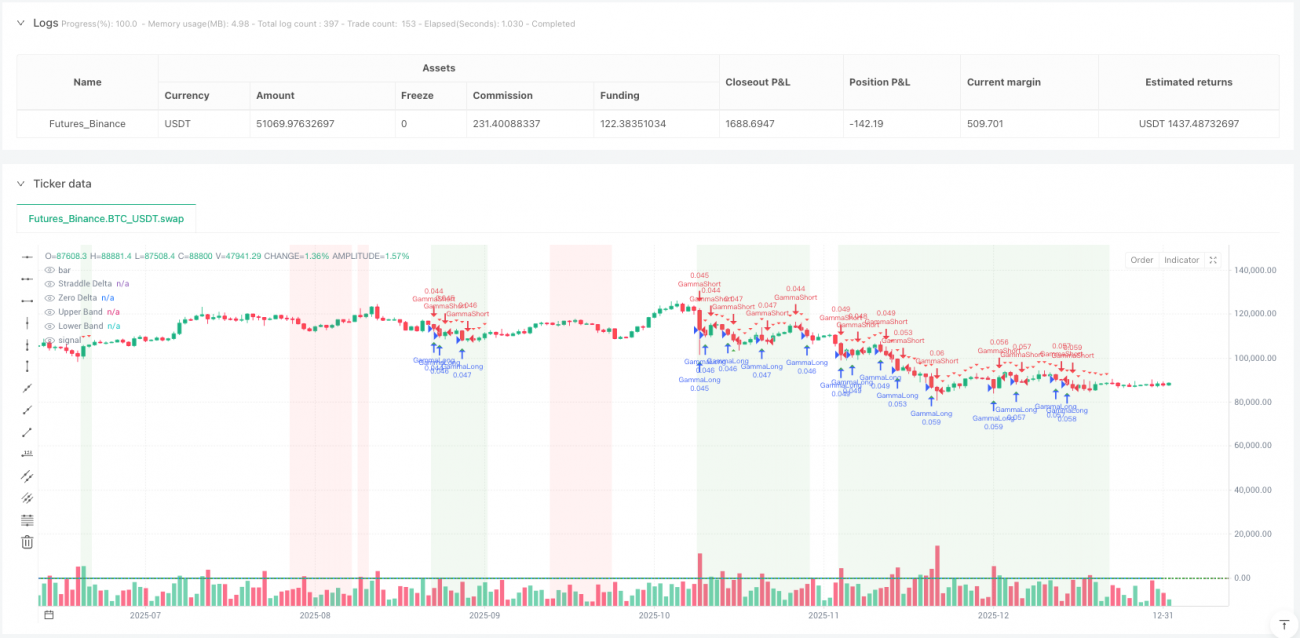
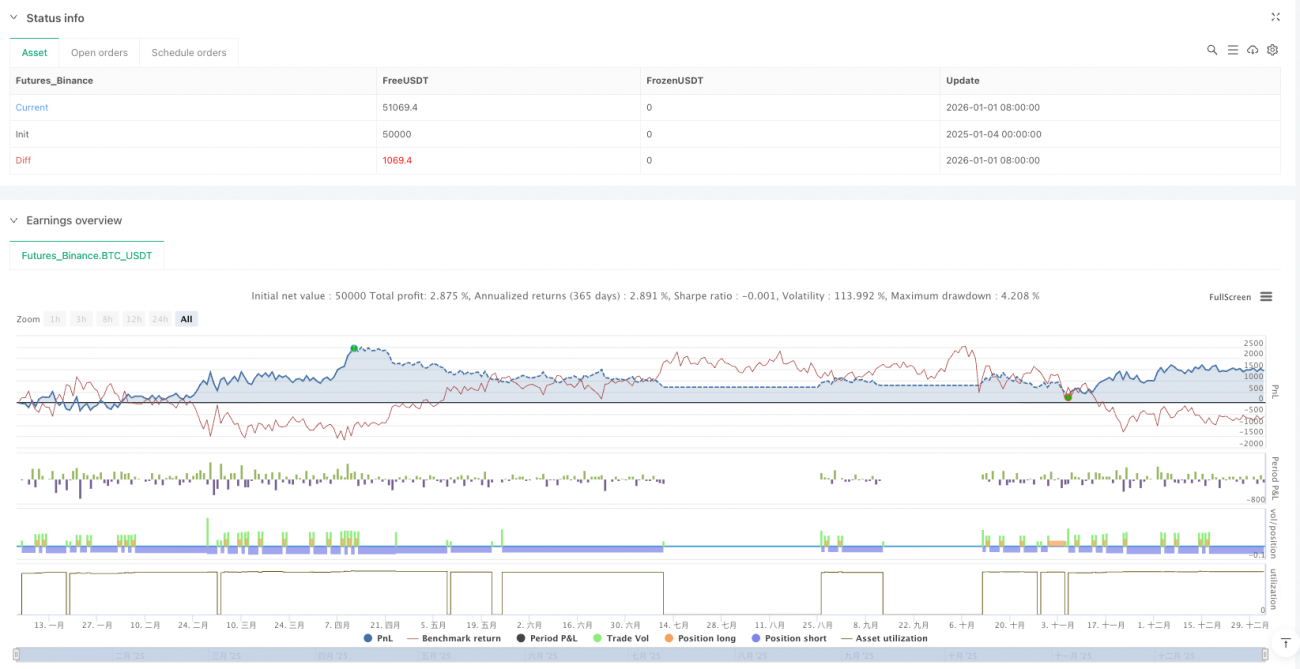
ブラック・ショールズ・ガンマ・スキャルピング戦略:オプションマーケットメーカーのための定量的知見


作成日: 2026-01-04 16:34:39 最終変更日: 2026-01-16 14:59:57
コピー: 15 クリック数: 370
2
フォロー
413
フォロワー

ブラック・ショールズ・ガンマ・スキャルピング戦略:オプションマーケットメーカーのための定量的知見 ブラック・ショールズ・ガンマ・スキャルピング戦略:オプションマーケットメーカーのための定量的知見

BS, GAMMA, DELTA, THETA, VEGA

なぜオプションのトレーダーは常に波動で利益を得ているのか?

量的な取引の世界では,矛盾しているように見える現象があります. 小売投資家が市場の波動に不安を抱いているとき,オプションは市場を安定的に利益を得ることができます. その背後にある秘密は何ですか? その答えは,今日分析するBlack-Scholesモデルに基づく馬の皮を剥ぐ戦略にあります.

この戦略の核となる考えは,オプションの市場取引を模倣することである. 合成のクロスフォーマーオプションのポートフォリオを構築し,ポータル効果を利用してダイナミック・ヘッジをすることで,波動率の利回りで利益を得ることである. 簡単に言えば,市場情緒と戦うのではなく,数学を私たちのために働かせることである.

戦略の数学的な基礎:ブラック・スコールズモデルの実戦的応用

Black-Scholesモデルは単なる学術的理論ではなく,現代のオプションの価格の基石である. この戦略では,私たちは5つのギリシャ文字を重視しています.

Delta(Δ): オプションの価格対指標の資産価格の変化の感受性を測定する.

Gamma(Γ)戦略の核心であるデルタの変動率. 正馬は,価格が上がるとデルタが上がり,価格が下がるとデルタが下がることを意味し,これは”低価格で買い,高価格で売る”機会を生み出します.

Theta(Θ)時間の衰退は,私たちが克服する必要があるコストです. 馬取引の利益は,実際の変動率が暗示された変動率を超えるとのみ,時間の衰退をカバーできます.

Vega(ν)波動率に対する感受性によって,波動率の環境を判断できます.

コード実装から見ると,策略は標準のブラック・スコルス式を使用してこれらのギリシャ文字を計算し,標準正規分布関数 ((アブラモウィッツ&ステガン近似を用いて) を使って計算精度を確保した.

取引のタイミングを把握するにはどうすればいいのでしょうか?

この戦略は,次の3つのシグナルフィルタリングの仕組みを設計しています.

層1:変動率制度の識別 歴史的波動率と暗示波動率の比率を比較して現在の波動率環境を判断する. 歴史的波動率/暗示波動率>1.2であるとき,市場がオプションの価格予想を超える実際の波動を示し,これは馬剥皮を行うのに理想的な環境である.

2階:馬の脱毛トリガー ATRの特定の倍数を超えた価格の動きが取引信号を誘発する.この設計は巧妙です.それは,過剰な取引を避けるために,十分な価格の動きがある場合にのみ,ヘッジ取引を行うことを保証します.

3層:デルタ・ヘッジベルト クロスオプションポートフォリオの純デルタ偏差が中立位置から設定された値を超えると,ヘッジ信号が生成されます.これは,デルタ中立を維持する市場作りの行動を模倣します.

この戦略はどんな状況で最も効果的でしょうか?

戦略的論理分析から,最適な使用シナリオは以下の通りです.

  1. 高波動率環境: 市場の実際の波動率が暗示的な波動率より持続的に高い場合,馬取引は余剰利益を生むことができる.

  2. トレンド状態の逆戻り強いトレンドの中での短期的なリターンは,多くの場合,良質な馬剥がし機会を生み出します.

  3. イベントによって引き起こされる変動財務報告や中央銀行の決定などの出来事の前後の変動率の変化は,戦略に理想的な取引環境を提供している.

注目すべきは,低波動率の整合市場では,価格の動きが有効な馬取引シグナルを誘発するのに十分なものではないため,戦略の効果が限られていることです.

リスク管理の巧妙な設計

この戦略のリスク管理は,専門的な量化取引のレベルを反映しています.

ダイナミックなポジション管理: 波動率に応じてポジションの大きさを調整し,波動率が高いときはポジションを減らす,波動率低いときはポジションを増やす.これは,従来の固定ポジション管理と大きく対照的です.

多層の停止メカニズムATRの倍数と最大撤回保護と時間価値に基づく退出メカニズムを組み合わせた

ポジションの制限: 最大の同時保有量によって,全体的なリスクのを制御する.

戦略の革新と限界

イノベーションの秘訣

  1. 複雑なオプションのギリシャ文字の計算を 株式/先物取引に完全に移植する
  2. 動的変動率のシステム識別,静的パラメータではなく
  3. 多次元信号確認メカニズム,偽信号を減らす

潜在的制限

  1. 取引コストに敏感で,手数料が低い環境が必要
  2. 極端な市場条件では,ブラック・スコルスモデルが 機能しない可能性がある.
  3. 戦略の複雑さには十分な反省が必要である.

実戦の勧告と最適化方向

このコードを深く分析した結果,私はこう提案します.

  1. パラメータ最適化市場状況に応じて変動率の値とカバー帯域の動的調整
  2. 複数時間枠確認: より長い周期の波動率のトレンドを組み合わせた信号フィルタリング
  3. コストコントロールウォルター・リチャード: スライドポイントと手数料の厳格な管理は,戦略の収益性に直接影響する

この戦略は,複雑な市場動作を数学的なモデルで実行可能な取引規則に簡素化することで,量化取引の魅力を示しています. これは,すべての取引が利益をもたらすことを保証するものではありませんが,長期的には,ポジティブな期待値を持つ取引の枠組みを提供します.

オプション取引の本質を深く理解したい数値トレーダーにとって,この戦略は間違いなく優れた学習例です. それは理論を実践に変換する方法を示しているだけでなく,より重要なのは,プロのトレーダーが市場について考える方法を示しています. 予測の方向ではなく,リスクを管理し,確率を私たちのために使います.

ストラテジーソースコード
/*backtest
start: 2025-01-04 00:00:00
end: 2026-01-02 00:00:00
period: 1d
basePeriod: 1d
exchanges: [{"eid":"Futures_Binance","currency":"BTC_USDT"}]
*/

//@version=6
strategy("Black-Scholes Gamma Scalping Strategy", 
         overlay=true,
         default_qty_type=strategy.percent_of_equity, 
         default_qty_value=10,
         pyramiding=5)

// ============================================================================
// STRATEGY CONCEPT:
// This strategy simulates gamma scalping - a volatility arbitrage technique
// used by options market makers. The core idea:
//
// 1. We model a synthetic long straddle position (long call + long put)
// 2. The straddle has positive gamma, meaning delta changes as price moves
// 3. We continuously delta-hedge by trading the underlying
// 4. If realized volatility > implied volatility, hedging profits exceed theta decay
// 5. Trading signals generated when price moves create hedging opportunities
//
// The Black-Scholes equation provides: Delta, Gamma, Theta, Vega
// ============================================================================

// === INPUT PARAMETERS ===
string grp_opt = "Option Parameters"
strike_offset_pct   = input.float(0.0, "Strike Offset from Current Price %", group=grp_opt, step=0.5)
days_to_expiry      = input.int(30, "Days to Expiration", group=grp_opt, minval=1, maxval=365)
implied_vol         = input.float(0.25, "Implied Volatility (Annual)", group=grp_opt, minval=0.05, maxval=2.0, step=0.01)
risk_free_rate      = input.float(0.05, "Risk-Free Rate (Annual)", group=grp_opt, step=0.001)
dividend_yield      = input.float(0.0, "Dividend Yield (Annual)", group=grp_opt, step=0.001)

string grp_vol = "Volatility Analysis"
hist_vol_period     = input.int(20, "Historical Volatility Period", group=grp_vol, minval=5)
vol_ratio_threshold = input.float(1.2, "HV/IV Ratio for Long Vol Signal", group=grp_vol, minval=1.0, step=0.05)
vol_ratio_short     = input.float(0.8, "HV/IV Ratio for Short Vol Signal", group=grp_vol, minval=0.1, maxval=1.0, step=0.05)

string grp_trade = "Trading Parameters"
gamma_scalp_threshold = input.float(0.5, "Gamma Scalp Threshold (ATR mult)", group=grp_trade, minval=0.1, step=0.1)
hedge_band_pct        = input.float(2.0, "Delta Hedge Band %", group=grp_trade, minval=0.5, step=0.5)
use_vol_filter        = input.bool(true, "Use Volatility Regime Filter", group=grp_trade)
max_positions         = input.int(3, "Max Concurrent Positions", group=grp_trade, minval=1, maxval=10)

string grp_risk = "Risk Management"
stop_loss_atr_mult    = input.float(2.0, "Stop Loss (ATR Multiple)", group=grp_risk, minval=0.5, step=0.5)
take_profit_atr_mult  = input.float(3.0, "Take Profit (ATR Multiple)", group=grp_risk, minval=1.0, step=0.5)
max_drawdown_pct      = input.float(15.0, "Max Drawdown % to Pause Trading", group=grp_risk, minval=5.0, step=1.0)

// ============================================================================
// BLACK-SCHOLES MATHEMATICAL FUNCTIONS
// ============================================================================

// --- Standard Normal CDF (Abramowitz & Stegun approximation) ---
norm_cdf(float x) =>
    float result = 0.0
    if na(x)
        result := na
    else
        float ax = math.abs(x)
        if ax > 10
            result := x > 0 ? 1.0 : 0.0
        else
            float t = 1.0 / (1.0 + 0.2316419 * ax)
            float d = 0.3989422804 * math.exp(-0.5 * x * x)  // 1/sqrt(2*pi) * exp(-x²/2)
            float p = t * (0.31938153 + t * (-0.356563782 + t * (1.781477937 + t * (-1.821255978 + t * 1.330274429))))
            result := x >= 0 ? 1.0 - d * p : d * p
    result

// --- Standard Normal PDF ---
norm_pdf(float x) =>
    na(x) ? na : 0.3989422804 * math.exp(-0.5 * x * x)

// --- Black-Scholes d1 and d2 ---
bs_d1(float S, float K, float r, float q, float sigma, float T) =>
    T > 0 and sigma > 0 ? (math.log(S / K) + (r - q + 0.5 * sigma * sigma) * T) / (sigma * math.sqrt(T)) : na

bs_d2(float S, float K, float r, float q, float sigma, float T) =>
    float d1 = bs_d1(S, K, r, q, sigma, T)
    na(d1) ? na : d1 - sigma * math.sqrt(T)

// --- Greeks ---
// Call Delta
call_delta(float S, float K, float r, float q, float sigma, float T) =>
    T <= 0 ? (S >= K ? 1.0 : 0.0) : math.exp(-q * T) * norm_cdf(bs_d1(S, K, r, q, sigma, T))

// Put Delta
put_delta(float S, float K, float r, float q, float sigma, float T) =>
    T <= 0 ? (S <= K ? -1.0 : 0.0) : math.exp(-q * T) * (norm_cdf(bs_d1(S, K, r, q, sigma, T)) - 1)

// Gamma (same for call and put)
option_gamma(float S, float K, float r, float q, float sigma, float T) =>
    if T <= 0 or sigma <= 0
        0.0
    else
        float d1 = bs_d1(S, K, r, q, sigma, T)
        math.exp(-q * T) * norm_pdf(d1) / (S * sigma * math.sqrt(T))

// ============================================================================
// HISTORICAL VOLATILITY CALCULATION
// ============================================================================

// Calculate annualized historical volatility
calc_historical_vol(int period) =>
    float log_return = math.log(close / close[1])
    float std_dev = ta.stdev(log_return, period)
    
    // Annualization factor based on timeframe
    float periods_per_year = switch
        timeframe.isdaily => 365.0
        timeframe.isweekly => 52.0
        timeframe.ismonthly => 12.0
        => 365.0 * 390.0 / (timeframe.isminutes ? timeframe.multiplier : 1440.0)
    
    nz(std_dev * math.sqrt(periods_per_year), 0.20)

hist_vol = calc_historical_vol(hist_vol_period)

// ============================================================================
// STRATEGY CALCULATIONS
// ============================================================================

// Dynamic strike price (ATM or offset)
float atm_strike = math.round(close / syminfo.mintick) * syminfo.mintick
float strike_price = atm_strike * (1 + strike_offset_pct / 100)

// Time to expiration in years
float tau = days_to_expiry / 365.0

// Calculate Greeks for synthetic straddle (1 call + 1 put at same strike)
float c_delta = call_delta(close, strike_price, risk_free_rate, dividend_yield, implied_vol, tau)
float p_delta = put_delta(close, strike_price, risk_free_rate, dividend_yield, implied_vol, tau)
float straddle_delta = c_delta + p_delta  // Net delta of straddle

float gamma = option_gamma(close, strike_price, risk_free_rate, dividend_yield, implied_vol, tau)
float straddle_gamma = 2 * gamma  // Straddle has 2x gamma

// Volatility ratio: Historical / Implied
float vol_ratio = hist_vol / implied_vol

// ATR for position sizing and stops
float atr = ta.atr(14)

// ============================================================================
// TRADING SIGNALS
// ============================================================================

// --- Signal 1: Volatility Regime ---
// Long volatility when realized > implied (gamma scalping profitable)
// Short volatility when realized < implied (collect theta)
bool long_vol_regime = vol_ratio > vol_ratio_threshold
bool short_vol_regime = vol_ratio < vol_ratio_short

// --- Signal 2: Gamma Scalp Trigger ---
// When price moves significantly, delta changes. We trade to capture this.
float price_move = close - close[1]
float move_threshold = atr * gamma_scalp_threshold

bool significant_up_move = price_move > move_threshold
bool significant_down_move = price_move < -move_threshold

// --- Signal 3: Delta Hedge Bands ---
// Trade when straddle delta deviates from neutral
float delta_band = hedge_band_pct / 100
bool delta_long_signal = straddle_delta < -delta_band  // Need to buy to hedge
bool delta_short_signal = straddle_delta > delta_band   // Need to sell to hedge

// --- Combined Entry Signals ---
bool vol_filter = use_vol_filter ? long_vol_regime : true

// Long entry: Price dropped significantly OR delta needs positive hedge
bool long_entry = vol_filter and (significant_down_move or delta_long_signal)

// Short entry: Price rose significantly OR delta needs negative hedge  
bool short_entry = vol_filter and (significant_up_move or delta_short_signal)

// ============================================================================
// RISK MANAGEMENT
// ============================================================================

// Track equity for drawdown protection
var float equity_peak = strategy.initial_capital
equity_peak := math.max(equity_peak, strategy.equity)
float current_drawdown = (equity_peak - strategy.equity) / equity_peak * 100
bool drawdown_exceeded = current_drawdown > max_drawdown_pct

// Position counting
int open_trades = strategy.opentrades

// ============================================================================
// STRATEGY EXECUTION
// ============================================================================

// Stop loss and take profit levels
float long_stop = close - atr * stop_loss_atr_mult
float long_target = close + atr * take_profit_atr_mult
float short_stop = close + atr * stop_loss_atr_mult
float short_target = close - atr * take_profit_atr_mult

// Entry conditions
bool can_trade = not drawdown_exceeded and open_trades < max_positions 

if can_trade
    // Long entries
    if long_entry and strategy.position_size <= 0
        strategy.entry("GammaLong", strategy.long, 
                       comment="Δ:" + str.tostring(straddle_delta, "#.##") + " Γ:" + str.tostring(straddle_gamma, "#.###"))
        strategy.exit("LongExit", "GammaLong", stop=long_stop, limit=long_target)
    
    // Short entries
    if short_entry and strategy.position_size >= 0
        strategy.entry("GammaShort", strategy.short,
                       comment="Δ:" + str.tostring(straddle_delta, "#.##") + " Γ:" + str.tostring(straddle_gamma, "#.###"))
        strategy.exit("ShortExit", "GammaShort", stop=short_stop, limit=short_target)

// Exit on extreme conditions
if drawdown_exceeded
    strategy.close_all(comment="Drawdown Protection")

// Exit if volatility regime shifts against us
if use_vol_filter and short_vol_regime and strategy.position_size != 0
    strategy.close_all(comment="Vol Regime Shift")

// ============================================================================
// VISUALIZATIONS
// ============================================================================

// Plot straddle delta
plot(straddle_delta, "Straddle Delta", color=color.blue, linewidth=2)
hline(0, "Zero Delta", color=color.gray, linestyle=hline.style_dashed)
hline(delta_band, "Upper Band", color=color.red, linestyle=hline.style_dotted)
hline(-delta_band, "Lower Band", color=color.green, linestyle=hline.style_dotted)

// Background color for volatility regime
bgcolor(long_vol_regime ? color.new(color.green, 90) : short_vol_regime ? color.new(color.red, 90) : na)

// Entry signals
plotshape(long_entry and can_trade, "Long Signal", shape.triangleup, location.belowbar, color.green, size=size.small)
plotshape(short_entry and can_trade, "Short Signal", shape.triangledown, location.abovebar, color.red, size=size.small)

// ============================================================================
// ALERTS
// ============================================================================

alertcondition(long_entry and can_trade, "Gamma Long Entry", "BS Strategy: Long entry signal - Delta={{straddle_delta}}")
alertcondition(short_entry and can_trade, "Gamma Short Entry", "BS Strategy: Short entry signal - Delta={{straddle_delta}}")
alertcondition(drawdown_exceeded, "Drawdown Alert", "BS Strategy: Max drawdown exceeded - trading paused")