Usando a estratégia de rastreamento de saldo da média móvel de Hull


Data de criação: 2023-12-29 16:26:49 última modificação: 2023-12-29 16:26:49
cópia: 2 Cliques: 589
1
focar em
1621
Seguidores

Usando a estratégia de rastreamento de saldo da média móvel de Hull

Visão geral

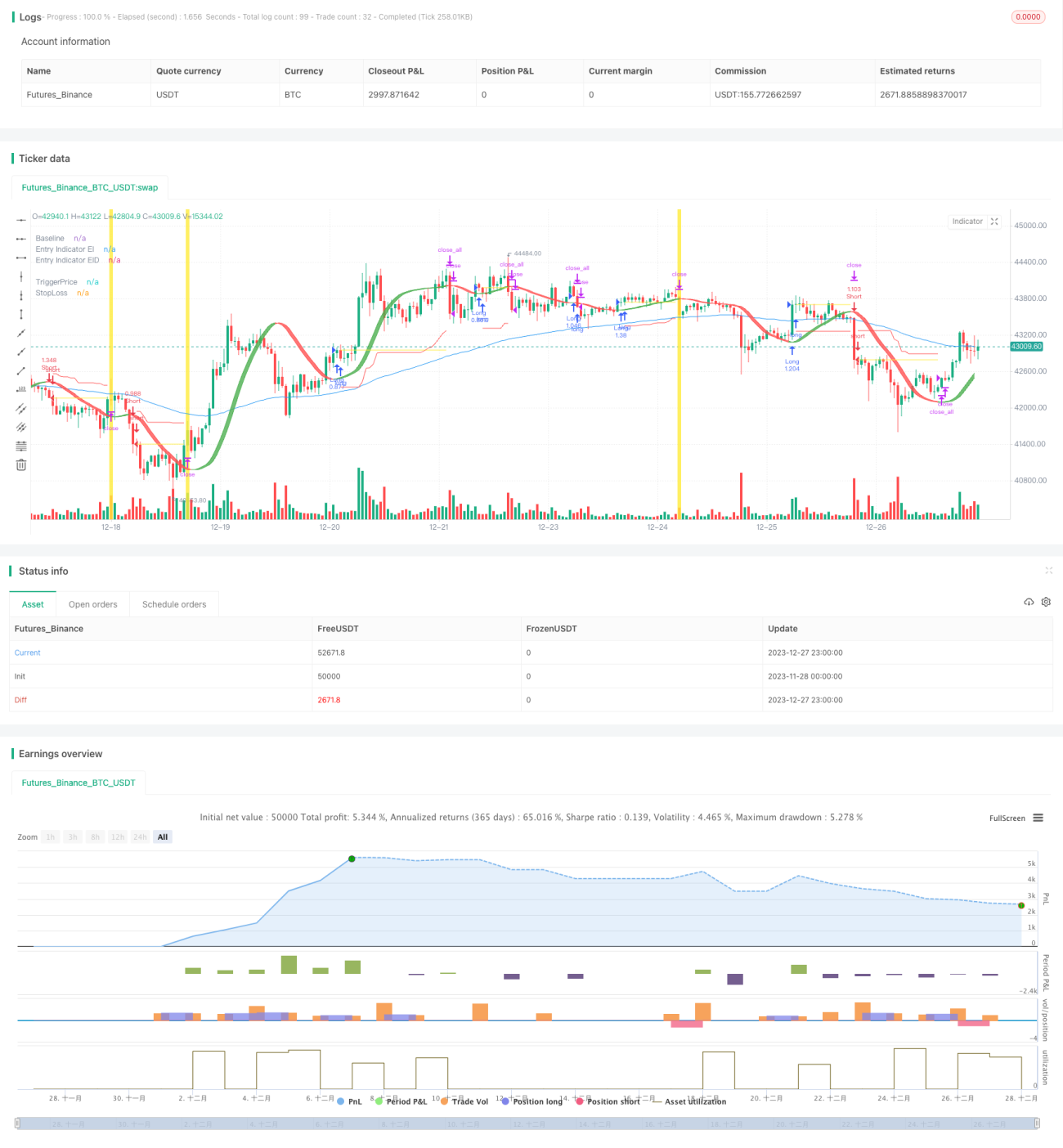
A estratégia de acompanhamento de equilíbrio usa a média móvel de Hull como principal indicador de entrada no mercado para determinar a direção da tendência dos preços. Ao mesmo tempo, a estratégia combina vários outros indicadores, como linha de referência, indicadores de confirmação, etc., para verificar a tendência dos preços e filtrar os falsos sinais. Após a entrada no mercado, a estratégia usa a amplitude real média para calcular o stop loss dinâmico para acompanhar a tendência e lucrar.

Princípio da estratégia

O núcleo da estratégia de acompanhamento de variação é a média móvel de Hull. A média móvel de Hull é mais sensível às mudanças de preço e pode determinar a direção da tendência com eficácia. Quando o preço se eleva acima da linha de Hull, confirma-se a formação de uma tendência ascendente, fazendo mais; quando o preço se abaixa abaixo da linha de Hull, confirma-se a formação de uma tendência descendente, fazendo um espaço.

Além disso, a estratégia também introduziu um indicador de linha de referência para determinar a tendência de longo prazo; um indicador de confirmação para filtrar brechas falsas. O sinal de negociação é emitido somente quando a linha de referência e o indicador de confirmação confirmam a direção da tendência.

Após o lançamento, a estratégia usa a amplitude real média calculada pelo ATR e pelo Hull EMA para definir a posição de parada. À medida que a tendência continua, a linha de parada também se move para cima / para baixo para bloquear o lucro da tendência.

Análise de vantagens

A estratégia de acompanhamento de equilíbrio combina os benefícios do julgamento de tendências e do controle de risco para obter melhores ganhos em situações de tendência. Em comparação com a estratégia de parada fixa, ela pode acompanhar a tendência por meio de um stop loss móvel, evitando ser interrompida pela flutuação normal do mercado.

O uso combinado de muitos indicadores também torna a estratégia mais sensível às mudanças no mercado, além de filtrar efetivamente os falsos sinais. Além disso, a estratégia também fornece vários parâmetros para ajustes, que o usuário pode otimizar de acordo com seu próprio julgamento sobre o mercado.

Análise de Riscos

A estratégia depende principalmente de indicadores de tendência, que são suscetíveis a erros de sinalização e de stop loss durante a liquidação. Além disso, combinações de vários indicadores podem ocorrer em situações de conflito de indicadores. A configuração inadequada dos parâmetros também pode levar ao mau desempenho da estratégia.

Pode-se considerar a inclusão de módulos de julgamento adicionais na estratégia, suspendendo a negociação se os indicadores estiverem discordantes; ou adotar um mecanismo de votação, integrando os resultados de julgamento de vários indicadores. No que diz respeito à configuração de parâmetros, o melhor parâmetro pode ser encontrado por meio de métodos de otimização de feedback.

Direção de otimização

A estratégia de acompanhamento de equilíbrio pode ser otimizada nas seguintes direções:

  1. Adição de módulos de julgamento, como o módulo de volatilidade, para suspender a negociação em momentos de alta volatilidade;
  2. Adicionar módulos de aprendizagem de máquina para avaliar o peso dos indicadores usando algoritmos de aprendizagem de máquina;
  3. Otimizar os parâmetros do indicador para encontrar a melhor combinação de parâmetros;
  4. Otimizar os algoritmos de stop loss móveis para que o stop loss acompanhe melhor as tendências;
  5. Adicionar módulos de gerenciamento de risco, como o stop loss de violação, o ajuste de posição dinâmica, etc.

Resumir

A estratégia de acompanhamento de equilíbrio é, em geral, uma excelente estratégia de acompanhamento de tendências. Ela combina com sucesso o julgamento de tendências com o stop loss dinâmico, o que permite efetivamente acompanhar as tendências para obter lucro.

Código-fonte da estratégia
/*backtest
start: 2023-11-28 00:00:00
end: 2023-12-28 00:00:00
period: 1h
basePeriod: 15m
exchanges: [{"eid":"Futures_Binance","currency":"BTC_USDT"}]
*/

// © Milleman
//@version=4
strategy("MilleMachine", overlay=true, default_qty_type = strategy.percent_of_equity, default_qty_value = 100, initial_capital=10000, commission_type=strategy.commission.percent, commission_value=0.06)


// Additional settings
Mode = input(title="Mode", defval="LongShort", options=["LongShort", "OnlyLong", "OnlyShort","Indicator Mode"])
UseTP = false                               //input(false, title="Use Take Profit?")
QuickSwitch = true                          //input(true, title="Quickswitch")
UseTC = true                                //input(true, title="Use Trendchange?")

// Risk management settings
//Spacer2 = input(false, title="======= Risk management settings =======")
Risk = input(1.0, title="% Risk",minval=0)/100
RRR = 2                                     //input(2,title="Risk Reward Ratio",step=0.1,minval=0,maxval=20)
SL_Mode = false                             // input(true, title="ON = Fixed SL / OFF = Dynamic SL (ATR)")
SL_Fix = 3                                  //input(3,title="StopLoss %",step=0.25, minval=0)/100
ATR = atr(14)                               //input(14,title="Periode ATR"))
Mul = input(2,title="ATR Multiplier",step=0.1)
xATR = ATR * Mul
SL = SL_Mode ? SL_Fix : (1 - close/(close+xATR))

// INDICATORS  //////////////////////////////////////////////////////////////////////////////////////////////////////////////////////////////////////////////////////////////////////
Ind(type, src, len) =>
    float result = 0
    if type=="McGinley"
        result := na(result[1]) ? ema(src, len) : result[1] + (src - result[1]) / (len * pow(src/result[1], 4))
    if type=="HMA"
        result := wma(2*wma(src, len/2)-wma(src, len), round(sqrt(len)))
    if type=="EHMA"
        result := ema(2*ema(src, len/2)-ema(src, len), round(sqrt(len)))
    if type=="THMA"
        lend = len/2
        result := wma(wma(src, lend/3)*3-wma(src, lend/2)-wma(src,lend), lend)
    if type=="SMA" // Simple
        result := sma(src, len)
    if type=="EMA" // Exponential
        result := ema(src, len)
    if type=="DEMA" // Double Exponential
        e = ema(src, len)
        result := 2 * e - ema(e, len)
    if type=="TEMA" // Triple Exponential
        e = ema(src, len)
        result := 3 * (e - ema(e, len)) + ema(ema(e, len), len)
    if type=="WMA" // Weighted
        result := wma(src, len)
    if type=="VWMA" // Volume Weighted
        result := vwma(src, len) 
    if type=="SMMA" // Smoothed
        w = wma(src, len)
        result := (w[1] * (len - 1) + src) / len
    if type == "RMA"
        result := rma(src, len)
    if type=="LSMA" // Least Squares
        result := linreg(src, len, 0)
    if type=="ALMA" // Arnaud Legoux
        result := alma(src, len, 0.85, 6)
    if type=="Kijun" //Kijun-sen
        kijun = avg(lowest(len), highest(len))
        result :=kijun
    if type=="WWSA" // Welles Wilder Smoothed Moving Average
        result := nz(result[1]) + (close -nz(result[1]))/len
    result

// Baseline : Switch from Long to Short and vice versa
BL_Act = input(true, title="====== Activate Baseline - Switch L/S ======")
BL_type = input(title="Baseline Type", defval="McGinley", options=["McGinley","HMA","EHMA","THMA","SMA","EMA","DEMA","TEMA","WMA","VWMA","SMMA","RMA","LSMA","ALMA","Kijun","WWSA"])
BL_src = input(close, title="BL source")
BL_len = input(50, title="BL length", minval=1)
BL = Ind(BL_type,BL_src, BL_len)

// Confirmation indicator
C1_Act = input(false, title="===== Activate Confirmation indicator =====")
C1_type = input(title="C1 Entry indicator", defval="SMA", options=["McGinley","HMA","EHMA","THMA","SMA","EMA","DEMA","TEMA","WMA","VWMA","SMMA","RMA","LSMA","ALMA","Kijun","WWSA"])
C1_src = input(close, title="Source")
C1_len = input(5,title="Length", minval=1)
C1 = Ind(C1_type,C1_src,C1_len)

// Entry indicator : Hull Moving Average
Spacer5 = input(true, title="====== ENTRY indicator =======")
EI_type = input(title="EI Entry indicator", defval="HMA", options=["McGinley","HMA","EHMA","THMA","SMA","EMA","DEMA","TEMA","WMA","VWMA","SMMA","RMA","LSMA","ALMA","Kijun","WWSA"])
EI_src = input(close, title="Source")
EI_Len = input(46,title="Length", minval=1)
EI = Ind(EI_type,EI_src,EI_Len)

// Trail stop settings
TrailActivation = input(true, title="===== Activate Trailing Stop =====")
TS_type = input(title="TS Traling Stop Type", defval="EMA", options=["McGinley","HMA","EHMA","THMA","SMA","EMA","DEMA","TEMA","WMA","VWMA","SMMA","RMA","LSMA","ALMA","Kijun","WWSA"])
TrailSLScaling = 1 //input(100, title="SL Scaling", minval=0, step=5)/100
TrailingSourceLong = Ind(TS_type,low,input(5,"Smoothing Trail Long EMA", minval=1))
TrailingSourceShort = Ind(TS_type,high,input(2,"Smoothing Trail Short EMA", minval=1))

//VARIABLES MANAGEMENT
TriggerPrice = 0.0, TriggerPrice := TriggerPrice[1]
TriggerSL = 0.0, TriggerSL := TriggerSL[1]
SLPrice = 0.0, SLPrice := SLPrice[1], TPPrice = 0.0, TPPrice := TPPrice[1]
isLong = false, isLong := isLong[1], isShort = false, isShort := isShort[1]

//LOGIC
GoLong = crossover(EI,EI[1]) and (strategy.position_size == 0.0 and QuickSwitch) and (not BL_Act or BL/BL[1] > 1) and (not C1_Act or C1>C1[1]) and (Mode == "LongShort" or Mode == "OnlyLong")
GoShort = crossunder(EI,EI[1]) and (strategy.position_size == 0.0 and QuickSwitch) and (not BL_Act or BL/BL[1] < 1) and (not C1_Act or C1<C1[1]) and (Mode == "LongShort" or Mode == "OnlyShort")
ExitLong = isLong and crossunder(EI,EI[1]) and UseTC
ExitShort = isShort and crossover(EI,EI[1]) and UseTC

//FRAMEWORK
//Reset Long-Short memory
if isLong and strategy.position_size == 0.0
    isLong := false
if isShort and strategy.position_size == 0.0
    isShort := false
//Long
if GoLong
    isLong := true, TriggerPrice := close, TriggerSL := SL
    TPPrice := UseTP? TriggerPrice * (1 + (TriggerSL * RRR)) : na
    SLPrice := TriggerPrice * (1-TriggerSL)
    Entry_Contracts = strategy.equity * Risk / ((TriggerPrice-SLPrice)/TriggerPrice) / TriggerPrice
    strategy.entry("Long", strategy.long, comment=tostring(round((TriggerSL/TriggerPrice)*1000)), qty=Entry_Contracts)
    strategy.exit("TPSL","Long", limit=TPPrice, stop=SLPrice)
if isLong
    NewValSL = TrailingSourceLong * (1 - (SL*TrailSLScaling))
    if TrailActivation and NewValSL > SLPrice
        SLPrice := NewValSL
    strategy.exit("TPSL","Long", limit=TPPrice, stop=SLPrice)
if ExitLong
    strategy.close_all(comment="TrendChange")
    isLong := false

//Short
if GoShort
    isShort := true, TriggerPrice := close, TriggerSL := SL
    TPPrice := UseTP? TriggerPrice * (1 - (TriggerSL * RRR)) : na
    SLPrice := TriggerPrice * (1 + TriggerSL)
    Entry_Contracts = strategy.equity * Risk / ((SLPrice-TriggerPrice)/TriggerPrice) / TriggerPrice
    strategy.entry("Short", strategy.short, comment=tostring(round((TriggerSL/TriggerPrice)*1000)), qty=Entry_Contracts)
    strategy.exit("TPSL","Short", limit=TPPrice, stop=SLPrice)
if isShort
    NewValSL = TrailingSourceShort * (1 + (SL*TrailSLScaling))
    if TrailActivation and NewValSL < SLPrice
        SLPrice := NewValSL
    strategy.exit("TPSL","Short", limit=TPPrice, stop=SLPrice)
if ExitShort
    strategy.close_all(comment="TrendChange")
    isShort := false

//VISUALISATION
plot(BL_Act?BL:na, color=color.blue,title="Baseline")
plot(C1_Act?C1:na, color=color.yellow,title="confirmation Indicator")
EIColor = EI>EI[1] ? color.green : color.red
Fill_EI = plot(EI, color=EIColor, linewidth=1, transp=40, title="Entry Indicator EI")
Fill_EID = plot(EI[1], color=EIColor, linewidth=1, transp=40, title="Entry Indicator EID")
fill(Fill_EI,Fill_EID, title="EI_Fill", color=EIColor,transp=50)

plot(strategy.position_size != 0.0 and (isLong or isShort) ? TriggerPrice : na, title="TriggerPrice", color=color.yellow, style=plot.style_linebr)
plot(strategy.position_size != 0.0 and (isLong or isShort) ? TPPrice : na, title="TakeProfit", color=color.green, style=plot.style_linebr)
plot(strategy.position_size != 0.0 and (isLong or isShort) ? SLPrice : na, title="StopLoss", color=color.red, style=plot.style_linebr)
bgcolor(isLong[1] and cross(low,SLPrice) and low[1] > SLPrice and TriggerPrice>SLPrice ? color.yellow : na, transp=75, title="SL Long")
bgcolor(isShort[1] and cross(high,SLPrice) and high[1] < SLPrice and TriggerPrice<SLPrice ? color.yellow : na, transp=75, title="SL Short")