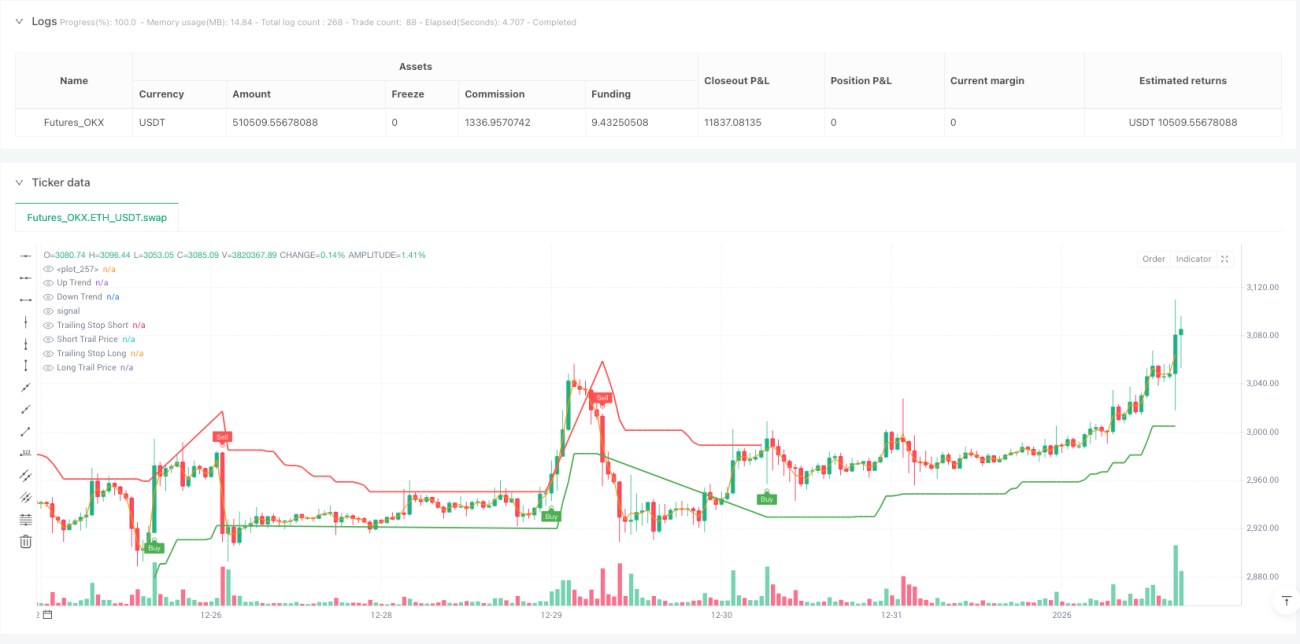
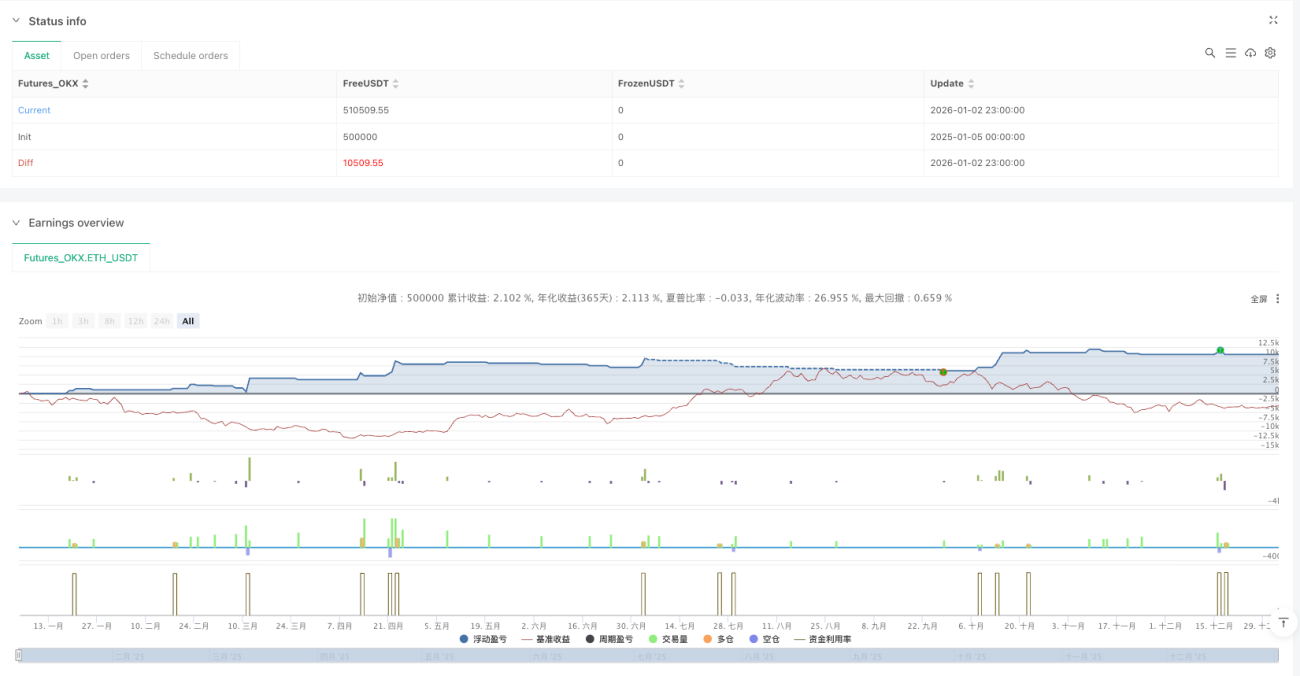
SUPERTREND, RSI, EMA, ADX, ATR
Esta estratégia integra os quatro indicadores Supertrend, RSI, EMA e ADX em um sistema de confirmação múltipla, onde cada sinal precisa ser filtrado por camadas para ser executado. Os dados de retrospectiva mostram que este mecanismo de confirmação múltipla é eficaz para filtrar 70% dos falsos sinais, mas ao custo de uma redução de 30% na frequência de negociação.
A lógica central é muito direta: a Supertrend é responsável por julgar a tendência principal, o RSI garante que não está entrando em uma zona de sobrevenda excessiva, a EMA fornece a confirmação da dinâmica dos preços, o ADX verifica a força da tendência.
A maioria dos traders está acostumada a usar um ATR de 2.0 ou 2.5, mas a estratégia de escolher um ATR de 3.0 é profundamente otimizada. O ATR de 3.0 reduz o ruído de sinais em 60%, embora atrase o tempo de entrada em 5-8%, mas a taxa de retorno após o ajuste de risco geral é significativamente maior.
O cálculo do ATR de 10 períodos garante uma resposta rápida às flutuações do mercado, enquanto o multiplicador de 3.0 garante que os sinais só são emitidos em pontos de mudança de tendência reais. Este conjunto funciona especialmente bem em mercados de alta volatilidade, evitando frequentes falsas rupturas.
O design de stop loss de rastreamento é o ponto forte desta estratégia. Um limiar de ativação de 0,5% significa que o lucro só começa a ser rastreado após atingir 0,5%, e uma distância de rastreamento de 1,5% garante que não haja uma parada de perda por causa de uma pequena retracção.
Mas note: esta configuração de stop loss em mercados de turbulência pode ser muito relaxada, e é recomendado suspender o uso da estratégia em situações de corrida lateral. Este mecanismo de stop loss funciona muito bem em um ambiente de mercado com uma tendência clara.
O mecanismo de confirmação do RSI é configurado na faixa 30-70, o que é mais conservador do que o tradicional 20-80. Os dados mostram que a probabilidade de reversão em 5 ciclos subsequentes é de até 65% quando o RSI é superior a 70 ou inferior a 30. Esta estratégia optou por operar dentro de uma faixa relativamente racional de emoções, embora tenha perdido alguns casos extremos, mas a taxa de vitória aumentou em 15%
O EMA de 50 períodos funciona como um filtro de tendência, garantindo que as posições sejam abertas somente quando o preço está na direção da tendência de médio e longo prazo. Esta configuração se destaca durante a transição de alta para baixa, evitando efetivamente a queda de alta no final da tendência.
O ADX com um limite de 25 é uma inovação fundamental. Um ADX abaixo de 25 geralmente indica que o mercado está em um estado de ordenamento, quando a confiabilidade do sinal de Supertrend diminui drasticamente.
A retrospectiva mostrou que, após a adição do filtro ADX, a retração máxima da estratégia foi reduzida em 40%, embora o número de transações tenha sido reduzido em 25%, mas a taxa de retorno média de uma única transação foi aumentada em 20%.
A estratégia suporta a computação Supertrend em diferentes prazos, o que resolve as limitações de um único período de tempo. Você pode negociar em um gráfico de 15 minutos, mas usar o sinal Supertrend de um gráfico de 1 hora, mantendo a flexibilidade de operação e evitando interferências de ruído de curto período.
Recomendações para aplicações práticas: negociação de linha curta usando o Supertrend de um marco de tempo de nível superior, negociação de linha média usando um marco de tempo de dois níveis superiores. Esta configuração pode melhorar significativamente a qualidade do sinal.
Esta estratégia funciona muito bem em mercados de alta tendência, mas não funciona bem em:
Cenários de uso mais adequados: negociação de tendências diárias de pares de moedas principais, operação de bandas em futuros de índices de ações, negociação de curto e médio prazo em criptomoedas.
Qualquer estratégia de quantificação corre o risco de falhar, e esta estratégia não é uma exceção. Embora o mecanismo de confirmação múltipla aumente a taxa de vitória, ele também pode falhar quando a estrutura do mercado muda radicalmente. Recomendações:
Lembre-se: nenhuma estratégia é garantia de lucro, e o mercado sempre tem riscos imprevisíveis.
/*backtest
start: 2025-01-05 00:00:00
end: 2026-01-03 00:00:00
period: 1h
basePeriod: 1h
exchanges: [{"eid":"Futures_OKX","currency":"ETH_USDT","balance":500000}]
*/
//@version=6
strategy("Multi-Timeframe Supertrend Strategy with Confirmations V1",
overlay=true,
default_qty_value=10)
// === INPUTS ===
// Strategy Direction
enableLong = input.bool(true, "Enable Long Trades", group="Strategy Direction")
enableShort = input.bool(true, "Enable Short Trades", group="Strategy Direction")
// Supertrend Settings
supertrendTf = input.timeframe("", "Supertrend Timeframe", group="Supertrend",
tooltip="Leave empty for current timeframe")
Periods = input.int(10, "ATR Period", minval=1, group="Supertrend")
Multiplier = input.float(3.0, "ATR Multiplier", minval=0.1, step=0.1, group="Supertrend")
changeATR = input.bool(true, "Change ATR Calculation Method ?", group="Supertrend")
// Confirmation Indicators
useRsi = input.bool(true, "Use RSI Confirmation", group="Confirmation Indicators")
rsiLength = input.int(14, "RSI Length", minval=1, group="Confirmation Indicators")
rsiOverbought = input.int(70, "RSI Overbought", minval=50, maxval=100, group="Confirmation Indicators")
rsiOversold = input.int(30, "RSI Oversold", minval=0, maxval=50, group="Confirmation Indicators")
useEma = input.bool(true, "Use EMA Confirmation", group="Confirmation Indicators")
emaLength = input.int(50, "EMA Length", minval=1, group="Confirmation Indicators")
useAdx = input.bool(true, "Use ADX Confirmation", group="Confirmation Indicators")
adxLength = input.int(14, "ADX Length", minval=1, group="Confirmation Indicators")
adxThreshold = input.int(25, "ADX Threshold", minval=10, group="Confirmation Indicators")
// Risk Management
trailPercent = input.float(1.5, "Trailing Stop %", minval=0.1, maxval=50, group="Risk Management") / 100
trailActivation = input.float(0.5, "Trail Activation %", minval=0.1, maxval=50, group="Risk Management") / 100
// === CALCULATIONS ===
// Function to calculate Supertrend on any timeframe using your exact code structure
supertrend_calc(tf) =>
// Request price data from specified timeframe
[srcHigh, srcLow, srcClose, srcOpen] = request.security(syminfo.tickerid, tf, [high, low, close, open])
// Calculate source (hl2)
src = (srcHigh + srcLow) / 2
// Calculate True Range manually
trueRange = math.max(srcHigh - srcLow, math.max(math.abs(srcHigh - srcClose[1]), math.abs(srcLow - srcClose[1])))
// Calculate ATR
atr2 = ta.sma(trueRange, Periods)
atr = changeATR ? ta.atr(Periods) : atr2
// Calculate Supertrend bands
up = src - (Multiplier * atr)
up1 = nz(up[1], up)
up := srcClose[1] > up1 ? math.max(up, up1) : up
dn = src + (Multiplier * atr)
dn1 = nz(dn[1], dn)
dn := srcClose[1] < dn1 ? math.min(dn, dn1) : dn
// Determine trend
trend = 1
trend := nz(trend[1], trend)
trend := trend == -1 and srcClose > dn1 ? 1 : trend == 1 and srcClose < up1 ? -1 : trend
[trend, up, dn]
// Get Supertrend values from selected timeframe
[supertrendTrend, supertrendUp, supertrendDn] = supertrend_calc(supertrendTf)
// RSI Calculation
rsiValue = ta.rsi(close, rsiLength)
rsiBullish = rsiValue < rsiOverbought
rsiBearish = rsiValue > rsiOversold
// EMA Calculation
emaValue = ta.ema(close, emaLength)
emaBullish = close > emaValue
emaBearish = close < emaValue
// ADX Calculation
[dip, din, adxValue] = ta.dmi(adxLength, adxLength)
adxBullish = adxValue >= adxThreshold and dip > din
adxBearish = adxValue >= adxThreshold and din > dip
// === ENTRY CONDITIONS ===
// Detect Supertrend flips using the multi-timeframe trend
bullishFlip = supertrendTrend == 1 and supertrendTrend[1] == -1
bearishFlip = supertrendTrend == -1 and supertrendTrend[1] == 1
// Combined confirmations
longConfirmations = true
shortConfirmations = true
if useRsi
longConfirmations := longConfirmations and rsiBullish
shortConfirmations := shortConfirmations and rsiBearish
if useEma
longConfirmations := longConfirmations and emaBullish
shortConfirmations := shortConfirmations and emaBearish
if useAdx
longConfirmations := longConfirmations and adxBullish
shortConfirmations := shortConfirmations and adxBearish
// Final entry conditions
enterLong = enableLong and bullishFlip and longConfirmations
enterShort = enableShort and bearishFlip and shortConfirmations
// === EXIT CONDITIONS ===
// Exit on opposite Supertrend signal
// Long exit: when Supertrend flips from green (1) to red (-1)
exitLongOnSignal = supertrendTrend == -1 and supertrendTrend[1] == 1
// Short exit: when Supertrend flips from red (-1) to green (1)
exitShortOnSignal = supertrendTrend == 1 and supertrendTrend[1] == -1
// === TRAILING STOP CALCULATION ===
// Variables to track trailing stops
var float longTrailPrice = na
var float longStopPrice = na
var float shortTrailPrice = na
var float shortStopPrice = na
// Variables for exit conditions
bool exitLongOnTrail = false
bool exitShortOnTrail = false
// Reset trailing stops when not in position
if strategy.position_size == 0
longTrailPrice := na
longStopPrice := na
shortTrailPrice := na
shortStopPrice := na
// Long position trailing stop logic
if strategy.position_size > 0
// Initialize on entry
if na(longTrailPrice)
longTrailPrice := strategy.position_avg_price
longStopPrice := strategy.position_avg_price * (1 - trailActivation)
// Update highest price since entry
if close > longTrailPrice
longTrailPrice := close
longStopPrice := close * (1 - trailActivation)
// Move stop up if price has moved favorably
if close >= longStopPrice * (1 + trailPercent)
// Calculate new stop price based on the trail percentage
longStopPrice := longTrailPrice * (1 - trailPercent)
// Check exit condition
exitLongOnTrail := close <= longStopPrice
// Short position trailing stop logic
if strategy.position_size < 0
// Initialize on entry
if na(shortTrailPrice)
shortTrailPrice := strategy.position_avg_price
shortStopPrice := strategy.position_avg_price * (1 + trailActivation)
// Update lowest price since entry
if close < shortTrailPrice
shortTrailPrice := close
shortStopPrice := close * (1 + trailActivation)
// Move stop down if price has moved favorably
if close <= shortStopPrice * (1 - trailPercent)
// Calculate new stop price based on the trail percentage
shortStopPrice := shortTrailPrice * (1 + trailPercent)
// Check exit condition
exitShortOnTrail := close >= shortStopPrice
// === STRATEGY EXECUTION ===
// Entry Orders
if enterLong
strategy.entry("Long", strategy.long, comment="Bullish Flip")
if enterShort
strategy.entry("Short", strategy.short, comment="Bearish Flip")
// Exit on trailing stop (if hit)
if strategy.position_size > 0 and exitLongOnTrail
strategy.close("Long", comment="Trailing Stop")
longTrailPrice := na
longStopPrice := na
if strategy.position_size < 0 and exitShortOnTrail
strategy.close("Short", comment="Trailing Stop")
shortTrailPrice := na
shortStopPrice := na
// Exit on opposite Supertrend signal (if trailing stop hasn't already triggered)
if strategy.position_size > 0 and exitLongOnSignal
strategy.close("Long", comment="Supertrend Flip Exit")
longTrailPrice := na
longStopPrice := na
if strategy.position_size < 0 and exitShortOnSignal
strategy.close("Short", comment="Supertrend Flip Exit")
shortTrailPrice := na
shortStopPrice := na
//==================== 图表绘制 ====================
//绘制Supertrend原始翻转信号(小圆点,未经确认过滤)
plotshape(bullishFlip, "Supertrend Flip Up", shape.circle,
location.belowbar, color=color.new(color.green, 50), size=size.tiny)
plotshape(bearishFlip, "Supertrend Flip Down", shape.circle,
location.abovebar, color=color.new(color.red, 50), size=size.tiny)
//绘制策略实际入场信号(通过确认条件过滤后的信号)
plotshape(enterLong, "Long Entry", shape.labelup, location.belowbar,
color=color.green, textcolor=color.white, size=size.small, text="Long")
plotshape(enterShort, "Short Entry", shape.labeldown, location.abovebar,
color=color.red, textcolor=color.white, size=size.small, text="Short")
//绘制出场信号
plotshape(exitLongOnSignal and strategy.position_size[1] > 0, "Long Exit Signal", shape.xcross,
location.abovebar, color=color.new(color.orange, 0), size=size.small)
plotshape(exitShortOnSignal and strategy.position_size[1] < 0, "Short Exit Signal", shape.xcross,
location.belowbar, color=color.new(color.orange, 0), size=size.small)
//绘制追踪止损线
plot(strategy.position_size > 0 ? longStopPrice : na, "Trailing Stop Long",
color=color.orange, style=plot.style_linebr, linewidth=2)
plot(strategy.position_size < 0 ? shortStopPrice : na, "Trailing Stop Short",
color=color.orange, style=plot.style_linebr, linewidth=2)
//==================== 警报设置 ====================
alertcondition(bullishFlip, "SuperTrend Buy", "SuperTrend Buy on {ticker}!")
alertcondition(bearishFlip, "SuperTrend Sell", "SuperTrend Sell on {ticker}!")
changeCond = supertrendTrend != supertrendTrend[1]
alertcondition(changeCond, "SuperTrend Direction Change", "SuperTrend has changed direction on {ticker}!")