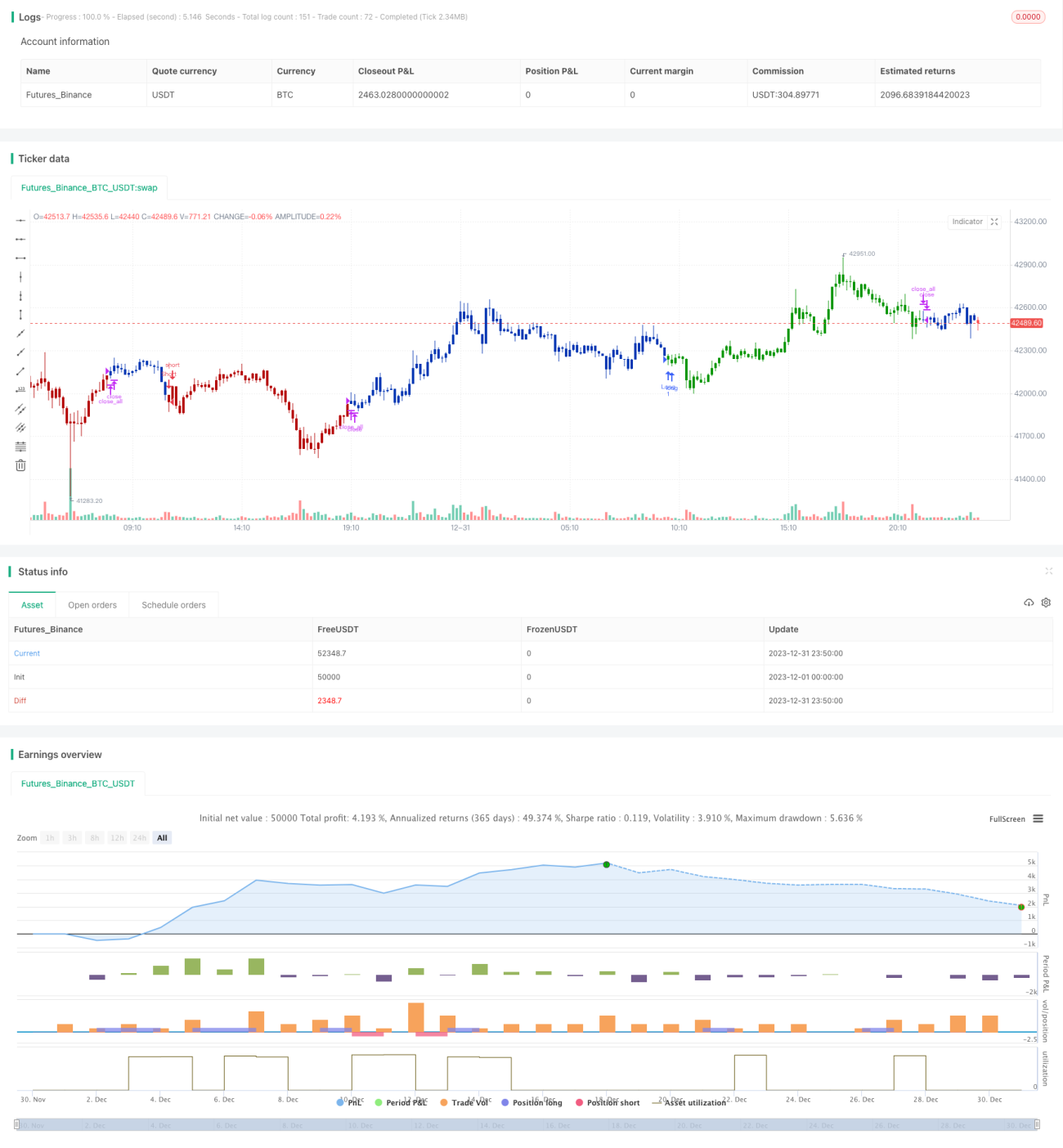
Основная идея этой стратегии заключается в том, чтобы в сочетании с 123 обратными формами и интеллектуальным индексом денежных потоков (SMI) обеспечить стабильную торговлю, отслеживающую тенденцию. Стратегия создает соответствующие позиции с несколькими или пустыми позициями только тогда, когда два сигнала посылают одновременно сигнал покупки или продажи.
Стратегия состоит из двух частей:
123 Обратная стратегия: стратегия, основанная на цене закрытия акции и 9-дневном индексе Стоха для осуществления обратной торговли. В частности, когда в течение двух последовательных дней происходит обратная связь цены закрытия (то есть, когда цена закрытия предыдущего дня выше, чем в предыдущие два дня, а цена закрытия следующего дня ниже, чем в предыдущий день), и скоростная линия Стоха выше, чем медленная линия, делается пробел; когда в течение двух последовательных дней происходит обратная связь цены закрытия (то есть, когда цена закрытия предыдущего дня ниже, чем в предыдущие два дня, а цена закрытия следующего дня выше, чем в предыдущий день), и скоростная линия Стоха ниже, чем медленная линия, делается пробел.
Стратегия SMI: Стратегия основана на интеллектуальном индексе денежных потоков для отслеживания тенденций. Показатель SMI может отражать игры между финансовыми учреждениями и розничными фондами. Повышение SMI указывает на то, что финансовые учреждения поглощают, а наоборот, на то, что финансовые учреждения продают.
Стратегия принимает позицию с несколькими головами, когда 123 обратная форма и индекс SMI одновременно посылают сигналы о покупке; стратегия принимает позицию с пустыми головами, когда они одновременно посылают сигналы о продаже.
Эта стратегия, в сочетании с обратными формами и индикаторами для отслеживания тенденций, позволяет эффективно идентифицировать рыночные обратные точки и отслеживать тенденции, обеспечивая стабильную прибыль. Конкретные преимущества:
123 формы реверса имеют высокий коэффициент выигрыша и прибыльности, что позволяет эффективно идентифицировать кратковременные возможности для реверса.
Показатель SMI может отражать движение средств организации, отслеживая стабильную прибыль, которую получают средства организации.
В сочетании с использованием обратной формы и индикаторами отслеживания тенденций можно повысить качество сигналов, уменьшить ненужные сделки и эффективно контролировать риск.
В этой стратегии также есть определенные риски, которые сосредоточены на следующих аспектах:
123 обратная форма существует определенный риск ложного сигнала, нельзя полностью избежать убыточных сделок. Можно соответствующим образом оптимизировать параметры, повысить качество сигнала.
Показатели SMI имеют определенную задержку и не могут полностью отражать движение средств в реальном времени. Они могут быть проверены в сочетании с другими показателями для повышения точности.
Двойные сигналы приводят к проблемам с чрезмерной консервативностью и могут пропускать более сильные односторонние тенденции. Можно соответствующим образом ослабить условия сигнала и снизить критерии фильтрации.
Эта стратегия может быть улучшена в следующих аспектах:
Оптимизация параметров, поиск оптимальных комбинаций параметров, повышение прибыльности стратегии.
Дополнительные механизмы по борьбе с убытками позволяют эффективно контролировать убытки.
В сочетании с другими показателями или формами, для дальнейшей проверки качества сигнала и повышения его точности.
Повышение адаптивности стратегий для оптимизации параметров для различных сортов.
Общая концепция стратегии ясна и эффективно сочетается с показателями обратного образа и отслеживания тенденций, что позволяет стабильно идентифицировать краткосрочные возможности для обратного обращения и отслеживать среднесрочные тенденции. Благодаря оптимизации параметров и улучшению дизайна механизмов можно еще больше повысить прибыльность стратегии и способность контролировать риски.
The main idea of this strategy is to combine the 123 reversal pattern and the Smart Money Index (SMI) indicator to achieve stable trend tracking trading. The strategy will only establish corresponding long or short positions when both signals issue buy or sell signals at the same time.
The strategy consists of two parts:
123 reversal strategy: This strategy implements reversal trading based on the closing price of the stock and the 9-day Stoch indicator. Specifically, go short when the closing price relationship reverses for two consecutive days (i.e. the previous closing price is higher than the one before the previous day, and the next closing price is lower than the previous day), and Stoch fast line is above slow line; go long when the closing price relationship reverses for two consecutive days (i.e. the previous closing price is lower than the one before the previous day, and the next closing price is higher than the previous day), and Stoch fast line is below slow line.
SMI strategy: This strategy implements trend tracking based on the Smart Money Index. The SMI indicator can reflect the game between institutional funds and retail funds. The rise of SMI indicates that institutional funds are absorbing funds, while the fall indicates that institutional funds are selling out. Go long when SMI rises and go short when SMI falls.
The strategy will only take a long position when both the 123 reversal pattern and the SMI indicator issue a buy signal at the same time. It will only take a short position when both issue a sell signal at the same time.
The strategy combines reversal patterns and trend tracking indicators to effectively identify market reversal points and track trends for steady profits. The specific advantages are as follows:
The 123 reversal pattern has a relatively high win rate and profit rate, which can effectively identify short-term reversal opportunities.
The SMI indicator can reflect the direction of institutional funds. Tracking institutional funds can obtain more steady profits.
The combined use of reversal patterns and trend tracking indicators can improve the quality of signals, reduce unnecessary trading, and effectively control risks.
The strategy also has some risks, mainly concentrated in the following areas:
The 123 reversal pattern has a certain risk of false signals and cannot completely avoid losing trades. Parameters can be optimized appropriately to improve signal quality.
The SMI indicator has a certain lag and cannot completely reflect the direction of funds in real time. Other indicators can be combined for verification to improve accuracy.
Double signals can lead to over-conservative problems, possibly missing stronger one-sided trending opportunities. Signal conditions can be appropriately relaxed to reduce filtering criteria.
The strategy can also be further optimized in the following aspects:
Optimize parameters to find the optimal parameter combination and improve the profitability of the strategy.
Add stop loss mechanisms to effectively control single loss.
Combine other indicators or patterns to further verify signal quality and improve signal accuracy.
Optimize parameters separately for different varieties to improve the adaptability of the strategy.
The overall idea of the strategy is clear, effectively combining reversal patterns and trend tracking indicators to steadily identify short-term reversal opportunities and track medium-to-long term trends. By improving parameters optimization and mechanism design, the profitability and risk control capabilities of the strategy can be further enhanced.
/*backtest
start: 2023-12-01 00:00:00
end: 2023-12-31 23:59:59
period: 10m
basePeriod: 1m
exchanges: [{"eid":"Futures_Binance","currency":"BTC_USDT"}]
*/
//@version=4
////////////////////////////////////////////////////////////
// Copyright by HPotter v1.0 10/07/2021
// This is combo strategies for get a cumulative signal.
//
// First strategy
// This System was created from the Book "How I Tripled My Money In The
// Futures Market" by Ulf Jensen, Page 183. This is reverse type of strategies.
// The strategy buys at market, if close price is higher than the previous close
// during 2 days and the meaning of 9-days Stochastic Slow Oscillator is lower than 50.
// The strategy sells at market, if close price is lower than the previous close price
// during 2 days and the meaning of 9-days Stochastic Fast Oscillator is higher than 50.
//
// Second strategy
// Smart money index (SMI) or smart money flow index is a technical analysis indicator demonstrating investors sentiment.
// The index was invented and popularized by money manager Don Hays.[1] The indicator is based on intra-day price patterns.
// The main idea is that the majority of traders (emotional, news-driven) overreact at the beginning of the trading day
// because of the overnight news and economic data. There is also a lot of buying on market orders and short covering at the opening.
// Smart, experienced investors start trading closer to the end of the day having the opportunity to evaluate market performance.
// Therefore, the basic strategy is to bet against the morning price trend and bet with the evening price trend. The SMI may be calculated
// for many markets and market indices (S&P 500, DJIA, etc.)
//
// The SMI sends no clear signal whether the market is bullish or bearish. There are also no fixed absolute or relative readings signaling
// about the trend. Traders need to look at the SMI dynamics relative to that of the market. If, for example, SMI rises sharply when the
// market falls, this fact would mean that smart money is buying, and the market is to revert to an uptrend soon. The opposite situation
// is also true. A rapidly falling SMI during a bullish market means that smart money is selling and that market is to revert to a downtrend
// soon. The SMI is, therefore, a trend-based indicator.
// Some analysts use the smart money index to claim that precious metals such as gold will continually maintain value in the future.
//
// WARNING:
// - For purpose educate only
// - This script to change bars colors.
////////////////////////////////////////////////////////////
Reversal123(Length, KSmoothing, DLength, Level) =>
vFast = sma(stoch(close, high, low, Length), KSmoothing)
vSlow = sma(vFast, DLength)
pos = 0.0
pos := iff(close[2] < close[1] and close > close[1] and vFast < vSlow and vFast > Level, 1,
iff(close[2] > close[1] and close < close[1] and vFast > vSlow and vFast < Level, -1, nz(pos[1], 0)))
pos
SMI(Length, tf) =>
pos = 0.0
nRes = 0.0
xcloseH1 = security(syminfo.tickerid, tf, close[1])
xopenH1 = security(syminfo.tickerid, tf, open[1])
nRes := nz(nRes[1], 1) - (open - close) + (xopenH1 - xcloseH1)
xSmaRes = sma(nRes, Length)
pos:= iff(xSmaRes > nRes, 1,
iff(xSmaRes < nRes, -1, nz(pos[1], 0)))
pos
strategy(title="Combo Backtest 123 Reversal & Smart Money Index (SMI)", shorttitle="Combo", overlay = true)
line1 = input(true, "---- 123 Reversal ----")
Length = input(14, minval=1)
KSmoothing = input(1, minval=1)
DLength = input(3, minval=1)
Level = input(50, minval=1)
//-------------------------
line2 = input(true, "---- Smart Money Index (SMI) ----")
LengthSMI = input(18, minval=1)
res = input(title="Resolution", type=input.resolution, defval="D")
reverse = input(false, title="Trade reverse")
posReversal123 = Reversal123(Length, KSmoothing, DLength, Level)
posSMI = SMI(LengthSMI, res)
pos = iff(posReversal123 == 1 and posSMI == 1 , 1,
iff(posReversal123 == -1 and posSMI == -1, -1, 0))
possig = iff(reverse and pos == 1, -1,
iff(reverse and pos == -1 , 1, pos))
if (possig == 1 )
strategy.entry("Long", strategy.long)
if (possig == -1 )
strategy.entry("Short", strategy.short)
if (possig == 0)
strategy.close_all()
barcolor(possig == -1 ? #b50404: possig == 1 ? #079605 : #0536b3 )