Multi-Timeframe Exponential Moving Average Crossover Strategy

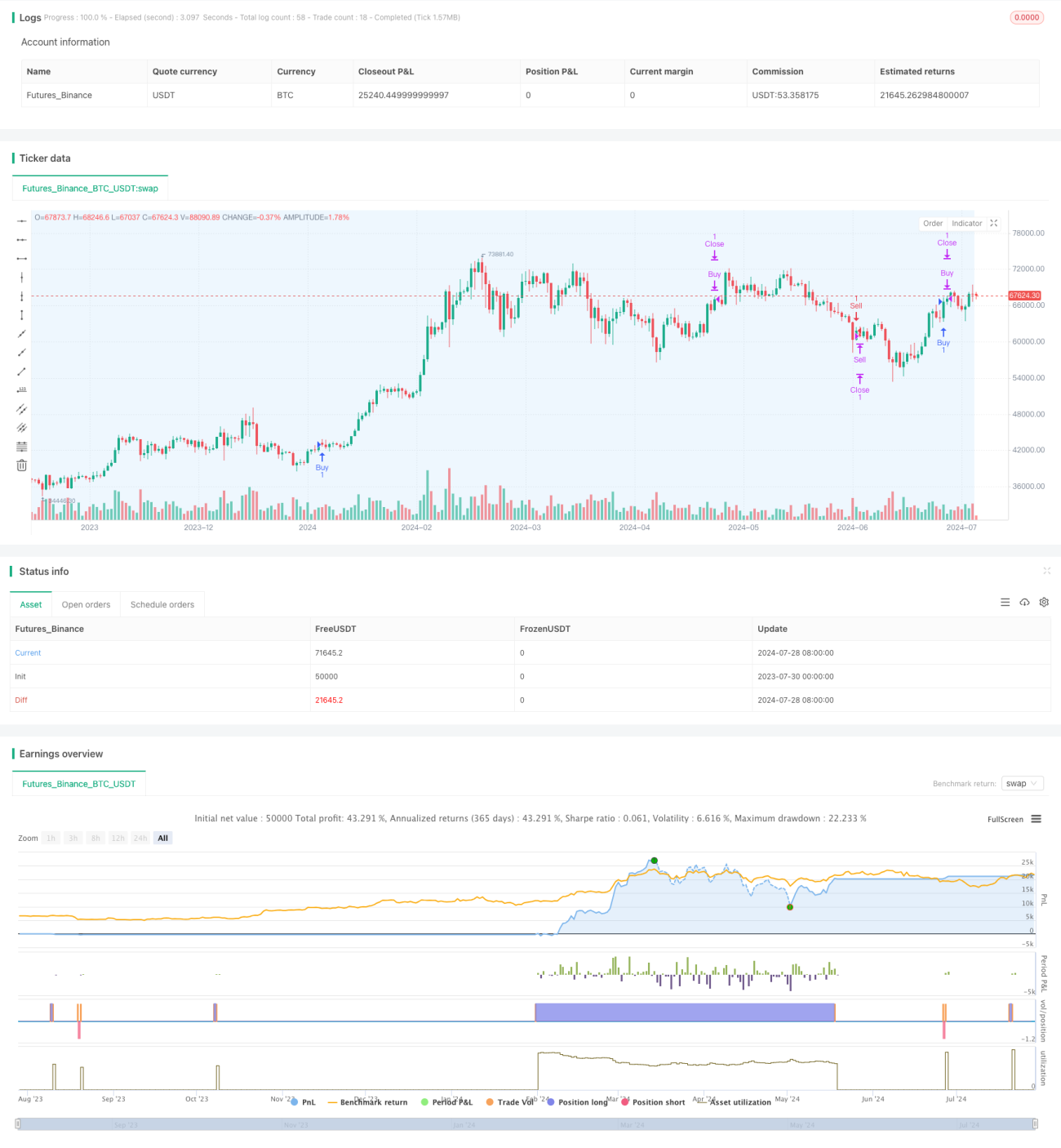
Overview
This Multi-Timeframe Exponential Moving Average Crossover Strategy is an automated trading system based on EMA crossover signals. It utilizes EMAs from different timeframes to generate trading signals and incorporates stop-loss and take-profit mechanisms for risk management. The strategy primarily relies on crossovers between fast and slow EMAs, as well as a higher timeframe EMA, to identify potential trading opportunities.
Strategy Principles
The core principle of this strategy is to use Exponential Moving Averages (EMAs) from multiple timeframes to identify market trends and generate trading signals. Specifically:
-
It uses a 9-period EMA as the fast line, a 50-period EMA as the slow line, and a 100-period EMA on a 15-minute timeframe as the higher timeframe reference.
-
Buy signal conditions:
- Fast EMA crosses above the slow EMA, and the fast EMA is above the higher timeframe EMA; or
- Fast EMA crosses above the higher timeframe EMA.
-
Sell signal conditions:
- Fast EMA crosses below the slow EMA, and the fast EMA is below the higher timeframe EMA; or
- Fast EMA crosses below the higher timeframe EMA.
-
Trade management:
- Sets fixed stop-loss (SL) and take-profit (TP) levels.
- When price reaches the first take-profit level (TP1), it closes 25% of the position and moves the stop-loss to breakeven.
- The remaining position continues to run until the second take-profit level (TP2) or stop-loss is hit.
-
Trading time control:
- Allows setting specific trading hours and trading days.
Strategy Advantages
-
Multi-timeframe analysis: Combining EMAs from different timeframes helps reduce false signals and improve trade quality.
-
Trend following: Effectively captures market trends through EMA crossovers and relative positions.
-
Risk management: Employs fixed stop-loss and stepped take-profit strategy, limiting potential losses while allowing profits to run.
-
Flexibility: EMA parameters, stop-loss, and take-profit levels can be adjusted for different markets and trading styles.
-
Automation: The strategy can be fully automated using the TradingView platform and PineConnector.
-
Time management: Ability to set specific trading hours and days to avoid trading in unfavorable market conditions.
Strategy Risks
-
Lag: EMAs are inherently lagging indicators and may not react quickly enough in volatile markets.
-
False signals: In ranging markets, EMA crossovers may produce frequent false signals, leading to overtrading.
-
Fixed stop-loss: Using fixed-point stop-losses may not be suitable for all market conditions, sometimes being too large or too small.
-
Dependency on historical data: The strategy's effectiveness is highly dependent on market behavior during the backtesting period, which may differ in the future.
-
Market adaptability: While the strategy performs well on some currency pairs, it may not be as effective on others.
Strategy Optimization Directions
-
Dynamic parameter adjustment: Consider dynamically adjusting EMA periods, stop-loss, and take-profit levels based on market volatility.
-
Additional filtering conditions: Introduce extra technical or sentiment indicators to filter trade signals and reduce false positives.
-
Improved stop-loss strategy: Implement trailing stops or ATR-based dynamic stop-losses to better adapt to market volatility.
-
Optimize trading times: Conduct more detailed time analysis to find the best trading hours and dates.
-
Enhanced position sizing: Adjust position sizes based on market volatility and account risk.
-
Multi-currency correlation analysis: Consider correlations between multiple currency pairs to avoid overexposure to similar market risks.
-
Machine learning integration: Utilize machine learning algorithms to optimize parameter selection and signal generation processes.
Conclusion
The Multi-Timeframe Exponential Moving Average Crossover Strategy is an automated trading system that combines trend following with risk management. By leveraging EMA crossover signals from different timeframes, the strategy aims to capture market trends and execute trades at appropriate times. While the strategy performs well under certain market conditions, it still has inherent risks and limitations. To further enhance the strategy's robustness and adaptability, considerations can be made to introduce dynamic parameter adjustments, additional filtering conditions, and more sophisticated risk management techniques. Overall, this strategy provides a solid starting point for quantitative traders, which can be further optimized and customized according to individual needs and market characteristics.
- 1