Trailing Take Profit Trailing Stop Loss Strategy

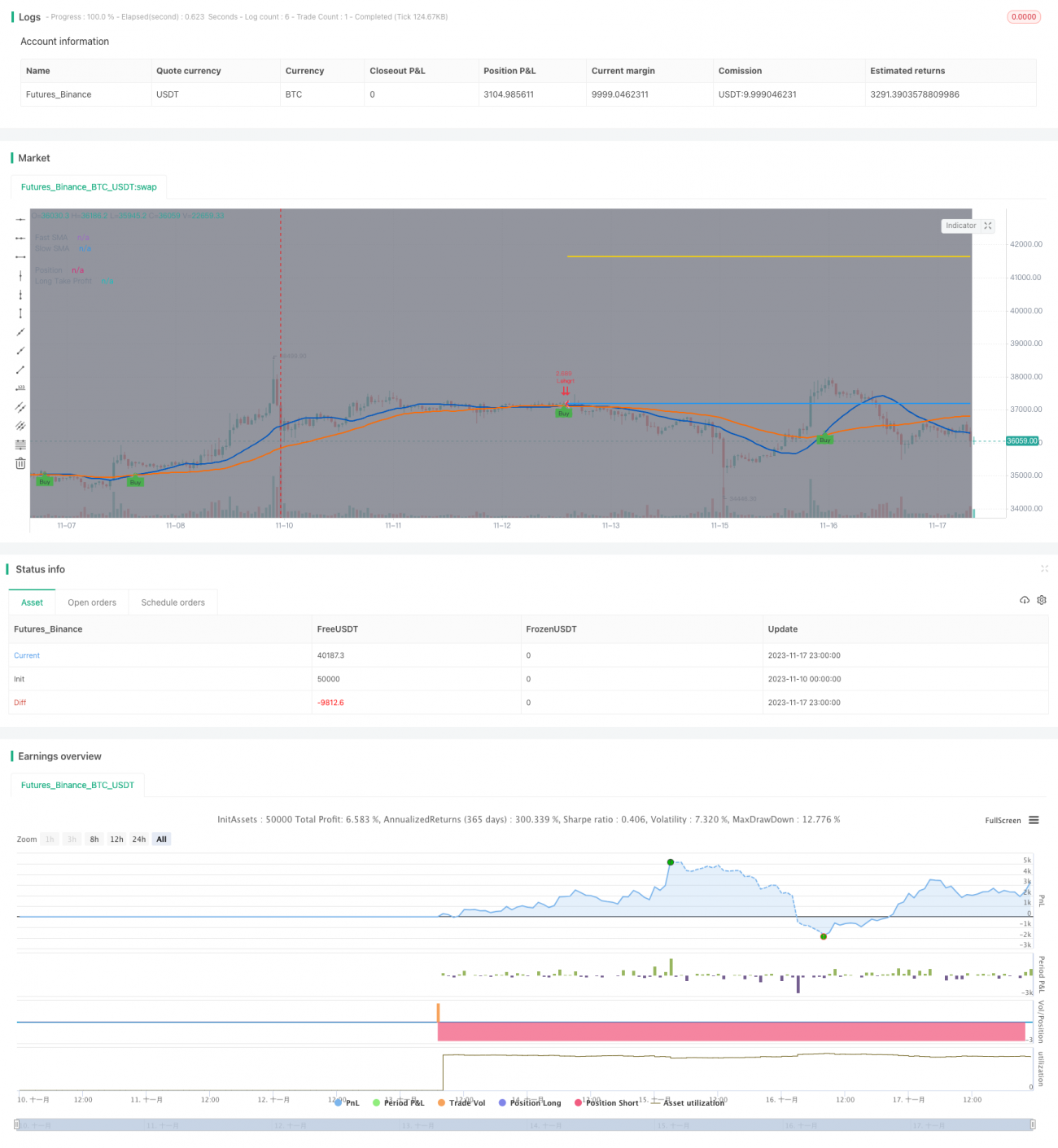
Overview
The Trailing Take Profit Trailing Stop Loss strategy is a quantitative trading strategy that combines trend tracking, partial take profit, full-cycle trailing stop loss and other functions. It aims to capture upside price trends in a bull market and take profits intelligently while controlling downside risks using trailing stops.
Strategy Logic
The strategy uses the golden cross of fast and slow moving averages as the buy signal. When the fast MA crosses above the slow MA, it indicates an uptrend is formed and the strategy will go long.
After entering a long position, the strategy sets a take profit price which equals the entry price multiplied by a predefined profit taking ratio. When price hits this level, the strategy will partially close the position by default selling 50% of the quantity. This realizes partial profits and locks in some gains.
Next, a trailing take profit mechanism will be activated if enabled. As price continues going up, the take profit price trails price at a predefined trailing step. This enables the take profit price to follow the uptrend closely, realizing the trailing take profit function.
At the same time, a trailing stop is also started. Once price hits the take profit price, the trailing stop price starts to move up following highs while maintaining a predefined stop loss percentage below the high prices. This allows more profits to be locked in as the trailing stop moves up while controlling downside risk.
Finally, if a pullback causes price to penetrate below the trailing stop price, the strategy will flatten the whole position at market price. The trading cycle finishes.
Advantage Analysis
Integrating trend tracking, partial take profit, full-cycle trailing stops and more, the strategy has the following edges:
- Effectively captures upside trends with accurate buy signals;
- Partial take profit locks in some profits, avoiding giving back all gains;
- Trailing take profit price sticks to uptrends closely;
- Activating trailing stops locks in more profits and controls risks;
- Customizable parameters to adjust to individual risk tolerance levels.
Risk Analysis
The strategy also has some risks mainly in the following areas:
- Price may reverse sharply after entry for no take profit or stop loss, leading to amplified losses;
- Trailing take profit may fail to follow promptly when trend ends, missing the best exit point;
- Stop loss percentage set too wide may cause excessive losses during sharp declines;
- High trading frequency leads to larger trading costs and slippage.
Some ways to optimize and improve accordingly include:
- Set moving average parameters properly to avoid wrong signals;
- Reduce partial take profit ratio to lower risks;
- Tighten stop loss percentage to limit losses;
- Fine tune trailing step to optimize trailing take profit effectiveness.
Optimization Directions
There is room for further optimization:
- Add more indicators to determine trends to prevent false breakouts;
- Incorporate position sizing to make position amount more reasonable;
- Build in dynamic mechanisms for take profit and stop loss levels to make parameters more adaptive;
- Add filters to avoid erroneous trades for highly volatile assets.
These optimizations can make the strategy more robust and improve performance.
Conclusion
The Trailing Take Profit Trailing Stop Loss Strategy skillfully utilizes a combination of trend tracking, intelligent take profit, full-cycle trailing stops and more. Building on capturing upside trends, it realizes take profit price trailing and raising trailing stop levels. This allows the strategy to follow trends while profiting in bull markets. Also, risks are controlled via partial take profits and stop losses to protect capital. In conclusion, this is a stable strategy type commonly seen in quantitative trading.
/*backtest
start: 2023-11-10 00:00:00
end: 2023-11-18 00:00:00
period: 1h
basePeriod: 15m
exchanges: [{"eid":"Futures_Binance","currency":"BTC_USDT"}]
*/

//@version=4
//
// ▒▒▒▒▒▒▒▒▒▒▒▒▒▒▒▒▒▒▒▒▒▒▒▒▒▒▒▒▒▒▒▒▒▒▒▒▒▒▒▒▒▒▒▒▒▒▒▒▒▒▒▒▒▒▒▒▒▒▒▒▒▒▒▒▒▒▒▒▒▒▒▒▒▒▒▒▒▒▒▒▒▒▒▒▒▒▒▒▒▒▒▒▒▒▒▒▒▒▒▒▒▒▒▒▒▒▒▒▒▒▒▒▒▒
// ------------------------------------------------------------------------------ 1