Gold Price Action Trading Algorithm

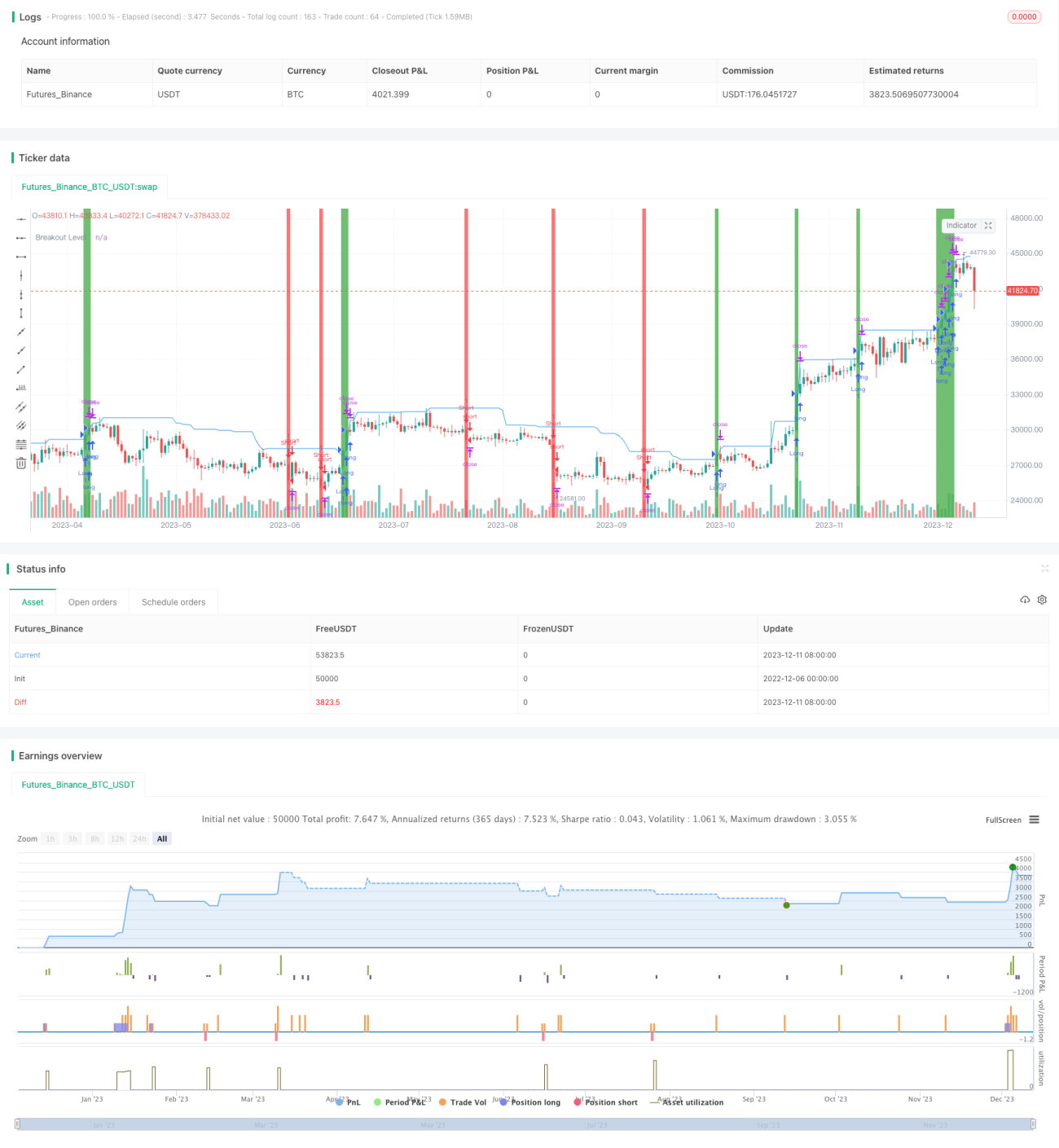
Overview
This algorithm trades gold based on its price action. It calculates the highest and lowest prices of the recent 20 candlesticks to determine the price fluctuation range. It goes long when the price breaks through the highest price of the latest candlestick and goes short when the price breaks through the lowest price of the latest candlestick. After opening long or short positions, it sets take profit and stop loss prices.
Principles
The core logic of this algorithm is based on the breakout theory. It records the highest and lowest prices of the most recent 20 candlesticks to determine the price fluctuation range. When the price exceeds this range, it is considered a breakout and thus a trading signal is triggered. Specifically, the algorithm flow is:
- Calculate the highest prices (highs) and lowest prices (lows) of the most recent 20 candlesticks
- Get the price fluctuation range (priceRange)
- Record the highest price of the latest candlestick as the breakout level (breakoutLevel)
- When the high of the latest candlestick breaks through the breakout level and the close also breaks through the breakout level, go long
- When the low of the latest candlestick drops below the breakout level and the close also drops below the breakout level, go short
- Set take profit and stop loss prices after opening long or short positions
As can be seen, the trading signals of this algorithm come from price breakout judgements. The key is to identify the timing of price breakouts.
Advantages Analysis
The algorithm has the following advantages:
- Simple and clear, easy to understand and implement
- Based on price action, not affected by other indicators
- Clear breakout signals, easy to grasp entry timing
- Can significantly filter market noise and avoid being trapped
- Take profit and stop loss in place to control single trade loss
In general, the core idea of this algorithm is clear and logical. It is simple to implement and easy to grasp entry timing. It also allows controlling single trade loss. Thus it is a quantitative trading strategy with strong practicality.
Risk Analysis
The algorithm also has some risks:
- High probability of failed breakout, risk of missing profits
- Improper grasp of breakout timing, may enter too early or too late
- Relatively large drawdowns, need certain psychological endurance
- Unreasonable take profit and stop loss settings, may miss larger profits or take higher losses
To control and optimize against these risks, the following measures can be taken:
- Confirm breakout with other indicators to increase reliability
- Optimize parameters to improve entry timing accuracy
- Adjust position sizing to reduce single trade loss risk
- Dynamically adjust take profit and stop loss prices
Optimization Directions
The algorithm can be optimized in the following aspects:
-
Combine with other indicators. Moving averages, Bollinger Bands etc can be introduced to double confirm the breakout signals and increase reliability.
-
Parameter optimization. Different parameter combinations can be tested to optimize the breakout period length and find more reliable parameter settings.
-
Take profit and stop loss optimization. Dynamically adjust take profit and stop loss distance based on volatility etc.
-
Position sizing optimization. Optimize position sizing algorithm to reduce single trade loss impact.
-
Machine learning. Learn from large amount of historical data to automatically find better parameter combinations.
The above optimizations can further enhance the stability, win rate and profitability of the algorithm.
Conclusion
The gold trading algorithm generates trading signals based on price action and the breakout theory. The idea is simple and clear, easy to implement, and highly practical. Meanwhile, it also has some risks and needs further optimization to improve stability and profitability. Overall speaking, it is suitable for gold trading and an efficient quantitative strategy. By combining other indicators, parameter optimization, take profit/stop loss optimization etc, better strategy performance can be achieved.
- 1