Adaptive Moving Average and Weighted Moving Average Crossover Trading Strategy

Overview
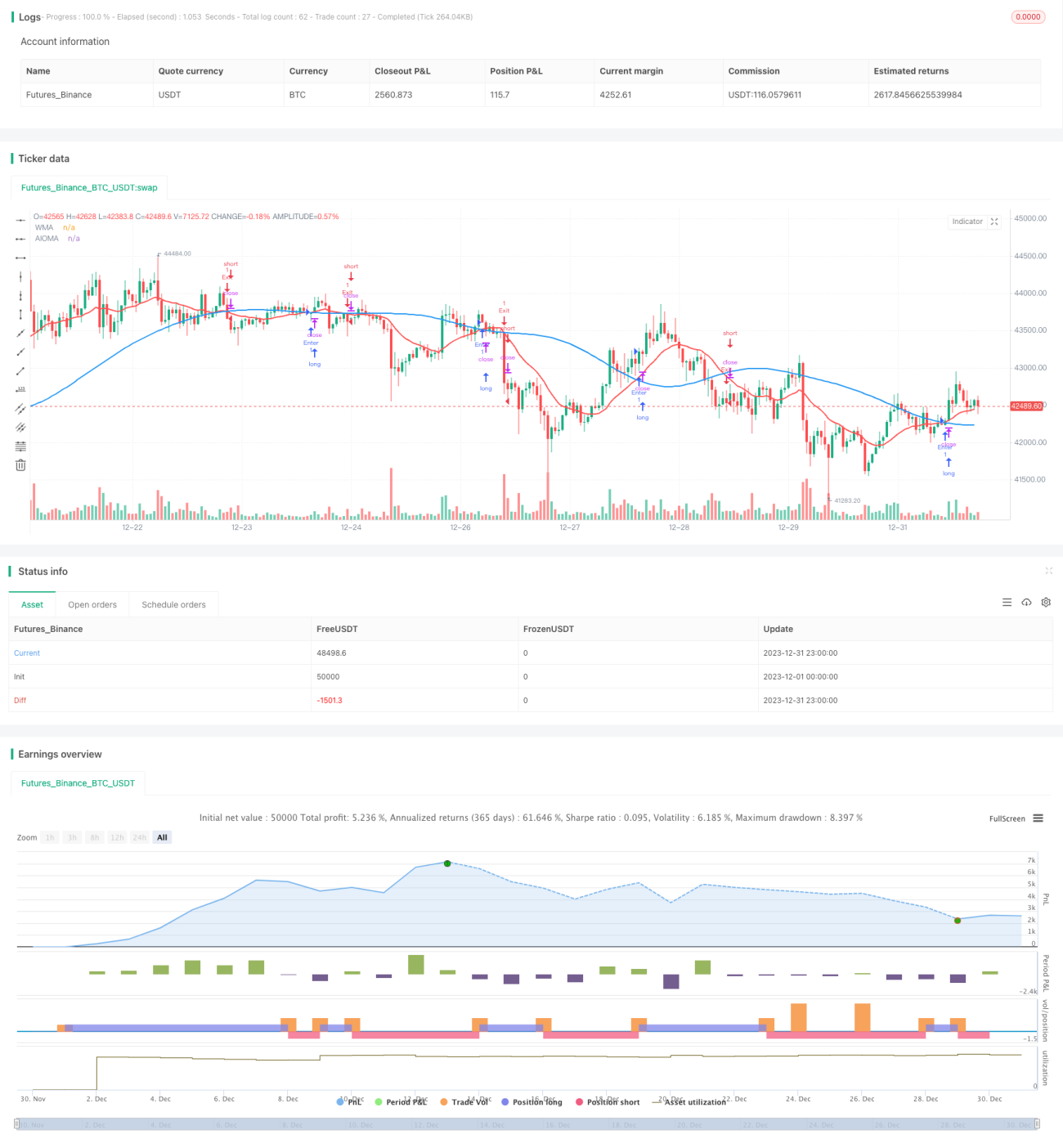
This strategy generates trading signals based on the Adaptive Indicator for Moving Averages (AIOMA) and the Weighted Moving Average (WMA) indicators. It produces buy and sell signals based on the crossovers between AIOMA and WMA.
Strategy Name
AIOMA-WMA Adaptive Crossover Strategy
Strategy Logic
The strategy includes the following main components:
-
AIOMA Indicator Calculation
- Calculate a series of Exponential Moving Averages (EMA) with specified length
- Chain these EMAs to create smoothed values
- The final AIOMA is an EMA of the last smoothed value
-
WMA Indicator Calculation
- Calculate WMA with specified length
-
Signal Generation
- Buy signal when WMA crosses above AIOMA
- Sell signal when WMA crosses below AIOMA
-
Trading Logic
- Enter long position on buy signal
- Enter short position on sell signal
- Close position on reverse crossover signals
Advantages
- Using two different types of moving averages improves signal accuracy
- AIOMA reduces false signals through multiple exponential smoothings
- WMA as the main indicator reacts faster to price changes to capture trends early
- Simple trading logic, easy to understand and implement
Risks
- Excessive lagging due to multiple EMA smoothings
- WMA prone to wrong signals from short-term price fluctuations
- No stop loss logic, can lead to large losses
Can reduce risks through parameter optimization, adding stop loss, filtering with other indicators etc.
Enhancement Areas
- Test different parameter combinations to find optimal values
- Trigger stop loss orders together with entry signals
- Filter signals using volatility indicators
- Incorporate position sizing strategies
Conclusion
This strategy combines the strengths of AIOMA and WMA by using crossovers to generate trading signals. Compared to single moving averages, it improves signal quality. Further refinements like parameter optimization, stop loss strategies, volatility filtering etc. can make it a robust trading system.
- 1