MACD-ATR-EMA Multi-Indicator Dynamic Trend Following Strategy

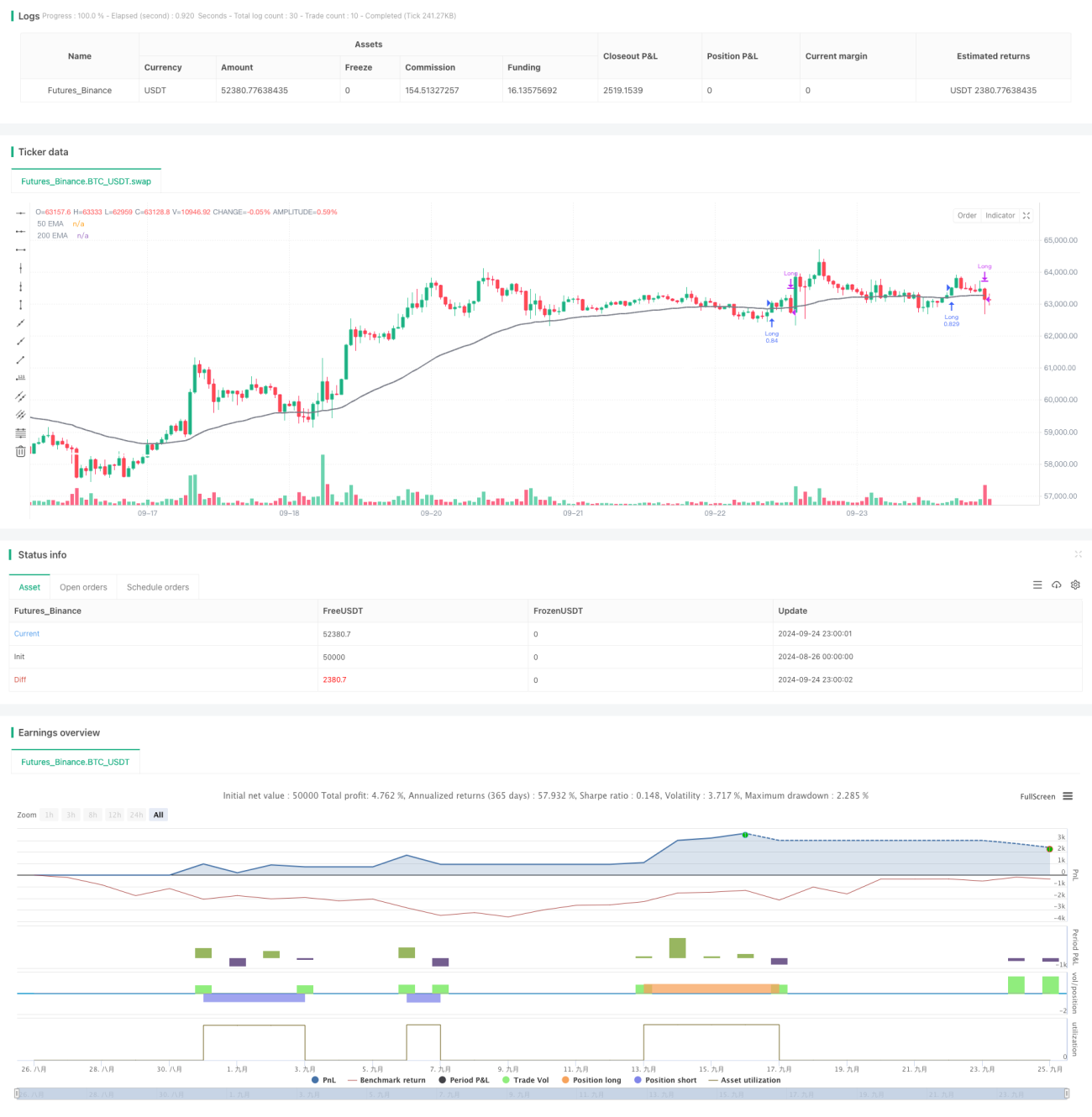
Overview
The MACD-ATR-EMA Multi-Indicator Dynamic Trend Following Strategy is a sophisticated trading system that combines multiple technical indicators. This strategy utilizes the Moving Average Convergence Divergence (MACD), Average True Range (ATR), and Exponential Moving Averages (EMA) to capture market trends while dynamically managing risk. The core idea is to identify potential trend reversals using MACD, filter out low volatility periods with ATR, and confirm trend direction using both short-term and long-term EMAs. Additionally, the strategy offers flexible stop-loss options, allowing traders to choose between recent swing high/low levels or a dynamic ATR-based stop, ensuring adaptability to various market conditions.
Strategy Principles
-
Trend Identification:
- Uses MACD indicator (12,26,9) to identify potential trend reversal signals.
- Utilizes 50-period and 200-period EMAs to confirm overall market trend direction.
-
Entry Conditions:
- Long Entry: MACD line crosses above the signal line, closing price above both 50 and 200 EMAs, and both MACD and signal lines are negative.
- Short Entry: MACD line crosses below the signal line, closing price below both 50 and 200 EMAs, and both MACD and signal lines are positive.
-
Risk Management:
- Employs ATR indicator (14-period) to filter out low volatility environments, only allowing trades when ATR is above a set threshold.
- Offers two stop-loss methods: based on recent swing highs/lows or dynamic ATR-based stops.
- Dynamically calculates position size for each trade based on user-defined risk percentage.
-
Exit Strategy:
- Long Exit: When price falls below the 50-period EMA.
- Short Exit: When price rises above the 50-period EMA.
-
Trade Execution:
- All trading signals are confirmed only at the close of candles.
- Implements single position management, ensuring only one active trade at a time.
Strategy Advantages
-
Multi-Indicator Synergy: Combining MACD, ATR, and EMA achieves multiple validations for trend identification, volatility filtering, and trend confirmation, enhancing the reliability of trading signals.
-
Dynamic Risk Management: ATR threshold filtering avoids frequent trading in unfavorable market conditions, while dynamic stop-loss setting using ATR or recent swing points adapts to different market phases.
-
Flexible Parameter Settings: The strategy offers multiple adjustable parameters such as MACD periods, EMA lengths, and ATR threshold, allowing traders to optimize based on different markets and personal preferences.
-
Integrated Capital Management: Built-in position sizing based on account total percentage ensures controlled risk for each trade, contributing to long-term stability.
-
Trend Following and Reversal Combination: While primarily a trend-following strategy, it also has some trend reversal capture capability through the use of MACD reversal signals, increasing the strategy's adaptability.
-
Clear Trading Logic: Entry and exit conditions are well-defined, facilitating understanding and backtesting, and also beneficial for continuous strategy improvement.
Strategy Risks
-
Lag Risk: Both EMA and MACD are lagging indicators, which may lead to delayed entries or exits in markets with sharp volatility or rapid reversals.
-
Overtrading Risk: Despite ATR filtering, frequent trading signals may still occur in oscillating markets, increasing transaction costs.
-
False Breakout Risk: MACD crossovers can produce false signals, especially during sideways consolidation phases, potentially leading to unnecessary trades.
-
Trend Dependency: The strategy performs well in strong trend markets but may underperform in range-bound markets.
-
Parameter Sensitivity: Multiple adjustable parameters mean strategy performance may be highly sensitive to parameter selection, risking overfitting.
-
Single Position Limitation: The strategy limits to holding only one position, potentially missing out on other profitable opportunities.
Strategy Optimization Directions
-
Add Trend Strength Filtering:
- Introduce ADX indicator to assess trend strength, trading only when trends are clear.
- Reason: This can reduce false signals in oscillating markets, improving trade quality.
-
Optimize MACD Settings:
- Experiment with different MACD parameter combinations or consider using adaptive MACD.
- Reason: Standard MACD parameters may not be suitable for all market conditions; adaptive parameters can increase strategy flexibility.
-
Implement Partial Profit-Taking:
- Consider partial position closure when reaching certain profit targets to lock in some gains.
- Reason: This can improve strategy profit stability while maintaining trend-following capability.
-
Introduce Market State Classification:
- Use volatility or trend indicators to classify market states and apply different trading parameters in different states.
- Reason: This adaptive approach can help the strategy better adjust to various market environments.
-
Add Trading Time Filters:
- Analyze optimal trading time periods and only allow trades during specific times.
- Reason: Some markets may produce more effective signals during certain time periods, which can improve strategy efficiency.
-
Optimize Position Management:
- Consider implementing a graduated scaling in/out strategy instead of simple all-in/all-out trades.
- Reason: This can better capitalize on major trends while reducing risk for individual trades.
Conclusion
The MACD-ATR-EMA Multi-Indicator Dynamic Trend Following Strategy is a comprehensive trading system that aims to capture market trends and dynamically manage risk by combining multiple technical indicators and risk management techniques. The strategy's main strengths lie in its multi-layered signal confirmation mechanism and flexible risk control methods, enabling it to maintain stability across different market environments. However, the strategy also faces potential risks such as lag, overtrading, and parameter sensitivity.
Through further optimization, such as adding trend strength filtering, improving MACD parameter settings, and implementing partial profit-taking strategies, the strategy's performance and adaptability can be further enhanced. Particularly, introducing market state classification and adaptive parameter methods holds promise for significantly improving the strategy's performance under various market conditions.
Overall, this strategy provides traders with a solid foundational framework that can be customized and optimized according to individual trading styles and market characteristics. With continuous monitoring and adjustment, this strategy has the potential to become a reliable long-term trading tool.
- 1