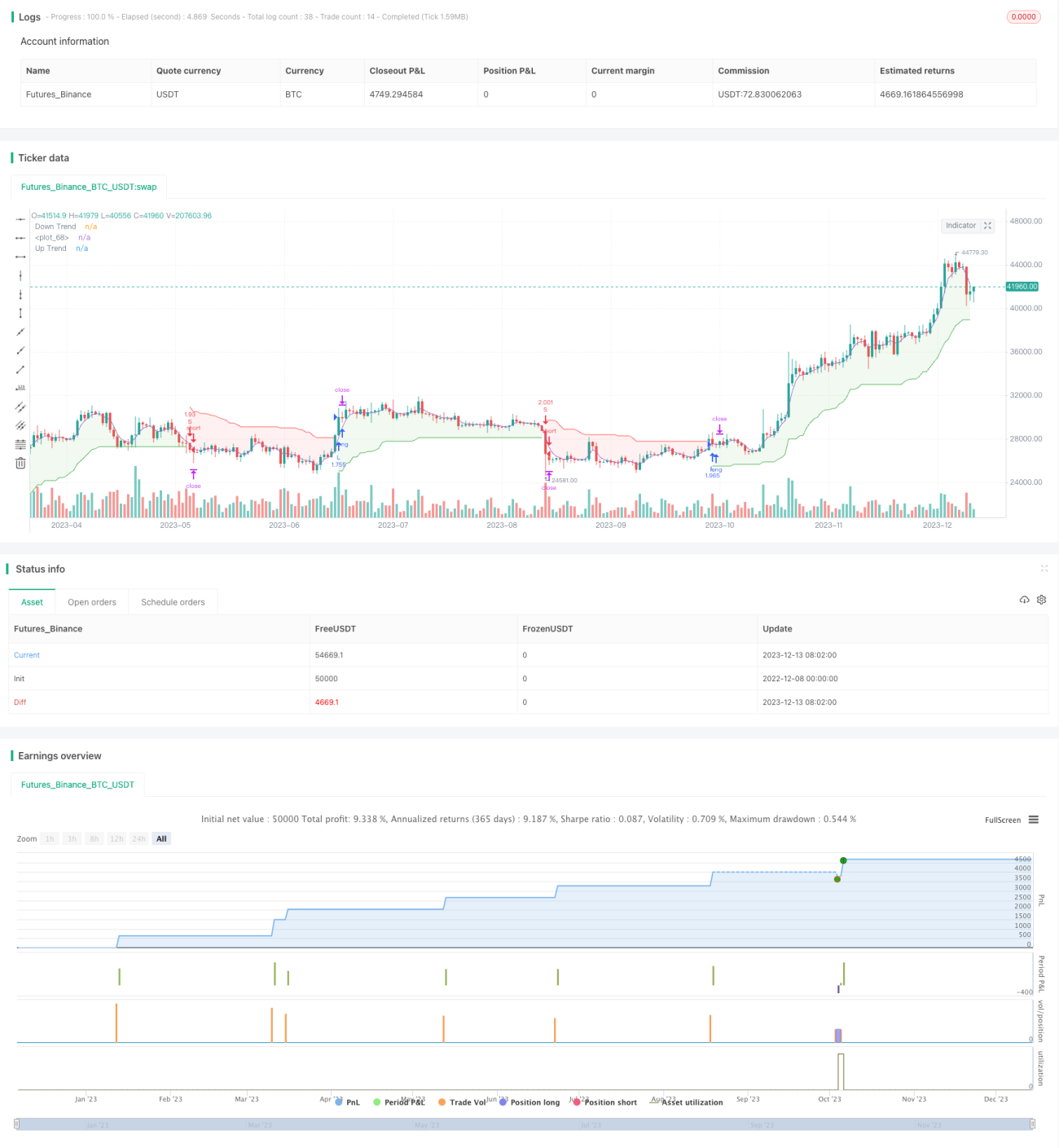
Estratégia de combinação de Heiken Ashi e Super Trend


Data de criação: 2023-12-15 11:11:27 última modificação: 2023-12-15 11:11:27
cópia: 0 Cliques: 1310
1
focar em
1621
Seguidores

Estratégia de combinação de Heiken Ashi e Super Trend

Visão geral

Esta é uma estratégia de negociação quantitativa que combina Heiken Ashi e Super Trend. A estratégia utiliza Heiken Ashi para filtrar o ruído do mercado e o indicador de super tendência para determinar a direção da tendência dos preços.

Princípio da estratégia

  1. Usando o indicador Heiken Ashi para processar a linha K e filtrar parte do ruído do mercado para tornar a tendência mais visível
  2. Ascensão e descensão de supertrends com base no ATR e no cálculo de fatores
  3. Quando o preço se eleva, é um sinal de baixa e quando ele baixa, é um sinal de alta.
  4. Quanto maior o fator, menos sinais de super-tendência, melhor o acompanhamento, mas menos entradas
  5. Combinação de Heiken Ashi e Super Trend Indicator para julgar e acompanhar tendências

Vantagens estratégicas

  1. O indicador Heiken Ashi filtra eficazmente parte do ruído do mercado, tornando os gráficos mais claros
  2. Otimizando os parâmetros do indicador de tendência super, você pode ajustar a frequência de entrada com flexibilidade
  3. Combinação de dois indicadores para melhor avaliar a tendência dos preços
  4. Implementação de um monitoramento automático de tendências fortes

Risco estratégico

  1. A combinação de indicadores não pode evitar completamente os sinais de erro no intervalo de liquidação
  2. Um salto alto pode causar falhas no indicador e, assim, perder pontos de sinal importantes
  3. Os fatores de tendência super-estabeleceram a convenção e perderam a oportunidade de tendência

Solução: (1) Ajustar adequadamente os parâmetros de super-trend, equilibrando o efeito de rastreamento e a frequência de entrada (2) Adicionar outros indicadores para auxiliar o julgamento e evitar problemas de saltos aéreos

Direção de otimização da estratégia

  1. Ajustar o ciclo ATR e o fator super-tendência para otimizar a frequência de entrada
  2. Aumentar os indicadores de stop loss e controlar as perdas individuais
  3. Combinação de outros indicadores para determinar o tipo de tendência, evitando a manipulação incorreta do ritmo de oscilação da tendência
  4. Aumentar os algoritmos de aprendizagem de máquina para ajudar a determinar a direção

Resumir

A estratégia integra os benefícios dos dois indicadores Heiken Ashi e Supertrend, e usa os indicadores para determinar a direção da tendência de valor, permitindo o acompanhamento automático. Em comparação com o uso de um indicador isolado, o desempenho da determinação do movimento dos preços é melhor e aumenta a estabilidade da estratégia.

Código-fonte da estratégia
/*backtest
start: 2022-12-08 00:00:00
end: 2023-12-14 00:00:00
period: 1d
basePeriod: 1h
exchanges: [{"eid":"Futures_Binance","currency":"BTC_USDT"}]
*/

// This source code is subject to the terms of the Mozilla Public License 2.0 at https://mozilla.org/MPL/2.0/
// © RingsCherrY

//@version=5

strategy("Heiken Ashi & Super Trend", overlay=true,  pyramiding=1,initial_capital = 10000, default_qty_type= strategy.percent_of_equity, default_qty_value = 100, calc_on_order_fills=false, slippage=0,commission_type=strategy.commission.percent,commission_value=0.02)

///////////////////////////////////////////////////
////////////////////Function///////////////////////
///////////////////////////////////////////////////


heikinashi_open = request.security(ticker.heikinashi(syminfo.tickerid), timeframe.period, open)
heikinashi_high = request.security(ticker.heikinashi(syminfo.tickerid), timeframe.period, high)
heikinashi_low  = request.security(ticker.heikinashi(syminfo.tickerid), timeframe.period, low)
heikinashi_close= request.security(ticker.heikinashi(syminfo.tickerid), timeframe.period, close)
heikinashi_color = heikinashi_open < heikinashi_close ? #53b987 : #eb4d5c
// plotbar(heikinashi_open, heikinashi_high, heikinashi_low, heikinashi_close, color=heikinashi_color)

x_sma(x, y) =>
    sumx = 0.0
    for i = 0 to y - 1
        sumx := sumx + x[i] / y
    sumx

x_rma(src, length) =>
	alpha = 1/length
	sum = 0.0
	sum := na(sum[1]) ? x_sma(src, length) : alpha * src + (1 - alpha) * nz(sum[1])

x_atr(length) =>
    trueRange = na(heikinashi_high[1])? heikinashi_high-heikinashi_low : math.max(math.max(heikinashi_high - heikinashi_low, math.abs(heikinashi_high - heikinashi_close[1])), math.abs(heikinashi_low - heikinashi_close[1]))
    //true range can be also calculated with ta.tr(true)
    x_rma(trueRange, length)

x_supertrend(factor, atrPeriod) =>
	src = (heikinashi_high+heikinashi_low)/2
	atr = x_atr(atrPeriod)
	upperBand = src + factor * atr
	lowerBand = src - factor * atr
	prevLowerBand = nz(lowerBand[1])
	prevUpperBand = nz(upperBand[1])

	lowerBand := lowerBand > prevLowerBand or heikinashi_close[1] < prevLowerBand ? lowerBand : prevLowerBand
	upperBand := upperBand < prevUpperBand or heikinashi_close[1] > prevUpperBand ? upperBand : prevUpperBand
	int direction = na
	float superTrend = na
	prevSuperTrend = superTrend[1]
	if na(atr[1])
		direction := 1
	else if prevSuperTrend == prevUpperBand
		direction := heikinashi_close > upperBand ? -1 : 1
	else
		direction := heikinashi_close < lowerBand ? 1 : -1
	superTrend := direction == -1 ? lowerBand : upperBand
	[superTrend, direction]
	

///////////////////////////////////////////////////
////////////////////Indicators/////////////////////
///////////////////////////////////////////////////

atrPeriod = input(10, "ATR Length")
factor = input.float(3.0, "Factor", step = 0.01)

[supertrend, direction] = x_supertrend(factor, atrPeriod)

bodyMiddle = plot((heikinashi_open + heikinashi_close) / 2, display=display.none)
upTrend = plot(direction < 0 ? supertrend : na, "Up Trend", color = color.green, style=plot.style_linebr)
downTrend = plot(direction < 0? na : supertrend, "Down Trend", color = color.red, style=plot.style_linebr)

fill(bodyMiddle, upTrend, color.new(color.green, 90), fillgaps=false)
fill(bodyMiddle, downTrend, color.new(color.red, 90), fillgaps=false)

///////////////////////////////////////////////////
////////////////////Strategy///////////////////////
///////////////////////////////////////////////////

var bool longCond                    = na, var bool shortCond                   = na, longCond := nz(longCond[1]), shortCond := nz(shortCond[1])
var int CondIni_long                 = 0, var int CondIni_short                 = 0, CondIni_long := nz(CondIni_long[1]), CondIni_short := nz(CondIni_short[1])
var float open_longCondition         = na, var float open_shortCondition   = na


long  = ta.change(direction) < 0
short = ta.change(direction) > 0


longCond        :=                                                              long
shortCond       :=                                                              short

CondIni_long    :=                                                              longCond[1] ? 1 : shortCond[1] ? -1 : nz(CondIni_long[1])
CondIni_short   :=                                                              longCond[1] ? 1 : shortCond[1] ? -1 : nz(CondIni_short[1])
longCondition   =                                                               (longCond[1] and nz(CondIni_long[1]) == -1)
shortCondition  =                                                               (shortCond[1] and nz(CondIni_short[1]) == 1)


open_longCondition             :=                                          long ? close[1] :                                                      nz(open_longCondition[1])
open_shortCondition            :=                                          short ? close[1] :                                                     nz(open_shortCondition[1])


//TP
tp                    = input.float(1.1  , "TP [%]",                      step = 0.1) 

//BACKTESTING inputs --------------------------------------------------------------------------------------------------------------------------------------------------------------------------------------------------------------------------------------------------------------------------------------------------------

testStartYear       =                   input.int(2000,                             title="start year",                                         minval = 1997, maxval = 3000,                                                   group= "BACKTEST") 
testStartMonth      =                   input.int(01,                               title="start month",                                        minval = 1, maxval = 12,                                                        group= "BACKTEST")
testStartDay        =                   input.int(01,                               title="start day",                                          minval = 1, maxval = 31,                                                        group= "BACKTEST")
testPeriodStart     =                   timestamp(testStartYear,testStartMonth,testStartDay,0,0)
testStopYear        =                   input.int(3333,                             title="stop year",                                          minval=1980, maxval = 3333,                                                     group= "BACKTEST")
testStopMonth       =                   input.int(12,                               title="stop month",                                         minval=1, maxval=12,                                                            group= "BACKTEST")
testStopDay         =                   input.int(31,                               title="stop day",                                           minval=1, maxval=31,                                                            group= "BACKTEST")
testPeriodStop      =                   timestamp(testStopYear, testStopMonth, testStopDay, 0, 0)
testPeriod          =                   true

// Backtest  ==================================================================================================================================================================================================================================================================================================================================


if longCond
    strategy.entry("L", strategy.long, when=testPeriod)

if shortCond
    strategy.entry("S", strategy.short, when=testPeriod)
    

strategy.exit("TP_L", "L", profit =((open_longCondition   *       (1+(tp/100))) - open_longCondition)/syminfo.mintick)

strategy.exit("TP_S", "S", profit =((open_shortCondition  *       (1+(tp/100))) - open_shortCondition)/syminfo.mintick)