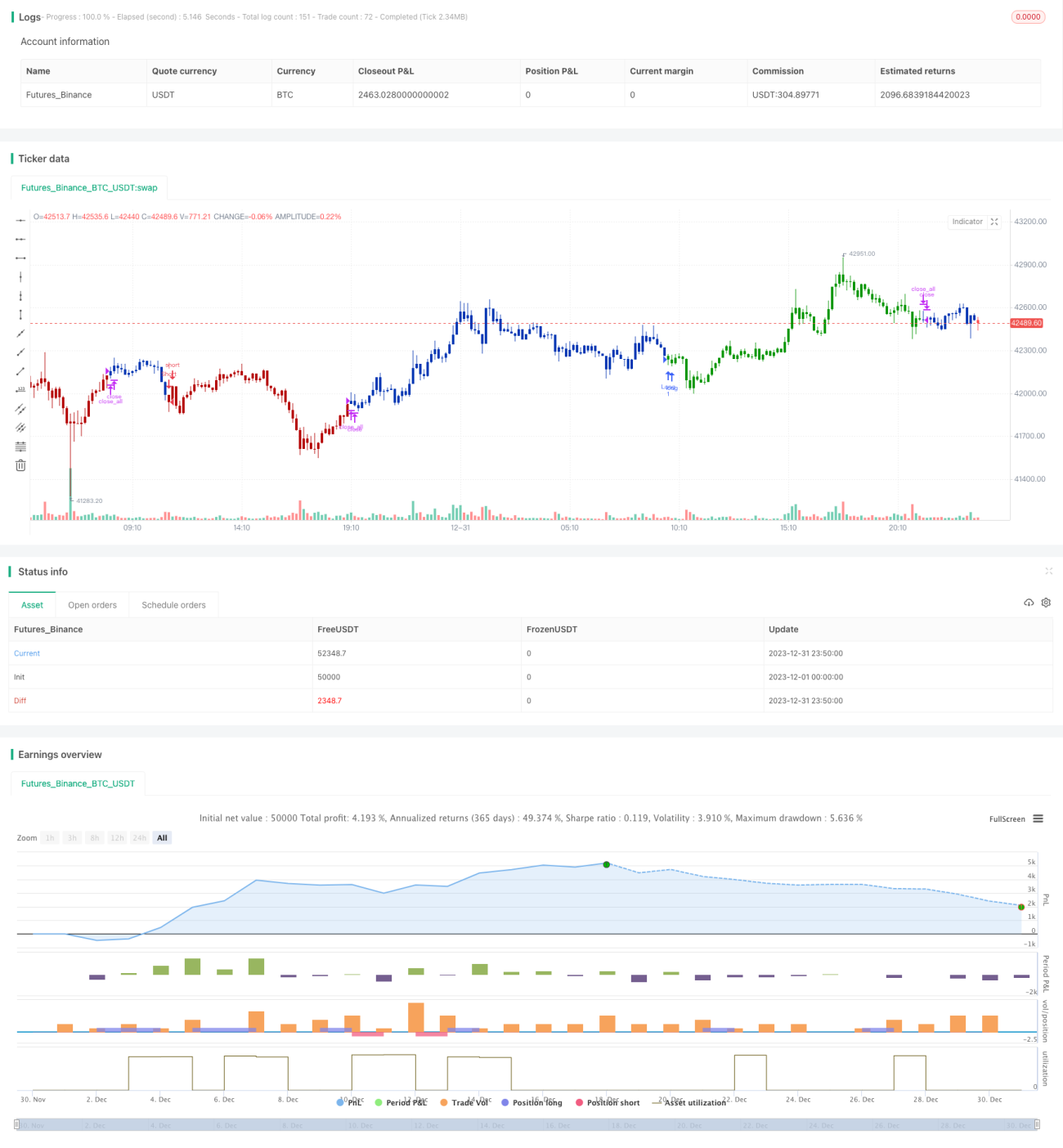
Ý tưởng chính của chiến lược này là kết hợp 123 hình thức đảo ngược và chỉ số dòng tiền thông minh (SMI) để đạt được giao dịch theo dõi xu hướng ổn định. Chiến lược này sẽ tạo ra vị trí đa đầu hoặc trống tương ứng khi hai tín hiệu đồng thời phát ra tín hiệu mua hoặc bán.
Chiến lược này bao gồm hai phần:
123 Chiến lược đảo ngược: Chiến lược này dựa trên giá đóng cửa của cổ phiếu và chỉ số Stoch ngày 9 để thực hiện giao dịch đảo ngược. Cụ thể, khi mối quan hệ giá đóng cửa hai ngày liên tiếp xảy ra đảo ngược (tức là giá đóng cửa ngày trước cao hơn hai ngày trước, giá đóng cửa ngày tiếp theo thấp hơn ngày trước) và đường thẳng của Stoch cao hơn đường chậm, làm trống; khi mối quan hệ giá đóng cửa hai ngày liên tiếp xảy ra đảo ngược (tức là giá đóng cửa ngày trước thấp hơn hai ngày trước, giá đóng cửa ngày tiếp theo cao hơn ngày trước) và đường thẳng của Stoch thấp hơn đường chậm, làm nhiều.
Chiến lược SMI: Chiến lược này dựa trên chỉ số dòng tiền thông minh để theo dõi xu hướng. Chỉ số SMI có thể phản ánh sự chơi của quỹ tổ chức và quỹ bán lẻ.
Chiến lược này sẽ thực hiện một vị trí đa đầu khi cả 123 reversal và chỉ số SMI cùng phát ra tín hiệu mua; chiến lược này sẽ thực hiện một vị trí trống khi cả hai đều phát ra tín hiệu bán.
Chiến lược này kết hợp với hình thức đảo ngược và các chỉ số theo dõi xu hướng, có thể xác định hiệu quả các điểm đảo ngược thị trường và theo dõi xu hướng, để đạt được lợi nhuận ổn định. Các lợi thế cụ thể như sau:
123 hình thức đảo ngược có tỷ lệ thắng và tỷ lệ thắng cao, có thể xác định hiệu quả các cơ hội đảo ngược ngắn hạn.
Chỉ số SMI có thể phản ánh dòng tiền của tổ chức, theo dõi nguồn tiền của tổ chức có thể thu được lợi nhuận ổn định hơn.
Kết hợp với việc sử dụng mô hình đảo ngược và các chỉ số theo dõi xu hướng, có thể cải thiện chất lượng tín hiệu, giảm giao dịch không cần thiết và kiểm soát rủi ro hiệu quả.
Chiến lược này cũng có một số rủi ro, chủ yếu tập trung vào các khía cạnh sau:
Có một số rủi ro tín hiệu sai, không thể hoàn toàn tránh được giao dịch thua lỗ. Bạn có thể tối ưu hóa các tham số thích hợp để cải thiện chất lượng tín hiệu.
Chỉ số SMI có một số chậm trễ, không thể phản ánh hoàn toàn dòng tiền trong thời gian thực. Nó có thể được kiểm chứng kết hợp với các chỉ số khác để tăng độ chính xác.
Tín hiệu kép gây ra vấn đề quá bảo thủ, có thể bỏ lỡ một xu hướng đơn phương mạnh hơn. Các điều kiện tín hiệu có thể được nới lỏng thích hợp, giảm tiêu chuẩn lọc.
Chiến lược này cũng có thể được tối ưu hóa hơn nữa trong các khía cạnh sau:
Tối ưu hóa các tham số, tìm kiếm sự kết hợp tối ưu của các tham số, nâng cao lợi nhuận của chiến lược.
Tăng cơ chế ngăn chặn thiệt hại để kiểm soát hiệu quả tổn thất đơn lẻ.
Kết hợp với các chỉ số hoặc hình thức khác để xác minh thêm chất lượng tín hiệu và tăng độ chính xác tín hiệu.
Tối ưu hóa các tham số cho các giống khác nhau để cải thiện khả năng thích ứng của chiến lược.
Chiến lược này có tư duy tổng thể rõ ràng, kết hợp hiệu quả với các chỉ số theo dõi xu hướng và biến đổi, có thể xác định ổn định các cơ hội đảo ngược ngắn hạn và theo dõi xu hướng trung và dài hạn. Bằng cách tối ưu hóa tham số và cải tiến thiết kế cơ chế, có thể tăng cường hơn nữa khả năng lợi nhuận và khả năng kiểm soát rủi ro của chiến lược.
The main idea of this strategy is to combine the 123 reversal pattern and the Smart Money Index (SMI) indicator to achieve stable trend tracking trading. The strategy will only establish corresponding long or short positions when both signals issue buy or sell signals at the same time.
The strategy consists of two parts:
123 reversal strategy: This strategy implements reversal trading based on the closing price of the stock and the 9-day Stoch indicator. Specifically, go short when the closing price relationship reverses for two consecutive days (i.e. the previous closing price is higher than the one before the previous day, and the next closing price is lower than the previous day), and Stoch fast line is above slow line; go long when the closing price relationship reverses for two consecutive days (i.e. the previous closing price is lower than the one before the previous day, and the next closing price is higher than the previous day), and Stoch fast line is below slow line.
SMI strategy: This strategy implements trend tracking based on the Smart Money Index. The SMI indicator can reflect the game between institutional funds and retail funds. The rise of SMI indicates that institutional funds are absorbing funds, while the fall indicates that institutional funds are selling out. Go long when SMI rises and go short when SMI falls.
The strategy will only take a long position when both the 123 reversal pattern and the SMI indicator issue a buy signal at the same time. It will only take a short position when both issue a sell signal at the same time.
The strategy combines reversal patterns and trend tracking indicators to effectively identify market reversal points and track trends for steady profits. The specific advantages are as follows:
The 123 reversal pattern has a relatively high win rate and profit rate, which can effectively identify short-term reversal opportunities.
The SMI indicator can reflect the direction of institutional funds. Tracking institutional funds can obtain more steady profits.
The combined use of reversal patterns and trend tracking indicators can improve the quality of signals, reduce unnecessary trading, and effectively control risks.
The strategy also has some risks, mainly concentrated in the following areas:
The 123 reversal pattern has a certain risk of false signals and cannot completely avoid losing trades. Parameters can be optimized appropriately to improve signal quality.
The SMI indicator has a certain lag and cannot completely reflect the direction of funds in real time. Other indicators can be combined for verification to improve accuracy.
Double signals can lead to over-conservative problems, possibly missing stronger one-sided trending opportunities. Signal conditions can be appropriately relaxed to reduce filtering criteria.
The strategy can also be further optimized in the following aspects:
Optimize parameters to find the optimal parameter combination and improve the profitability of the strategy.
Add stop loss mechanisms to effectively control single loss.
Combine other indicators or patterns to further verify signal quality and improve signal accuracy.
Optimize parameters separately for different varieties to improve the adaptability of the strategy.
The overall idea of the strategy is clear, effectively combining reversal patterns and trend tracking indicators to steadily identify short-term reversal opportunities and track medium-to-long term trends. By improving parameters optimization and mechanism design, the profitability and risk control capabilities of the strategy can be further enhanced.
/*backtest
start: 2023-12-01 00:00:00
end: 2023-12-31 23:59:59
period: 10m
basePeriod: 1m
exchanges: [{"eid":"Futures_Binance","currency":"BTC_USDT"}]
*/
//@version=4
////////////////////////////////////////////////////////////
// Copyright by HPotter v1.0 10/07/2021
// This is combo strategies for get a cumulative signal.
//
// First strategy
// This System was created from the Book "How I Tripled My Money In The
// Futures Market" by Ulf Jensen, Page 183. This is reverse type of strategies.
// The strategy buys at market, if close price is higher than the previous close
// during 2 days and the meaning of 9-days Stochastic Slow Oscillator is lower than 50.
// The strategy sells at market, if close price is lower than the previous close price
// during 2 days and the meaning of 9-days Stochastic Fast Oscillator is higher than 50.
//
// Second strategy
// Smart money index (SMI) or smart money flow index is a technical analysis indicator demonstrating investors sentiment.
// The index was invented and popularized by money manager Don Hays.[1] The indicator is based on intra-day price patterns.
// The main idea is that the majority of traders (emotional, news-driven) overreact at the beginning of the trading day
// because of the overnight news and economic data. There is also a lot of buying on market orders and short covering at the opening.
// Smart, experienced investors start trading closer to the end of the day having the opportunity to evaluate market performance.
// Therefore, the basic strategy is to bet against the morning price trend and bet with the evening price trend. The SMI may be calculated
// for many markets and market indices (S&P 500, DJIA, etc.)
//
// The SMI sends no clear signal whether the market is bullish or bearish. There are also no fixed absolute or relative readings signaling
// about the trend. Traders need to look at the SMI dynamics relative to that of the market. If, for example, SMI rises sharply when the
// market falls, this fact would mean that smart money is buying, and the market is to revert to an uptrend soon. The opposite situation
// is also true. A rapidly falling SMI during a bullish market means that smart money is selling and that market is to revert to a downtrend
// soon. The SMI is, therefore, a trend-based indicator.
// Some analysts use the smart money index to claim that precious metals such as gold will continually maintain value in the future.
//
// WARNING:
// - For purpose educate only
// - This script to change bars colors.
////////////////////////////////////////////////////////////
Reversal123(Length, KSmoothing, DLength, Level) =>
vFast = sma(stoch(close, high, low, Length), KSmoothing)
vSlow = sma(vFast, DLength)
pos = 0.0
pos := iff(close[2] < close[1] and close > close[1] and vFast < vSlow and vFast > Level, 1,
iff(close[2] > close[1] and close < close[1] and vFast > vSlow and vFast < Level, -1, nz(pos[1], 0)))
pos
SMI(Length, tf) =>
pos = 0.0
nRes = 0.0
xcloseH1 = security(syminfo.tickerid, tf, close[1])
xopenH1 = security(syminfo.tickerid, tf, open[1])
nRes := nz(nRes[1], 1) - (open - close) + (xopenH1 - xcloseH1)
xSmaRes = sma(nRes, Length)
pos:= iff(xSmaRes > nRes, 1,
iff(xSmaRes < nRes, -1, nz(pos[1], 0)))
pos
strategy(title="Combo Backtest 123 Reversal & Smart Money Index (SMI)", shorttitle="Combo", overlay = true)
line1 = input(true, "---- 123 Reversal ----")
Length = input(14, minval=1)
KSmoothing = input(1, minval=1)
DLength = input(3, minval=1)
Level = input(50, minval=1)
//-------------------------
line2 = input(true, "---- Smart Money Index (SMI) ----")
LengthSMI = input(18, minval=1)
res = input(title="Resolution", type=input.resolution, defval="D")
reverse = input(false, title="Trade reverse")
posReversal123 = Reversal123(Length, KSmoothing, DLength, Level)
posSMI = SMI(LengthSMI, res)
pos = iff(posReversal123 == 1 and posSMI == 1 , 1,
iff(posReversal123 == -1 and posSMI == -1, -1, 0))
possig = iff(reverse and pos == 1, -1,
iff(reverse and pos == -1 , 1, pos))
if (possig == 1 )
strategy.entry("Long", strategy.long)
if (possig == -1 )
strategy.entry("Short", strategy.short)
if (possig == 0)
strategy.close_all()
barcolor(possig == -1 ? #b50404: possig == 1 ? #079605 : #0536b3 )