Multi-EMA Trend Following Strategy with SMMA Confirmation
Overview
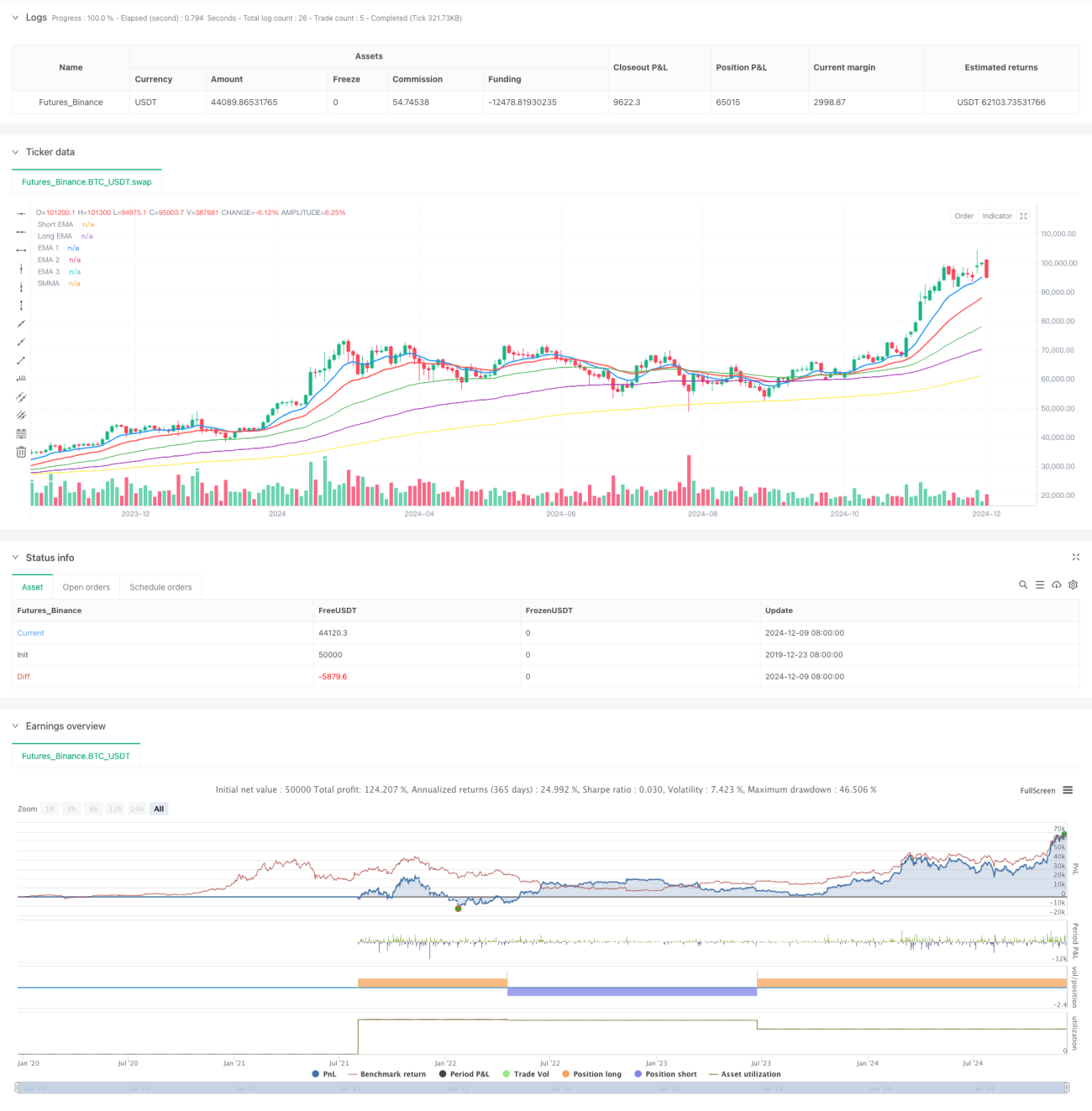
This strategy is a trend-following trading system based on multiple Exponential Moving Averages (EMAs) and Smoothed Moving Average (SMMA). It generates trading signals through the crossover of short-term and long-term EMAs, uses SMMA as a trend confirmation indicator, and incorporates additional EMA lines as support and resistance references. This approach enables both trend capture and effective control of false breakout risks.
Strategy Principle
The strategy employs 10-day and 22-day EMAs as primary signal lines, 200-day SMMA as a trend filter, along with 50-day, 100-day, and 200-day EMAs as auxiliary indicators. A buy signal is generated when the short-term EMA crosses above the long-term EMA and price is above the SMMA; a sell signal is generated when the short-term EMA crosses below the long-term EMA and price is below the SMMA. The additional three EMA lines provide further technical support and resistance reference points.
Strategy Advantages
- Multiple timeframe confirmation improves trading reliability
- SMMA integration effectively filters false breakout signals
- Additional EMA lines provide clear support and resistance reference points
- Simple and clear strategy logic, easy to understand and execute
- Complete trend-following mechanism ensures capture of major trend movements
Strategy Risks
- May generate frequent false signals in ranging markets
- Moving average crossover signals have inherent lag
- Multiple moving averages might create confusion in certain situations
- Potential for significant drawdowns in highly volatile markets
- Slow response to rapid market reversals
Strategy Optimization Directions
- Incorporate volatility indicators for position sizing
- Add volume confirmation mechanism
- Implement stop-loss and take-profit conditions for risk control
- Optimize moving average parameters for specific markets
- Consider adding trend strength filters
Summary
This is a trend-following strategy that integrates multiple moving average systems, capturing trends while controlling risks through the coordinated use of different period moving averages. The strategy's core strength lies in its multiple confirmation mechanism, though attention must be paid to its performance in ranging markets. Through appropriate parameter optimization and risk management, this strategy can achieve good results in trending markets.
- 1

